



Use Wozber and land your dream job
Create CV
No registration required
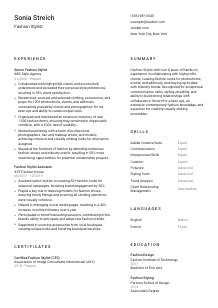
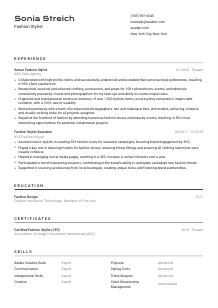
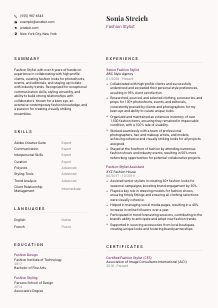
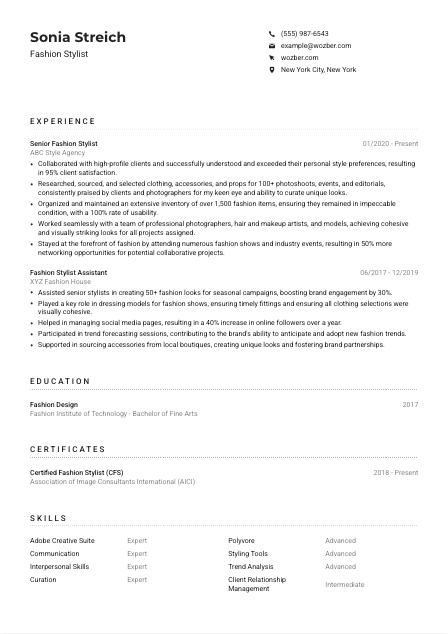
Curating chic ensembles, but your CV lacks that runway flair? Check out this Fashion Stylist CV example, created with Wozber free CV builder. It shows how to thread your sartorial instincts through job requirements, making sure your career journey is always fashion-forward, never in a style slump!
Fashion styling gets reviewed through the work itself. Hiring teams want to see whether you can translate a brief into a cohesive visual story, source the right garments and props, coordinate fittings and shoot-day details, and keep client taste, brand direction, and trend awareness moving in the same direction. Your CV needs to make that styling judgment easy before anyone opens your portfolio.
When the CV is tailored to the posting, the first read becomes much clearer. Wozber's free CV builder helps you align your wording with the role's language and create an ATS-compliant CV that surfaces the right experience, from client-facing styling work to photoshoot collaboration and inventory handling. That makes it easier for a hiring team to see whether your background fits the pace and standards of a Fashion Stylist opening.
For a Fashion Stylist, the header should feel polished and practical. This section is where the employer confirms who you are, how to reach you, and whether a basic requirement such as location is already covered.
Use your full name as the most prominent text on the page. Keep the formatting clean and professional, the same way you would present credits on a client deck or portfolio title page. A simple, readable header works better than decorative styling.
Place "Fashion Stylist" directly under your name if that is the role you are pursuing. Matching the title from the posting keeps your positioning clear and helps both recruiters and ATS software connect your CV to the job quickly.
List a working phone number and a professional email address. If you also use a portfolio site to show editorials, event styling, brand campaigns, or lookbooks, include that link here so your contact section supports the visual side of your application.
If a role specifies a city requirement, include your current city and state or note your willingness to relocate. In the example, listing New York City, New York directly supports a stated requirement, which removes a common early screening question.
A website or portfolio link is especially useful in styling because employers often want to see your eye for silhouette, colour, accessories, and shoot concept execution. Make sure the work shown matches the level and type of styling you describe in the CV.
Your personal details should answer the practical basics right away: identity, contact, portfolio access, and any required location detail. Once that is clear, the rest of the CV can focus on your styling work.




This is where a Fashion Stylist CV either becomes credible or stays generic. Employers want to see the kinds of shoots, clients, styling environments, and visual outcomes you have handled, plus whether you can source well, collaborate smoothly, and deliver looks that work on set or at events.
Read the posting for the actual work being hired. For this role, that includes client consultations, sourcing clothing and props, collaborating with photographers and makeup teams, maintaining inventory, and staying current on trends. Use those responsibilities to decide which achievements deserve space on your CV first.
Start with your most recent styling position and work backward. Include job title, employer or brand, and dates. That structure lets the reader follow your progression from assistant-level support into lead styling, editorial ownership, campaign work, or client-facing responsibility.
Each bullet should show what you styled, who you worked with, and what happened as a result. Strong examples include curating looks for photoshoots, coordinating with photographers and glam teams, managing fittings, or building wardrobes that matched a client's image goals. In the sample CV, sourcing for 100+ photoshoots and editorials works because it pairs volume with a recognizable styling task.
Fashion hiring responds well to metrics when they match the work. Count projects, clients, satisfaction scores, inventory size, campaign engagement, or repeat collaborations. The example's 95% client satisfaction and management of 1,500 fashion items give a better sense of scale than a vague claim about strong styling ability.
Keep the section centered on fashion styling work and adjacent responsibilities that matter, such as trend research, visual curation, showroom pulls, fittings, and on-set coordination. If you include broader fashion or marketing tasks, tie them back to styling outcomes so the narrative stays focused on the role you want now.
Your experience section should show that you can take a styling brief from concept to finished look, manage the logistics around it, and deliver results that clients, brands, or creative teams notice. That is the standard this section needs to establish.
Education matters here because many Fashion Stylist roles still screen for formal training in fashion design, styling, merchandising, or a related discipline. This section should confirm that foundation quickly without taking attention away from your portfolio and experience.
If the posting asks for a bachelor's degree in Fashion Design, Fashion Styling, or a related field, make that match easy to find. In the example, a Bachelor of Fine Arts in Fashion Design lines up cleanly with the employer's stated requirement.
For each entry, include the school, degree, field of study, and graduation year. Recruiters do not need a dense academic narrative here. They need a clean record they can scan in seconds.
When your program title supports your candidacy, do not bury it. Degrees in Fashion Design, Fashion Styling, Costume Design, Visual Merchandising, or similar fields should be clearly stated because they reinforce your technical and aesthetic grounding.
Early-career candidates can benefit from listing coursework or academic projects tied to editorial styling, textile knowledge, trend forecasting, fashion history, or creative direction. For more experienced stylists, this usually matters less than campaign, client, and shoot work.
Honors, competitive projects, fashion show participation, or styling exhibitions can add value if they point to real industry preparation. Choose details that show visual judgment, industry exposure, or collaboration with photographers, designers, or models.
This section should confirm that you have the formal grounding the role asks for, then get out of the way. Once the degree match is clear, your styling experience and portfolio should carry more weight.
Certifications are not mandatory in every styling hire, but they can strengthen your profile when they reflect recognized training, image consulting expertise, or current professional development. They are most useful when they support the kind of styling work you want to do.
List credentials that connect to wardrobe styling, personal styling, image consulting, fashion business, or relevant software training. A certification such as Certified Fashion Stylist can reinforce your professional commitment when it sits alongside real client and editorial work.
Do not pad this section with unrelated short courses. Include certifications that support the role's demands, such as trend knowledge, client presentation, styling methods, or visual communication tools used in fashion workflows.
If a certification is current, renewed, or recently completed, add the date. That helps show your knowledge is active, especially in a field where seasonal trends, brand movements, and visual standards change quickly.
Fashion styling benefits from ongoing learning. Training in editorial styling, luxury client service, trend forecasting, or Adobe tools can show that you keep sharpening both your taste and your process as the industry evolves.
Certifications work best when they back up the story your CV already tells. They should add professional credibility around your styling practice, not carry the application on their own.
A Fashion Stylist skills section should read like a working toolkit, not a personality list. The most useful mix usually combines visual and technical skills with the collaboration skills needed for shoots, fittings, and client-facing styling work.
Start with the language in the job description. Here, that includes Adobe Creative Suite, styling tools or platforms, communication, interpersonal skills, relationship building, and current fashion knowledge. Those terms belong on the CV when they reflect your real experience.
Focus on skills that support actual fashion styling work, such as wardrobe curation, trend analysis, client consultation, visual coordination, sourcing, look development, fitting preparation, and creative collaboration. The sample CV does this well by combining Adobe Creative Suite with curation and trend analysis.
Lead with the capabilities that matter most for the target role. A shorter list with the right mix of software, styling judgment, and client-facing strengths is stronger than an overcrowded section. If you use ratings, make sure they are believable and consistent with the rest of the CV.
By the time someone reads this section, they should understand the tools you use, the styling strengths you rely on, and the collaboration skills you bring to shoots and client work. Keep it grounded in how fashion styling actually gets done.
Language ability can matter more in styling than candidates expect. Client consultations, on-set direction, fittings, vendor communication, and collaboration with photographers or makeup artists all depend on clear communication, especially in fast-moving environments.
If the posting specifies English proficiency, list English clearly and use an accurate level. That requirement should never be left implied when the employer has called it out directly.
Order languages by relevance and fluency. If English is your native or fully professional language, place it at the top so the reader can confirm communication readiness immediately.
Extra languages can help with international clients, fashion events, luxury retail crossovers, or multicultural production environments. In the example, French adds a useful layer because fashion work often intersects with global brands and industry networks.
Choose clear terms such as Native, Fluent, Advanced, or Conversational. Avoid inflated claims. In client-facing styling, overstatement can quickly become obvious during consultations or collaborative production work.
Some styling roles are highly local, while others involve international brands, editorial teams, or travelling clients. Include languages that meaningfully support that scope rather than listing every basic exposure from school.
Your language section should confirm that you can communicate smoothly where the job requires it and add breadth where extra languages genuinely support the work. Keep it accurate and useful.
The summary is your quickest chance to define what kind of Fashion Stylist you are. In a few lines, it should establish your level, your styling focus, and the kind of clients, shoots, or fashion environments you know how to handle.
Start with your title and years of experience, such as a Fashion Stylist with 3+ years or 6+ years in editorial, commercial, personal, or event styling. That first line should position you immediately within the market the employer is hiring for.
Mention the kinds of assignments you handle best, whether that is photoshoots, campaigns, editorials, personal styling, brand lookbooks, or event dressing. The sample summary works because it quickly points to client collaboration and curated looks across several styling settings.
Choose specifics the role values, such as trend awareness, client relationship building, sourcing ability, visual curation, or collaboration with photographers and makeup teams. Keep these tied to practice, not vague adjectives.
Aim for a short paragraph that can be scanned in seconds. The summary should introduce your most relevant styling strengths, not repeat the entire CV. Save detailed metrics and project scope for the experience section.
A strong summary tells the reader what kind of stylist you are, where you have done your best work, and what you are likely to bring to their shoots, clients, or brand image. If that is clear, the rest of the CV lands more quickly.
A Fashion Stylist CV should show more than taste. It should show how you work with clients, source and curate looks, collaborate on set, and stay current enough to shape a strong visual result. When those details are tailored to the posting, your CV becomes much easier to shortlist.
Use Wozber's free CV builder to tighten your structure, align your wording with the job description, and create an ATS-friendly CV format that supports both human review and ATS optimisation. The final version should make one thing easy to judge: whether you can step into the styling workflow and deliver.




