




Use Wozber and land your dream job
Create CV
No registration required
Stitching style but your CV hem is fraying? Check out this Tailor CV example, created with Wozber free CV builder. Learn how to tailor your fashion-forward skills to match job fittings, keeping your career always in sharp dress code!

Tailoring work is judged in the fitting room long before anyone asks about style. Employers want to see that you can take accurate measurements, understand how different fabrics behave, execute clean alterations, and deliver garments that satisfy clients the first time or with minimal rework. Your CV should make that level of hands-on precision visible, not hide it behind vague phrases about fashion or creativity.
When tailoring language matches the job ad, hiring teams can quickly tell whether your background is rooted in fittings, garment construction, client-facing alterations, or production support. Wozber's free CV builder helps you organise that experience into an ATS-compliant CV, so terms like "alteration," "fitting," and "garment care" are easy to scan and tied to real results. That makes it easier to see whether you can step into the workbench, fitting area, and client conversations with confidence.
For a tailor, the header should feel as orderly as a well-set worktable. Keep it clean, professional, and easy to scan so the employer can immediately confirm who you are, what role you do, and whether you meet practical requirements such as location and contact availability.
Place your name at the top in a clear, readable font that stands out from the rest of the page. Hiring managers often review CVs quickly between appointments, fittings, or production tasks, so your identity should be instantly visible without decorative styling getting in the way.
Add "Tailor" directly under your name if that is the role you are targeting. This simple choice immediately aligns your CV with the position and avoids confusion with adjacent titles such as seamstress, alterations specialist, or fashion designer unless one of those labels better reflects your actual background.
Include a reliable phone number and a professional email address in a simple format. Tailor roles often move fast when a shop needs help with fittings, alterations, or customer flow, so make sure an employer can reach you without hunting through extra information.
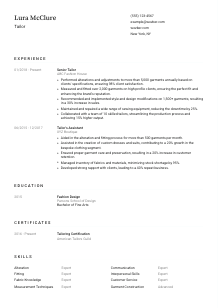
If the employer needs someone based in a specific area, include your city and state. Here, listing New York, NY matters because the opening explicitly requires local availability. Keep it factual and brief. You do not need to add a full street address.
A website or LinkedIn profile can help if it shows relevant work such as bespoke garments, alteration examples, bridal work, menswear, or client testimonials. Only include it if the content is current and consistent with the experience on your CV. A weak or outdated link does more harm than good.
This section should confirm the basics fast: who you are, how to contact you, what role you do, and whether you meet immediate logistical requirements. Wozber's ATS-friendly CV templates help keep that information clean and easy to scan.




This is where a tailor CV either becomes convincing or stays generic. Employers need to see the actual work you have done: fittings completed, alterations handled, garment types supported, client satisfaction, shop efficiency, and any design input or equipment upkeep you took on.
Read the posting closely and mark the work that appears most often or carries the most responsibility. For a tailor, that usually includes measuring clients, fitting garments, performing alterations, recommending style adjustments, maintaining sewing equipment, and delivering strong customer service. Build your bullets around those functions so the employer sees direct overlap with the role.
List each position in reverse chronological order with your title, employer, and dates. For tailoring work, the employer name can also add context about your environment, whether that was a fashion house, bridal studio, dry cleaner, boutique, costume shop, or bespoke atelier. That context helps explain the pace, garment types, and client expectations behind your experience.
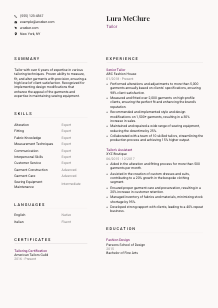
Do not stop at "performed alterations" or "worked with clients." Show scope and results. The sample CV does this well with bullets like altering more than 5,000 garments annually and achieving 98% client satisfaction. That kind of detail tells an employer how much volume you handled and how well you delivered under real customer expectations.
Quantify your experience where the numbers are meaningful. Good metrics for this field include garments altered per week or year, fittings completed, repeat-business rates, sales lift from style recommendations, turnaround improvements, reduced machine downtime, or lower remake rates. These are more useful than generic claims because they reflect how tailoring performance is actually measured.
Choose experience points that strengthen your case for the specific opening. Prioritise alteration work, garment construction, measurement accuracy, fabric handling, client consultation, and equipment maintenance over unrelated duties. If you include an assistant role, frame it around production support, fitting assistance, custom work, or material management that prepared you for full tailor responsibilities.
A hiring manager should finish this section with a clear picture of the garments you handled, the client standards you met, and the shop value you added. Wozber's ATS CV scanner can help you line up your wording with the posting while keeping those accomplishments grounded in real tailoring work.
Formal education is not always the deciding factor in tailoring hires, but it can strengthen your profile when it shows training in fashion design, garment construction, textiles, patternmaking, or related craft disciplines. Present it clearly and keep the emphasis on relevance.
This job posting focuses more on hands-on tailoring experience than on a specific degree, but your education still adds useful context. It can show where you built your understanding of garment structure, design principles, materials, or visual presentation, especially if you trained in fashion or apparel-related studies.
List your degree, school, and graduation year in a clean structure. Recruiters do not need a paragraph here. They need to quickly identify your level of study and whether it adds weight to your tailoring background.
If your degree connects directly to the work, make that connection obvious. A Bachelor of Fine Arts in Fashion Design, like the one in the example, supports experience in garment construction and design modification. That is especially useful when the role involves more than routine hemming and requires style judgment during fittings.
Relevant coursework can be worth listing if you are earlier in your career or if the classes closely match the job, such as patternmaking, draping, textiles, apparel construction, or fashion illustration. Skip generic course lists that do not strengthen your case for tailoring work.
Honors, scholarships, exhibitions, or design projects can help when they relate to apparel, construction, or craftsmanship. For an experienced tailor, these details should stay secondary to client work and alteration results. For a newer candidate, they can help show technical foundation and commitment to the trade.
Education works best here when it reinforces your command of garments, materials, and construction methods. Wozber's free CV builder helps present that background in an ATS-friendly CV format that stays clean and easy to review.
Certifications are useful in tailoring when they show recognized training, updated technical knowledge, or sustained commitment to the trade. They are especially helpful if the employer values craft standards, specialization, or ongoing professional development.
Focus on credentials connected to alteration, garment construction, sewing, patternmaking, textiles, or professional tailoring standards. The sample certificate from the American Tailors Guild works because it directly supports the candidate's trade identity, even though this particular posting does not require a certification.
Only include certificates that add real weight to your application. A concise list of relevant credentials is more effective than a long catalogue of loosely connected classes. Employers hiring a tailor care more about practical craftsmanship than volume of training entries.
Add the year earned and, if applicable, the active period. This helps show whether your training is recent or maintained over time. In a field where methods, equipment, and client expectations evolve, current credentials can reinforce your professionalism.
If you work in tailoring, ongoing training can strengthen your CV over time. Advanced alteration techniques, bridal tailoring, menswear construction, fabric care, or specialty machine use are all worthwhile areas to develop depending on the kind of clients and garments you serve.
Certificates should support the practical work already shown in your experience, not replace it. Wozber's ATS optimisation tools can help you place them where both hiring managers and screening systems can quickly connect them to your tailoring background.
A tailor's skills section should read like the toolkit behind the finished garment. The strongest lists combine technical ability, garment knowledge, and client-facing strengths that matter during fittings, alterations, and final delivery.
Start with the language the employer already uses. In this case, that includes alteration, fitting, garment construction, fabrics, measurements, garment care, attention to detail, manual dexterity, communication, and interpersonal skills. These terms belong in your CV if they accurately reflect your experience.
A tailor needs more than technical sewing ability. Include hard skills such as measurement techniques, pattern adjustments, hand finishing, pressing, and machine maintenance alongside customer service, communication, and consultation skills. That mix reflects the actual flow of the job, where precision work and client interaction are closely linked.
Choose the skills you would expect to use in the target role. Avoid padding the section with broad creative terms or tools that do not matter to the employer. The example CV keeps the focus on tailoring essentials such as fitting, fabric knowledge, garment care, and sewing equipment maintenance, which makes the section feel credible and targeted.
This section should confirm that you can take a garment from measurement to finished fit while handling clients professionally along the way. Wozber's ATS-friendly CV format helps keep those skills easy to scan and aligned with the language employers use.
Language skills matter more in tailoring than many candidates realize. Clear communication affects measurements, fit preferences, style adjustments, pickup instructions, and client satisfaction, especially when your work is highly personal or custom.
If the posting names a language requirement, list it clearly and use an honest proficiency level. Here, advanced English is required, so English should appear first. That tells the employer you can handle fitting conversations, alteration requests, and care instructions without friction.
Additional languages can be valuable when your customer base is diverse or your shop serves international, fashion-forward, or multilingual communities. The example's fluent Italian may be useful in the right setting, but the main point is to include extra languages only when they strengthen your client communication profile.
Stick to clear terms such as Native, Fluent, Advanced, Intermediate, or Basic. Avoid vague descriptions. A tailoring employer needs to know whether you can manage nuanced conversations about fit, fabric behaviour, and design changes, not just exchange greetings.
If your work includes custom garments, bridal appointments, luxury retail, or repeat private clients, language range can become a real business advantage. In more production-focused alteration roles, it may matter less. Let the level of client contact guide how much emphasis you place on this section.
Do not overstate proficiency. If you claim a language, assume you may need to discuss garment details, timelines, and client concerns in that language. Accuracy here protects your credibility and sets the right expectations from the start.
For a tailor, language skills are most valuable when they improve fitting conversations, reduce misunderstandings, and strengthen client trust. Wozber's free CV builder makes it easy to present them cleanly within an ATS-compliant CV.
Your summary should quickly tell the employer what kind of tailoring work you do, how long you have done it, and what results or strengths define your practice. Keep it specific enough to signal your niche, but broad enough to fit more than one opportunity.
Before writing the summary, identify the few requirements that matter most in the posting. For this role, the essentials are professional tailoring experience, alteration and fitting expertise, fabric and garment knowledge, client communication, and strong finishing standards. Use those priorities to decide what belongs in your opening lines.
Begin with a direct statement such as "Tailor with 6+ years of experience" or a version that accurately reflects your background. This immediately places you in the field and gives the employer a fast read on seniority, which is especially useful when the posting asks for at least 3 years of experience.
Use the next lines to name the areas where you consistently deliver. That might include high-volume alterations, precision fitting, custom garment adjustments, fabric expertise, or client satisfaction. The sample summary works because it ties experience in tailoring techniques to measurable service quality and design improvement, instead of staying abstract.
Aim for a short paragraph of about 3 to 5 lines. The summary should introduce your value, not repeat your full work history. If every sentence points back to the type of garments, clients, and tailoring outcomes you handle well, the section is doing its job.
A good summary helps the employer quickly place you in the right level of tailoring work, whether that means alterations, bespoke support, client fittings, or garment finishing. With Wozber's ATS CV scanner and ATS-friendly CV templates, you can sharpen that opening so your experience reads clearly from the first lines.
A tailor CV works when it makes your craftsmanship easy to picture: the volume of garments you have handled, the fit problems you can solve, the clients you have worked with, and the standards you maintain at the machine and in the fitting room.
Use Wozber's free CV builder to organise that experience into an ATS-friendly CV template, align your language with the job ad, and present your background in a format that is easy to scan. The finished CV should make one thing clear right away: you can deliver precise alterations, sound client guidance, and garments that leave the shop fitting exactly as they should.