



Use Wozber and land your dream job
Create CV
No registration required
Harmonizing careers, but feeling off-key with your CV? Tune in to this Artist Manager CV example, created with Wozber free CV builder. It shows how to orchestrate your managerial artistry to match job demands, putting your candidates in the spotlight and your career in the applause zone!
Artist management sits at the intersection of career strategy, deal-making, and day-to-day artist support. Hiring teams want to see that you can move an artist's career forward in practical terms, whether that means securing stronger booking opportunities, coordinating release visibility with PR and marketing partners, or keeping budgets, schedules, and travel running without friction.
A tailored CV changes how quickly that range becomes clear. When your experience, skills, and summary use the same language a music company uses for bookings, endorsements, artist development, and administration, an employer can separate you from adjacent profiles like talent bookers or event managers much faster. Wozber's free CV builder helps shape that into an ATS-compliant CV that reflects the role's actual priorities, so your background reads as artist management, not just general entertainment experience.
Artist management is relationship-driven, but the basics still matter. Your contact section should make you look established, reachable, and already positioned for the market you want to work in.
Use your full name as the most visible text at the top of the page. Keep it simple and easy to scan. In music and entertainment hiring, a cluttered header can make even experienced candidates look less polished than their roster management, booking, and negotiation work deserves.
Place "Artist Manager" directly under your name if that is the role you are pursuing. That immediate alignment matters, especially when your background also includes related work such as talent booking, tour coordination, promotions, or event management. It helps the reader understand the lens through which to read the rest of your experience.
Include a working phone number and a professional email address. If you have a website or LinkedIn page that shows artist campaigns, booking history, media coverage, or entertainment industry credentials, add it here. Make sure every detail matches your CV exactly, because missed calls and mismatched profiles create doubt fast in a role built on communication and follow-through.
For some Artist Manager jobs, location matters because the work depends on proximity to labels, venues, agencies, studios, and industry meetings. In the example posting, Los Angeles, CA is explicitly required, so listing Los Angeles in the header removes an immediate question. Treat that as tailoring guidance, not a universal rule for every artist management opening.
A professional website, LinkedIn profile, or portfolio can strengthen your CV if it reflects your current work. For an Artist Manager, that might include client rosters, campaign highlights, press mentions, live event history, or business development work. Leave it off if it is outdated or inconsistent with the experience on the page.
This section should confirm the essentials in seconds: who you are, what role you want, how to reach you, and whether any location requirement is already covered. Then the reader can move straight to your artist strategy and deal experience.




This is where Artist Manager CVs usually separate themselves. Hiring teams are not looking only for entertainment industry exposure. They want to see career development work, commercial outcomes, trusted industry relationships, and the operational control needed to keep artists moving.
Start with positions that show direct responsibility for artists, bookings, endorsements, talent development, or music business partnerships. Reverse chronological order works best because it puts your current network, current deal experience, and current scope first. If you have held adjacent roles such as Talent Booker, present them in a way that highlights transferable work like venue coordination, industry relationship building, and revenue generation.
For every position, include your job title, company name, and dates. That sounds basic, but in artist management the title tells the reader a lot about your level of ownership. "Artist Manager" suggests career planning and representation. "Talent Booker" points more to sourcing, scheduling, and live event coordination. Clear labels help the employer map your background to the level of artist oversight they need.
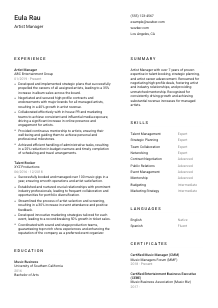
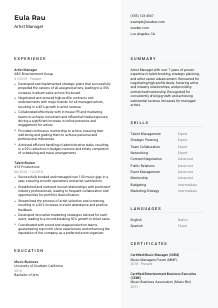
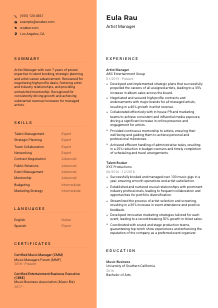
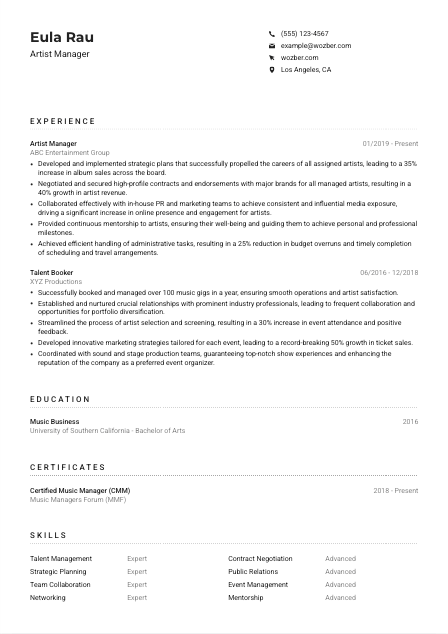
Your bullet points should show what changed because of your work. Strong Artist Manager bullets often cover revenue growth, contract value, booking volume, media reach, fan engagement, tour support, or cost control. The sample CV does this well with results like a 35% increase in album sales, 40% growth in artist revenue, and a 25% reduction in budget overruns. Those numbers make strategic planning and administrative discipline tangible.
Balance the glamorous parts of the role with the practical ones. Yes, include negotiations, endorsements, and major opportunities. Also include the less visible work that keeps artists functioning, such as budgeting, travel logistics, scheduling, cross-team coordination, and personal support. The strongest CVs show that you can handle both career acceleration and day-to-day execution without dropping either.
Do not overload this section with every entertainment job you have ever held. Prioritise experience that speaks to artist growth, relationship management, bookings, promotions, contracts, brand partnerships, and operational follow-through. If an older role does not support your case for managing artists, reduce it or remove it so the more relevant work gets more space.
A hiring team should finish this section with a clear view of the artists you supported, the deals or campaigns you influenced, and the commercial or operational results you delivered. That is what turns entertainment experience into Artist Manager credibility.
Education matters most here when it reinforces your understanding of the music business, artist development, contracts, marketing, or entertainment operations. It will not outweigh weak experience, but it can strengthen your profile when the degree lines up with the role or the posting specifically asks for it.
If you have a bachelor's degree in Music Business, Arts Management, or a related field, list it clearly. The example job description asks for exactly that kind of academic background, and the sample CV matches it with a Bachelor of Arts in Music Business. When your degree aligns this closely, do not bury it.
These details are usually enough for most mid-career Artist Manager CVs. School name, degree type, field of study, and graduation date give the employer the context they need without slowing down the page. Keep the format clean and consistent with the rest of the CV.
If you are earlier in your career or your degree title is broad, a short mention of relevant coursework can help. Focus on subjects such as music business, artist management, entertainment law, marketing, event production, or contract negotiation. Skip long course lists that do not connect to artist representation or commercial growth.
Awards, honors, student leadership, or music industry organizations can help if they show a long-standing connection to the field. For example, leadership in a concert programming board, music business club, or campus promotion team may support your story. Keep it concise, especially if you already have more than 5 years of relevant experience.
Short courses, workshops, and industry programs can reinforce your education when they relate to booking, branding, artist development, music rights, or entertainment finance. If they function more like credentials than academic entries, you can also place them in your certificates section. The key is to show continuing fluency in how the music business operates today.
This section works best when it supports your understanding of the industry rather than trying to carry the CV on its own. Show the academic background that backs up your work with artists, deals, and growth planning.
Certifications are especially useful in artist management when they point to recognized knowledge of music business practices, representation standards, or entertainment operations. They are rarely the deciding factor on their own, but they can strengthen a CV that already shows real management results.
When a job description mentions specific certifications, move them into clear view. Here, credentials such as Certified Music Manager (CMM) and Certified Entertainment Business Executive (CEBE) are listed as preferred, so they deserve space if you hold them. The sample CV includes both, which immediately matches a stated employer preference.
Choose certifications that support artist representation, music business operations, contract knowledge, or related commercial areas. A short, targeted list is more persuasive than a broad collection of unrelated credentials. If a certificate does not strengthen your case for managing artists, leave it out.
Listing the issuing organisation and dates adds legitimacy and helps show whether the credential is current. In a field shaped by changing platform economics, brand partnerships, touring conditions, and rights issues, current credentials can signal that your business knowledge has not gone stale.
If you maintain certifications, renew industry memberships, or complete specialised training, that is worth noting when it is relevant. It suggests you stay engaged with current practices in negotiation, artist development, marketing, and entertainment business. Keep the emphasis on practical relevance, not on collecting badges.
Use this section to back up your experience with recognized industry credentials, especially when the employer calls them out. It should strengthen the impression that you understand both the creative and business sides of managing artists.
Artist management is a mix of commercial judgment, relationship management, and operational discipline. Your skills section should reflect that mix directly, using language that matches the role rather than broad entertainment buzzwords.
Start with the posting and identify the abilities tied to outcomes. In this case, that includes strategic planning, contract negotiation, communication, interpersonal skills, networking, budgeting, scheduling, and coordination with PR and marketing teams. Use the same terminology when it matches your background so both hiring teams and ATS screening can read your profile correctly.
Do not separate hard and soft skills so sharply that the section feels artificial. Artist management depends on both. Include business-facing strengths like talent management, booking, negotiation, budgeting, marketing strategy, and event management alongside collaboration, mentorship, and relationship building. The sample CV handles this well by pairing contract and planning skills with networking and mentorship.
A crowded skill block weakens the message. Choose the skills you can support elsewhere in the CV through specific achievements, deals, campaigns, or artist outcomes. If you list strategic planning, the experience section should show artist growth or revenue gains. If you list public relations collaboration, the experience section should show increased visibility, engagement, or media exposure.
The best skills section reads like a quick index to the rest of your CV. Every item should point back to real work with artists, partnerships, campaigns, negotiations, or operations.
English may be the baseline for many Artist Manager roles, but additional languages can become a real advantage when artists, media partners, brands, venues, or touring markets cross borders. List languages in a way that reflects how you can actually use them professionally.
If the posting specifies English competency, make that explicit in your languages section. Native or fluent English is enough if that reflects your ability. The requirement should also be supported by clear writing throughout the CV, since communication is central to negotiations, artist support, and cross-functional coordination.
Additional languages can matter when you work with international talent, multicultural audiences, overseas bookings, or cross-border brand opportunities. Spanish, for example, may be useful in many music markets and media contexts. Include extra languages when they are real working strengths, not just casual familiarity.
Use straightforward labels such as Native, Fluent, Advanced, or Intermediate. Artist management relies on trust, and language claims are easy to test in conversation. Honest proficiency levels help set the right expectations for artist communication, press interactions, and partner outreach.
When relevant, think beyond translation. Additional languages can help with relationship-building, smoother coordination during tours, local media opportunities, and stronger artist support in high-pressure settings. You do not need to explain all of that on the CV, but the language list should reflect genuine business utility.
If multilingual ability broadens the kinds of artists or markets you can support, it belongs here. The sample CV lists English and Spanish, which works well because it signals range without overexplaining. Keep your own list concise and credible.
This section should quickly show whether you can operate across the communication demands of the job. For Artist Manager roles, that can mean stronger client rapport, better partner coordination, and broader market reach.
Your summary should establish your lane quickly. In a few lines, it needs to show that your experience goes beyond being around artists or live events and extends into career strategy, negotiations, relationship management, and commercial results.
Read the posting closely and identify the centre of gravity. Here, the role combines artist career development, negotiation, coordination with PR and marketing, mentorship, and administrative control. Your summary should reflect that blend rather than focusing on only one side of the job.
The first line should state who you are professionally, how long you have been doing this work, and where your expertise sits. For example, "Artist Manager with 7+ years in talent booking and artist development" is much stronger than a generic line about being passionate about music. The sample summary gets this right by leading with years of experience and core strengths.
After the opening line, mention the parts of your work that matter most for the role. That may include negotiating endorsements, growing artist revenue, increasing media visibility, building industry partnerships, or mentoring talent through career milestones. If you have measurable wins, include one. A summary that references revenue growth or successful strategic planning feels much more grounded than one built on adjectives alone.
Aim for three to five lines. Every phrase should earn space by connecting to artist management work the employer actually needs. Remove broad descriptors that could fit any entertainment professional and keep the focus on career advancement, industry relationships, deals, collaboration, and artist support.
A hiring manager should reach the end of your summary already expecting to see strategic artist work, strong industry relationships, and measurable commercial results in the experience section. That is the right setup for the rest of the CV.
When each section points back to artist growth, negotiation strength, industry relationships, and reliable execution, your CV starts to read like someone who can manage both the business and human sides of a roster. That is the standard this role calls for.
Use Wozber's free CV builder to shape that experience into an ATS-friendly CV template, refine role-specific language with its AI CV builder features, and check alignment with an ATS CV scanner. The final result should make one thing easy to judge: whether you can move an artist's career forward with discipline and commercial instinct.