



Use Wozber and land your dream job
Create CV
No registration required
Leading the strings, but your CV isn't striking a chord? Play along with this Concertmaster CV example, created with Wozber free CV builder. Learn how to present your leadership and musical prowess so it resonates with symphonic job calls, making your career crescendo as harmoniously as the first violins!
A Concertmaster is heard before a single bullet point is read. Hiring committees want a musician who can lead a section from the chair, set technical and stylistic standards in rehearsal, work closely with the Music Director, and represent the orchestra in auditions, outreach, and performance. Your CV needs to show that level of musical authority and ensemble leadership clearly, not bury it under generic performance credits.
The first pass on a Concertmaster CV often comes down to whether your experience reads as principal-level orchestral leadership or as strong playing without enough directing responsibility. Wozber's free CV builder helps organise that distinction in an ATS-friendly CV format, so the language around rehearsals, repertoire input, section leadership, and community-facing work is easy to follow and easy to match to the posting. That makes it much clearer that you can lead the orchestra from the front desk, not just perform in it.
For a Concertmaster, the header should feel professional and settled. This role combines public-facing leadership, collaboration with artistic staff, and day-to-day reliability, so your contact details should immediately show that you are easy to reach and ready to work at the orchestra's required location.
Use your full name as the most visible text on the page. There is no need for decorative styling. In orchestral hiring, your reputation, credits, and leadership history carry the weight, so a clean presentation works best.
Place "Concertmaster" directly under your name when that is the role you are pursuing. This helps frame the rest of the CV around principal-level section leadership, rehearsal direction, and artistic collaboration instead of a broader orchestral performance profile.
Include one phone number and a professional email address you check regularly. If your email still looks casual, replace it with a straightforward format such as your name. Committees and administrators need a reliable way to reach you for auditions, interviews, and scheduling conversations.
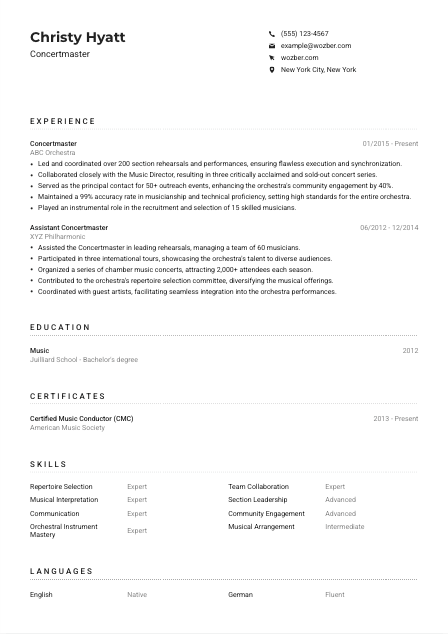
If a job specifies a city requirement, show that clearly in your header. Here, listing New York City, New York directly addresses the employer's location filter and removes uncertainty about availability. For other applications, follow the posting rather than assuming location must always be featured this prominently.
A website or LinkedIn profile can help if it adds useful context such as orchestral credits, recordings, guest appearances, teaching work, or leadership appointments. Keep it updated and consistent with your CV so the same performance history and roles appear across both.
Your personal details do not need personality flourishes. They need to show that you are a professional Concertmaster candidate who is reachable, credible, and aligned with any stated logistics.




Concertmaster hiring decisions turn on more than years played. Committees look for evidence that you have led rehearsals, shaped ensemble execution, contributed to programming discussions, supported auditions, and upheld a high musical standard across repeated performances. Your experience section should make those responsibilities visible in concrete terms.
Read the job description closely and build your experience bullets around the work that defines the chair. For a Concertmaster, that usually means section leadership, rehearsal coordination, collaboration with the Music Director, outreach representation, and input on personnel or repertoire. If those themes are already part of your work, name them directly instead of describing your background only as performance experience.
Start with your most recent orchestral appointment and move backward. For each entry, include ensemble name, title, and dates. This makes your progression into principal or assistant leadership roles easy to track, which matters when the employer is looking for someone with extensive professional orchestra experience.
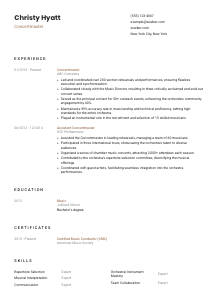
Each bullet should show what you led, influenced, or improved. Strong examples include coordinating section rehearsals, preparing bowings, aligning interpretation with the conductor, mentoring section players, or serving as the point of contact for educational appearances. In the example CV, "Led and coordinated over 200 section rehearsals and performances" works because it shows sustained responsibility, not a one-off contribution.
Metrics give hiring committees scale. They can include number of rehearsals or performances led, audience reach for outreach events, musicians supervised, tours completed, attendance growth, sold-out series, or hires supported through auditions. The sample's "50+ outreach events" and "40%" increase in community engagement are effective because they tie artistic work to institutional impact.
Space is limited, so keep the focus on principal-level musicianship and leadership. Bullets that only say you performed repertoire, attended rehearsals, or participated in concerts add less value than bullets showing section direction, artistic judgment, ensemble coordination, or collaboration with guest artists and staff. Every line should move you closer to the responsibilities of the chair.
After the experience section, a reader should be able to picture you leading rehearsals, shaping performances, and representing the orchestra in artistic and community settings. That is the standard this role is hired against.
Formal training matters in orchestral leadership roles because it establishes your technical base and professional preparation. For a Concertmaster posting, the education section usually needs to confirm the required degree quickly, then get out of the way so your rehearsal and performance record can do the heavier work.
If the employer calls for a Bachelor's degree in Music or a related field, make sure that information is easy to find. This is a straightforward screening item, so your degree, field, school, and graduation year should be presented clearly.
List the degree, field of study, institution, and date in the same order for each entry. Clean formatting helps the section read quickly, especially when a committee is reviewing many candidates with similar conservatory or university backgrounds.
For this role, a Bachelor's degree in Music should be prominent because it directly matches the stated requirement. The example CV does this well with a clear music degree from Juilliard, though the broader lesson is simply to foreground the credential that satisfies the posting.
If you are earlier in your career or your program included notable emphasis in orchestral performance, conducting, chamber music, music history, or ensemble leadership, a brief coursework note can help. For an established Concertmaster with extensive professional experience, it is usually optional.
Awards, scholarships, fellowship programs, or prestigious ensemble participation can strengthen this section when they reinforce high-level musicianship. Use them selectively. Academic details should support your professional standing, not distract from your orchestral leadership record.
This section should confirm that you meet the academic requirement and have serious musical training. Once that is clear, let the rest of the CV carry the argument for your readiness to lead.
Certifications are rarely the deciding factor for a Concertmaster, but they can reinforce leadership range, conducting knowledge, pedagogy, or specialised musical training. Include them when they add professional depth that the rest of the CV does not already cover.
Prioritise credentials related to conducting, advanced performance study, music education, leadership, adjudication, or other recognized musical specializations. If a certificate does not connect to rehearsal leadership, musical interpretation, or professional development, it probably does not belong here.
List the certificate name, issuing organisation, and date or active period. That gives the credential context and makes it easier for the employer to understand whether it reflects recent development, ongoing membership, or a completed program.
A Concertmaster is expected to maintain technical command and artistic judgment over time. Certificates can support that story when they show you have kept investing in related areas such as conducting, coaching, or educational leadership alongside performance work.
Do not collect certificates for the sake of filling space. Pursue training that supports the work you are actually targeting, whether that is orchestral leadership, community engagement, audition mentoring, or broader artistic direction. In the example CV, a conducting-related credential adds useful breadth because it complements ensemble leadership responsibilities.
Certificates should sharpen your professional profile, not pad it. If they add leadership, instructional, or artistic authority relevant to a Concertmaster post, include them.
A Concertmaster skills section should read like the toolkit of a principal orchestral leader. That means balancing instrumental mastery and interpretation with rehearsal leadership, communication, and the collaborative judgment needed to work with conductors, guest artists, and section players.
Start with the skills the employer names or strongly implies. For this job, that includes exceptional command of a major orchestral instrument, leadership experience, interpersonal communication, and the ability to work across performance, programming, and outreach settings. Mirror that language where it truthfully matches your background.
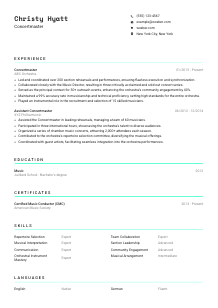
Lead with role-defining abilities such as orchestral instrument mastery, section leadership, repertoire selection, musical interpretation, ensemble coordination, and communication. Then add complementary skills like community engagement or collaboration with artistic staff. The sample CV does this effectively by keeping musical and leadership capabilities at the top of the list.
Avoid broad filler like "hardworking" or "team player." Use terms that connect to actual orchestral work, such as bowing preparation, audition participation, chamber leadership, rehearsal direction, score study, or coaching younger musicians if those are part of your experience. A concise list of real skills is far more persuasive than a long generic one.
Your skills section should make it obvious that you can lead from the stand, communicate across the ensemble, and maintain the technical and interpretive standard expected of a Concertmaster.
Language ability matters here because a Concertmaster is not isolated in performance alone. The role often includes communication with conductors, administrators, guest artists, students, and community partners, so your language section should reflect the communication demands of the work rather than serve as a decorative extra.
If the job requires clear English communication, list English prominently and state your proficiency accurately. That is especially important for roles involving rehearsal leadership, auditions, educational programs, and public-facing engagement.
Begin with the language most necessary for the job, then list additional languages that could support touring, outreach, or work with international artists. In the example, English is shown first, followed by German, which adds useful context without overshadowing the required language.
Use honest levels such as native, fluent, conversational, or basic. Overstating fluency can quickly become a problem in a role where communication with artistic staff or community partners needs to be smooth and credible.
Extra language ability can be valuable for orchestras with broad education programs, international collaborations, or diverse audiences. Treat it as a supporting strength, especially if you have used that language in touring, teaching, or artist coordination.
If multilingual communication is becoming more relevant in your work, continued study can support stronger outreach and educational engagement. It is not a core requirement in every Concertmaster search, but it can become a useful differentiator in the right organisation.
For this role, language skills should confirm that you can communicate clearly in rehearsal and represent the orchestra well in public-facing settings. Any additional fluency is a bonus when it supports those responsibilities.
The summary is where you establish your level quickly. In a few lines, it should tell the reader whether you bring the combination of orchestral experience, principal leadership, and artistic collaboration expected for the chair.
Look at the posting and identify the two or three elements that matter most. For a Concertmaster, that is usually years in professional orchestra settings, principal or section leadership, and the ability to collaborate with artistic leadership while maintaining top-level musicianship.
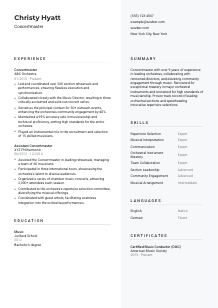
Start with your title or specialization and your years of relevant experience. Keep it direct. For example, a summary that says you have 9+ years in professional orchestra leadership immediately gives the reader a frame for the rest of the document.
Choose one or two details that show you can handle the full scope of the role, such as leading major rehearsal schedules, supporting acclaimed performances, shaping repertoire discussions, or expanding outreach work. The example summary works best where it combines leadership, collaboration with directors, and community engagement rather than relying on praise words alone.
End by stating the professional standard you offer, whether that is section leadership, interpretive authority, ensemble cohesion, or a track record of representing the orchestra effectively on and off stage. Keep it concise enough that every word earns its place.
By the end of the summary, a hiring committee should already understand your level, your leadership scope, and the kind of musical standard you bring to an orchestra.
A Concertmaster CV should leave no doubt that you can lead rehearsals, support artistic decisions, maintain exemplary musicianship, and represent the orchestra beyond the stage. When those points are specific and easy to find, the document starts working like a serious professional profile instead of a list of performance credits.
Use Wozber to refine the language, strengthen ATS optimisation, and shape your experience into an ATS-compliant CV that reflects the posting accurately. The final version should make one thing easy to judge: you are ready to lead from the first chair.




