



Use Wozber and land your dream job
Create CV
No registration required
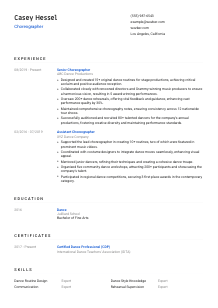
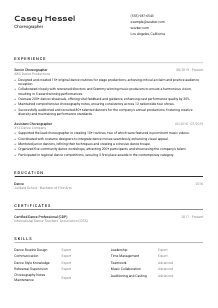
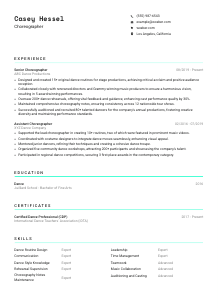
Crafting flows, but your CV feels offbeat? Get in step with this Choreographer CV example, created with Wozber free CV builder. It shows how to spotlight your dance direction in line with job requirements, helping your career perform centre stage!
Choreography work gets judged long before opening night. Hiring teams want to see whether you can build original movement, direct dancers through rehearsal, and keep a production visually consistent across performances, shoots, or tours. Your CV should make that range visible, from creative authorship to the practical discipline of notes, casting, and collaboration.
A tailored CV helps separate choreographers who can create compelling routines from those who can also run a dependable production process. Using Wozber's free CV builder to shape an ATS-compliant CV helps you mirror the language of the posting, surface credits like stage productions or music videos, and make your experience easier to read as real production-ready leadership.
This section should read like a clean production header. For a choreographer, that means clear identity, current contact information, and any practical detail that removes friction for auditions, rehearsals, and on-site collaboration.
Your name should be the easiest element to find on the page. Use a clean, readable format that feels professional rather than decorative. In creative fields, strong presentation matters, but the CV still needs to scan quickly for casting, production, and HR teams.
Place "Choreographer" directly under your name if that is the role you are targeting. If your background includes adjacent work like movement direction or assistant choreography, keep the title focused on the job you want so the CV is immediately aligned with the opening.
List a working phone number and a professional email address. Choreographers often move through fast hiring cycles tied to auditions, rehearsals, and production schedules, so your contact details need to be reliable and easy to use.
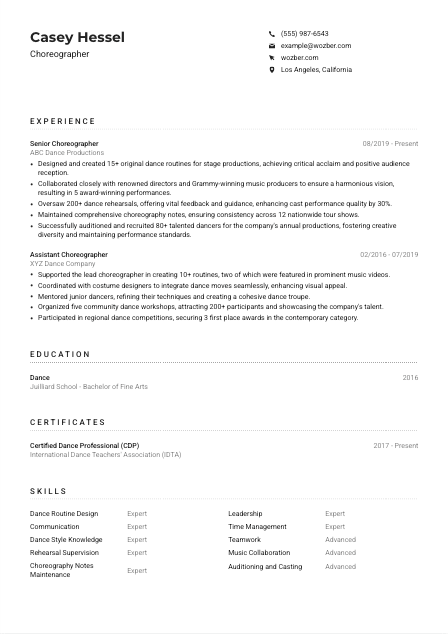
If a posting calls for a specific location, include it plainly. Here, listing "Los Angeles, California" answers a stated requirement and shows you can be available for rehearsals, creative meetings, and performance timelines without relocation questions slowing things down.
Include a portfolio site, LinkedIn profile, or reel when it strengthens your application. For a choreographer, this can give hiring teams a fuller sense of your performance work, production credits, style range, or collaboration history. Make sure the titles, dates, and projects match your CV exactly.
Your personal details should remove basic questions immediately. Once that information is clean and complete, the reader can focus on what matters most for a choreographer: your creative range, rehearsal leadership, and production experience.




This is where choreographer CVs become credible. Productions, rehearsal oversight, casting input, and collaboration with directors or music teams all belong here, especially when you show what changed because of your work.
Before rewriting bullets, mark the responsibilities and requirements that define the job. For choreographer roles, that often includes original routine design, rehearsal direction, collaboration across departments, casting, and consistency across performances. Those are the areas your experience section should answer directly.
Lead with your most recent and relevant work. For each role, include your title, company or production name, and dates. That structure helps the reader track your progression from dancer or assistant choreographer work into larger creative and leadership responsibilities.
Use bullet points that show what you choreographed, who you collaborated with, and what results followed. Strong examples include designing routines for stage productions, aligning movement with directors and music producers, or improving cast performance through rehearsal feedback. The sample CV does this well by tying choreography work to 15+ original routines, award-winning performances, and measurable rehearsal impact.
Metrics make choreographer experience easier to judge when they reflect real production scope. Use counts such as number of routines created, rehearsals led, dancers cast, shows maintained, tours supported, or awards earned. Numbers like "200+ rehearsals" or "12 tour shows" tell a hiring team far more than a generic claim about leadership.
Keep older or less relevant experience brief unless it directly supports the role. The focus should stay on choreography credits, rehearsal leadership, casting decisions, collaboration with costume or music teams, and the performance standards you maintained. Think of this section as a selective production history, not a complete archive.
By the end of this section, the reader should be able to picture you running a rehearsal room, shaping movement for a production, and keeping execution consistent from first run-through to final performance.
Education matters most here as confirmation of formal training and artistic foundation. For choreographer roles, it works best when it is concise, clearly relevant, and easy to match to the posting requirements.
If the role asks for a bachelor's degree in Dance, Performing Arts, or a related field, make that qualification easy to spot. A Bachelor of Fine Arts in Dance, as shown in the example, directly supports the requirement without extra explanation.
List your degree, school, field of study, and graduation year or date. That is usually enough. Education should support the CV, not compete with your production credits for space.
Match your degree wording to the posting where accurate. If your credential is in Dance, Performing Arts, or a closely related discipline, write it clearly so both hiring teams and ATS screening can connect it to the requirement.
Most experienced choreographers do not need a long course list. Include specialised study only if it adds something useful, such as composition, movement analysis, dance history, or culturally specific forms that relate to the kind of productions you pursue.
If your academic work included choreographing student productions, leading ensembles, or completing notable workshops or residencies, include those details only when they reinforce your current professional direction. Early-career candidates usually benefit from this more than established choreographers do.
This section should confirm that your training supports your practice. Keep it direct, relevant, and clearly tied to the artistic and technical foundation behind your choreography work.
Certificates are usually secondary for choreographer roles, but they can still add value when they show continued training, teaching credibility, or specialised movement expertise. Include them when they support the kind of productions or teams you work with.
Start with the job description. This posting does not require a certificate, so any certification you include should strengthen your profile rather than fill space. A credential like "Certified Dance Professional" can help by showing formal commitment to the field.
Prioritise certificates tied to dance instruction, movement methodology, choreography, performance coaching, or safety and conditioning where relevant. One strong, recognized credential is more useful than a scattered list of loosely related programs.
If a certification is current, say so. Dates help hiring teams understand whether your training is recent and still in practice, especially in areas where technique, teaching standards, or professional membership matter.
Ongoing learning can strengthen your range as a choreographer, especially in styles, cultural forms, dancer development, or rehearsal methods. Add new credentials when they reflect real growth in the work you want to be hired for, not just attendance.
Certificates should reinforce your professional range, not distract from your choreography credits. Use them to show continuing development that has clear relevance to performance creation, dancer direction, or movement expertise.
A choreographer's skills section should show how you build, teach, refine, and maintain performance work. That includes both artistic capabilities and the practical skills needed to run rehearsals and collaborate across a production team.
Read the posting closely and separate core practice from supporting strengths. Here, the most relevant skills include original choreography, knowledge of multiple dance styles, rehearsal supervision, collaboration, communication, casting judgment, and note maintenance.
List skills that connect directly to how you operate in productions. "Dance Routine Design," "Rehearsal Supervision," "Dance Style Knowledge," and "Auditioning and Casting" are all stronger than broad filler terms because they describe real parts of the choreographer's workflow.
Do not make the section all creative or all interpersonal. Choreographers are hired for both movement creation and production collaboration, so pair technical strengths with communication, leadership, and teamwork. The sample skills list works because it combines choreography-specific abilities with the people management needed in rehearsal rooms.
This section should make your working style easy to understand. A hiring team should be able to see that you can create movement, direct performers, collaborate with other creatives, and keep standards consistent throughout production.
Language skills matter in choreography when they affect rehearsal communication, dancer coaching, and collaboration with creative teams. Keep this section simple and only include languages you can genuinely use in a professional setting.
If the posting specifies English proficiency, place English first and state your level clearly. In this case, strong spoken and written English matters because choreographers need to direct rehearsals, give notes, and communicate with directors, designers, and producers.
Include other languages when they are useful in rehearsals, touring environments, community outreach, or multicultural productions. Spanish, for example, can be valuable in many performance settings, but it should appear as an added strength rather than a replacement for the required language.
Choose straightforward labels such as Native, Fluent, Advanced, or Conversational. Avoid vague descriptions. Production teams need a realistic sense of how comfortably you can direct, coach, or correspond in each language.
Only include languages you would feel confident using in rehearsal notes, coaching conversations, or professional email exchanges. Language ability is most persuasive when it clearly supports the way you work with dancers and collaborators.
Additional languages can suggest broader cultural fluency and help in diverse casts or international projects, but they should remain secondary to your choreography record. Treat them as an advantage that complements your production experience.
Present languages as a practical working asset. For choreographer roles, the section is most useful when it clarifies how well you can communicate artistic direction across rehearsals, teams, and performance contexts.
Your summary should quickly place you in the right lane of choreography work. A few lines can establish your experience level, production background, and the creative and leadership strengths that matter most for the role.
Start with your title and years of relevant experience. For a choreographer, that usually means naming your background in professional dance, choreography, or production work so the reader immediately knows your level of practice.
Use the next sentence to define your range. Mention the types of work you have choreographed, such as stage productions, music videos, touring performances, or live events, depending on your background. This helps place your experience in a recognizable production context.
Choose two or three details that match the role closely, such as creating original routines, collaborating with directors and music producers, improving performance quality through rehearsal leadership, or maintaining consistency across multiple shows. The example summary succeeds because it combines years of experience, collaboration, troupe development, and artistic standards in a compact way.
Aim for a concise paragraph, not a personal statement. Skip generic enthusiasm and use the space for real information a hiring team can act on. If every phrase points to choreography practice, production scope, or leadership in rehearsal, the summary is doing its job.
A well-written summary gives immediate context for the rest of the CV. It should tell the reader, in a few lines, what kinds of productions you have shaped and what kind of choreographer they are about to evaluate.
A choreographer CV works when each section supports the same professional picture: you can create original movement, lead dancers through rehearsal, collaborate across a production team, and maintain quality from concept to performance. That clarity matters on both creative review and ATS screening.
Use Wozber's free CV builder to structure that story in an ATS-friendly CV format, refine language with role-specific terms, and strengthen ATS optimisation around the production work you have actually done. The finished CV should make one thing easy to judge: whether you can step into the room and lead the choreography with confidence.




