



Use Wozber and land your dream job
Create CV
No registration required
Weaving word symphonies, but your CV feels tone-deaf? Tune into this Lyricist CV example, created with Wozber free CV builder. Learn how to harmonize your poetic prowess with job criteria, making sure your career hits all the right notes!
Lyricist hiring rarely turns on creativity alone. The work has to land inside a song's structure, support the artist's voice, and hold up through revision with composers, producers, and performers. Your CV needs to make that practical craft visible, showing how you write to theme, rhythm, genre, and audience instead of presenting lyric writing as a purely abstract talent.
A tailored CV also helps separate songwriters with real collaborative credits from candidates whose experience stays too general. Using Wozber's free CV builder to align your wording with the posting and produce an ATS-compliant CV makes it easier to surface the details that matter first, such as genre fluency, revision work, and results tied to released songs or audience response.
For a Lyricist, the top of the CV should read like a clean professional header, not a creative writing sample. Hiring teams want fast confirmation that you are reachable, professionally presented, and available for the working setup the role requires, especially when collaboration moves quickly between demos, rewrites, and review rounds.
Use your full name as the main heading and make it the easiest element to find on the page. Keep the styling simple and readable. In a creative field, the work can speak for itself later. The header should simply establish your professional identity without decorative phrasing or nicknames that do not appear on your credits.
Place "Lyricist" directly beneath your name if that is the position you are targeting. This helps recruiters and ATS systems connect your profile to the opening immediately. If your recent work includes related titles such as songwriter or senior lyricist, keep the headline focused on the target role unless seniority is clearly relevant to the posting.
List a current phone number and a professional email address with no errors. Add a website only if it leads to relevant work such as songwriting credits, a portfolio, published tracks, or a professional profile. For this field, links should help someone quickly confirm your body of work, collaborations, or released material.
Some lyricist roles are open broadly, but others depend on in-person sessions, studio access, or a local creative network. Here, the employer asks for Los Angeles, California, so showing "Los Angeles, California" in your header removes an immediate point of doubt. Use location this way as a tailoring choice when the job specifically calls for it.
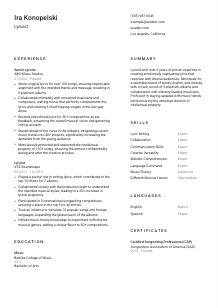
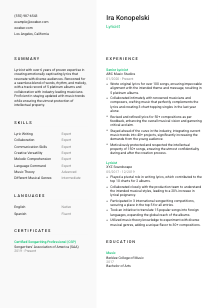
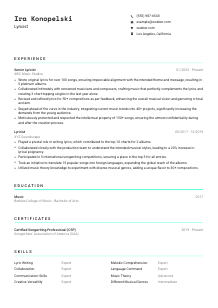
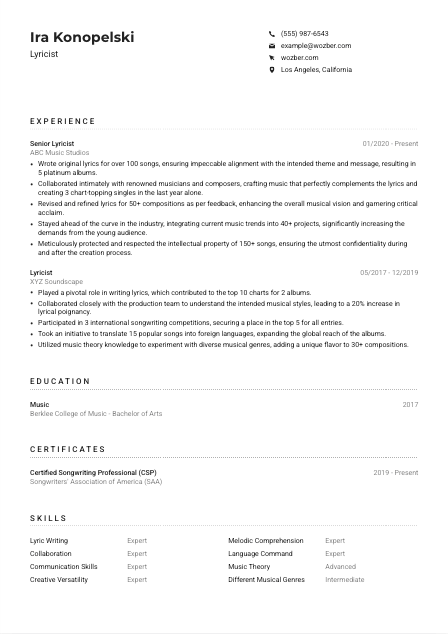
If you include a website, make sure it helps the hiring team hear or verify your work quickly. A strong lyricist portfolio can feature released songs, writing credits, genre range, collaboration history, or selected lyric samples tied to actual productions. The example CV does this well by pairing a professional website with accomplishments that reference songs, albums, and chart results.
Your header should answer the basics in seconds: who you are, what role you do, how to reach you, and whether you meet any stated location requirement. Then the rest of the CV can focus on the writing.




This section carries the most weight for a Lyricist because credits, collaboration history, and finished work tell hiring teams far more than general creative claims. Show where you wrote, who you worked with, how often you revised, and what the songs achieved in release, reception, or commercial reach.
Before writing bullets, identify the actions and standards the employer repeats. In this case, that includes writing original lyrics, blending words with music, revising to feedback, understanding genre and audience trends, and protecting confidential material. Build your experience around those working realities so your bullets read like evidence of the role, not a generic music industry profile.
List your positions in reverse chronological order with job title, company, and dates. That gives the reader a quick view of your level, continuity, and progression. Titles matter here. "Senior Lyricist" and "Lyricist" immediately frame writing responsibility differently, especially when hiring teams are scanning for depth of professional practice rather than hobby or side-project experience.
Each bullet should show what you actually contributed to the creative process. Focus on outputs such as original lyrics, rewrites, multilingual adaptations, genre experimentation, or close collaboration with composers and artists. The sample CV is effective because it ties the writing itself to concrete outcomes like charting singles, platinum albums, and critical response instead of stopping at "responsible for writing lyrics."
Quantify impact where it reflects real industry performance. Good measures for lyricists include number of songs written, albums released, placements, streaming or chart success, revision volume, competition results, or audience growth tied to a project. Saying you wrote lyrics for more than 100 songs or revised 50+ compositions gives much stronger hiring context than broad creative language alone.
Prioritise work that proves lyric development, musical collaboration, audience awareness, and genre fluency. Adjacent experience can stay if it strengthens your case, such as songwriting, vocal production support, translation for songs, or literary work connected to music. Cut unrelated entries that do not help explain how you write for melody, theme, and revision under professional constraints.
By the end of the Experience section, the reader should understand your writing volume, your collaborative range, and the level of results your lyrics have supported. That combination carries far more weight than creative adjectives.
Education matters most when it confirms the foundation behind your writing. For lyricists, that often means formal study in music, English, songwriting, composition, literature, or another field that strengthens language control and musical understanding.
If the posting asks for a bachelor's degree in Music, English, or a related field, make sure that information is easy to find. Lead with your highest relevant degree. In the example, a Bachelor of Arts in Music from Berklee College of Music directly supports the employer's requirement and reinforces the candidate's technical grounding in song structure.
List school, degree, field of study, and graduation year in a consistent format. This section should be quick to scan. Hiring teams are usually looking for confirmation of the credential first, not a long academic narrative.
If your degree title does not fully explain your fit, include a brief note on coursework, projects, or concentrations related to songwriting, poetry, music theory, composition, literature, or performance. That extra context is useful when your educational path is adjacent rather than exact, and it helps connect the degree to day-to-day lyric work.
Early-career candidates can get more value from honors, songwriting showcases, publications, ensemble work, or senior projects tied to music and writing. Experienced lyricists usually need less detail here unless a distinction is unusually relevant, such as a notable songwriting program or published academic work in lyrical composition.
Workshops, short courses, and advanced study can strengthen this section if they deepen skills the role depends on, such as rhyme and meter, genre writing, music theory, topline development, or collaborative songwriting. Add them when they reinforce your current writing profile rather than filling space.
Education should support the professional story already established in your experience. For a lyricist, the best version confirms that your instincts are backed by training in language, music, or both.
Certifications are optional for many lyricist roles, but they can help when they show focused training in songwriting, music theory, copyright awareness, or another area tied to professional writing practice. Include them when they deepen your profile, not just to make the CV look fuller.
Review the posting and keep certificates that reinforce what the employer values. For lyricists, that usually means writing craft, musical fluency, collaboration, or professional standards around publishing and intellectual property. A songwriting credential is more relevant here than a broad creative course with no clear tie to song development.
List certificates that add real professional context. The example uses "Certified Songwriting Professional (CSP)," which complements the candidate's writing experience and shows sustained commitment to the craft. One relevant certificate is often stronger than several loosely related ones.
Include the year earned and, if applicable, the active period or renewal status. This matters most for credentials that remain current over time. Clear dates also show whether the learning is recent enough to reflect your present toolkit and industry awareness.
Lyric writing changes with genre trends, audience taste, release formats, and collaboration workflows. If you take workshops on toplining, sync writing, co-writing, or rights management, those can strengthen later versions of your CV. Add new learning when it improves your credibility for the specific role you want next.
Treat certificates as support for your main story. They work best when they sharpen your professional profile in songwriting and music creation rather than distracting from stronger experience.
A lyricist's skills section should balance writing craft with musical and collaborative ability. Hiring teams are looking for more than creativity. They want to see whether you can shape language to melody, work across genres, take feedback, and contribute inside a real recording or songwriting process.
Scan the posting for both explicit and implied skills. Here, the clearest ones include command of language, rhythm, and melody, music theory, genre awareness, collaboration, and communication. Those should guide what appears in your skills section so the language matches what the employer is already prioritising.
Put the most role-critical skills first. For lyricists, that often means lyric writing, melodic comprehension, music theory, collaboration, and communication with composers or artists. The sample CV also includes creative versatility and language command, which works well because both relate directly to adapting voice, theme, and style across projects.
Choose skills that reflect actual practice, not broad personality traits. "Lyric Writing" and "Different Musical Genres" tell the reader far more than generic entries like "creative" or "team player." If you use proficiency levels, make sure they are believable and consistent with the rest of the CV.
Your skills list should read like the toolkit behind your credits. When it is aligned to the posting, it strengthens both ATS optimisation and the human reading of how you write and collaborate.
Language ability can be a real advantage for lyricists, especially in markets where translation, adaptation, cross-border collaboration, or multilingual releases matter. It is rarely the deciding factor on its own, but it can widen the kind of projects you are able to support.
Start with the posting. If a language is required for writing, collaboration, or audience reach, place it prominently. When no specific language is requested, include only those that add clear value to your work, such as helping with bilingual lyrics, translation, or artist communication.
Lead with the languages you can genuinely use in professional settings. Native and fluent languages should come before intermediate ones. This ordering helps the reader quickly understand whether you can write, adapt, or discuss lyrical content across more than one language environment.
Additional languages can show versatility, especially if you have worked on international releases, translated songs, or written for varied audiences. The example CV lists Spanish alongside native English, which pairs well with the candidate's experience translating songs and suggests broader collaboration potential.
Describe each language with straightforward levels such as "Native," "Fluent," "Intermediate," or "Basic." For lyricists, honesty matters. Writing a chorus, discussing meter, and translating emotional nuance require a different level of command than casual conversation.
If your language skills have shaped your work, make that visible elsewhere in the CV through experience bullets or portfolio examples. Multilingual ability becomes more persuasive when it is tied to translated tracks, bilingual lyrics, international collaborations, or access to a specific audience segment.
For the right project, language ability can make you more useful in the room and more flexible in the catalogue. Keep it accurate and tie it to real music work where possible.
The summary should quickly show what kind of lyricist you are, how much professional experience you bring, and what kind of outcomes your writing has supported. Keep it grounded in credits, craft, and collaboration, not vague statements about passion or creativity.
Read the posting closely and decide which parts of your background deserve the top line. For this job, the strongest themes are professional lyric writing experience, command of language and melody, collaboration with musicians, genre fluency, and the ability to revise toward a clear artistic vision. Your summary should foreground those points in a compact form.
Start with a direct line that states who you are and how long you have worked in the field. "Lyricist with 6+ years of professional experience" is stronger than a broad creative label because it immediately establishes level. If your career also includes notable songwriting or publishing work, mention that only if it sharpens the target profile.
Use one or two concrete achievements that show your writing has landed in the market. The sample summary works because it references platinum albums, collaboration with industry musicians, and the ability to blend words, rhythm, and melody. Those details tell a hiring team far more than claiming to be innovative or versatile.
End by reinforcing the abilities that matter most for the opening, such as revising lyrics to match evolving musical direction, staying current with listener trends, or protecting confidential songs during development. Keep the full summary concise enough to scan quickly while still sounding specific to professional songwriting work.
A good lyricist summary gives the reader a fast, accurate picture of your level, your writing environment, and the kind of musical results your work has helped produce. That should be clear before they reach the first bullet.
Once each section reflects the way lyricists are actually hired, your CV starts reading less like a creative profile and more like a professional track record. Use Wozber's free CV builder to shape that story into an ATS-friendly CV template, align your wording with the posting, and check key requirements with an ATS CV scanner.
Keep the final version focused on credits, collaboration, musical fluency, and outcomes. It should make it easy to judge whether you can step into the room, write to brief, revise with artists, and deliver lyrics that hold up in the finished song.




