



Use Wozber and land your dream job
Create CV
No registration required
Lending pitch-perfect harmonies, but your CV isn't hitting the right notes? Tune up your credentials with this Backing Vocalist CV example, created with Wozber free CV builder. Learn how to blend your musical talents with job demands, crafting a career that's always on key!
Backing vocal work is judged in the room and on the recording. Hiring teams want to see whether you can lock into harmony, support a lead without overpowering the arrangement, learn material fast, and stay consistent through rehearsals, shows, and studio takes. Your CV should make that musicianship visible, not just list that you
A tailored CV also helps separate experienced ensemble singers from general performers. When you align your wording with the posting, use role-specific terms, and build an ATS-compliant CV with Wozber's free CV builder, the first scan makes your live performance history, rehearsal discipline, and studio familiarity easier to read. That matters when the team needs someone who can step into the set, sync quickly, and hold the vocal line under pressure.
For a performance role, the header needs to answer practical questions fast: who you are, what role you perform, and whether you meet any immediate logistics such as location and contact availability.
Use your full name in a clean, readable format at the top of the page. For artists and vocalists, this works as your professional identifier, so keep it simple and easy to spot.
Place the target title directly under your name when it matches the job you are pursuing. If the posting says
Add a current phone number and a professional email address you actually monitor. If you include a website, portfolio, or performance reel, make sure it leads to material that supports your live or studio vocal work.
Some music roles are tied to rehearsal schedules, local sessions, or on-site performances. Here, Los Angeles, California is a stated requirement, so listing city and state in the header helps remove a basic eligibility question right away.
Age, marital status, and similar details do not strengthen a Backing Vocalist application. Use the space for information that supports bookings, rehearsals, and communication instead.
This section should confirm the basics in seconds: your identity, target role, contact details, and any stated location requirement. Once that is clear, the reader can focus on your vocal background and performance record.




For Backing Vocalist roles, experience has to show more than stage time. It should show how you contributed to the sound, how quickly you learned material, and how reliably you worked with lead vocalists, musicians, and production teams.
Before rewriting your bullets, mark the duties and requirements that define the role. In this case, that includes harmonizing with lead vocals, adapting across styles, rehearsing consistently, performing live, and handling recording sessions. Those points should shape what you emphasize in each role.
Write your jobs in reverse chronological order and include the title, organisation, and dates. If your title varied, such as
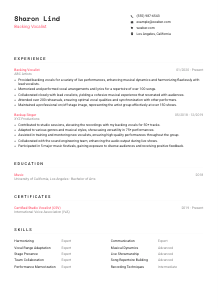
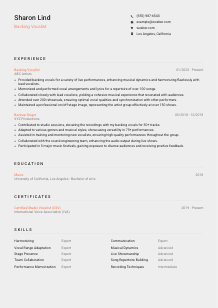
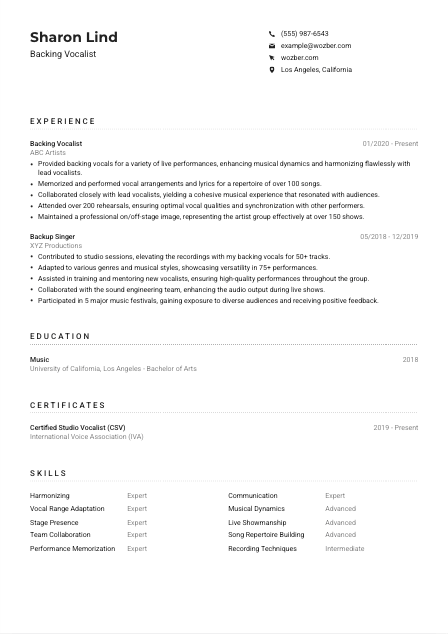
Each bullet should show what you added to the performance or session. Good Backing Vocalist bullets mention harmonies, synchronization, memorized repertoire, genre flexibility, rehearsal discipline, or collaboration with the lead and band. The sample does this well by describing support for live shows, vocal arrangements, and cohesive audience-facing performances.
Metrics help when they match the way performers are actually evaluated. Song count, number of rehearsals, live shows, studio tracks, or festival appearances all add useful scale. Details such as performing a repertoire of 100+ songs or contributing to 50+ recorded tracks tell the reader how much material you have handled.
Prioritise experience that supports the role you want now. If you have other music work, keep only the parts that show ensemble awareness, stage professionalism, recording exposure, or vocal leadership. A hiring team for backing vocals wants to picture you in rehearsal, on stage, and in session.
Your experience section should make it easy to hear how you operate in a real performance setting. When the bullets show range, reliability, and ensemble skill, your CV starts to read like someone who can join the production without a long ramp-up.
Education is rarely the deciding factor for a Backing Vocalist, but it can strengthen your profile when it connects to musicianship, ensemble training, vocal technique, or performance study.
If you hold a degree in music, vocal performance, or a related field, include it clearly. A Bachelor of Arts in Music, like the example, adds useful context because it suggests formal grounding in theory, performance, and rehearsal discipline.
List the school, degree, field of study, and graduation year. This section does not need extra design or long explanations unless the training directly supports the role.
When your education connects to ensemble singing, ear training, arranging, or stage performance, make that easy to see. If your background is less directly related, keep the entry concise and let experience carry more weight.
Relevant courses can help early-career candidates or performers with limited credits. Vocal performance, music theory, sight-singing, recording basics, or ensemble studies are worth naming if they add missing context.
Awards, ensemble leadership, scholarship recognition, or major performance credits from school can add value when they show discipline and performance quality. Use them if they strengthen your professional story, not just because they happened.
Keep this section concise and relevant. When your training connects clearly to vocal technique, musicianship, or ensemble performance, it gives extra depth without distracting from your live and studio record.
Certifications are optional for many Backing Vocalist roles, but the right one can reinforce studio knowledge, vocal technique, or specialised training that does not fully appear elsewhere on the CV.
Start with the job description. This opening does not require a certification, so any credential you include should support the work rather than fill space.
Prioritise credentials that connect to studio sessions, vocal coaching, music performance, or related technical practice. The sample's
Include the issue date or active period if it helps show that your training is current. That is especially useful for studio-related skills, contemporary vocal methods, or ongoing professional development.
A short list is better than a scattered one. Pick credentials that support the kind of material you perform, the environments you work in, or the technical standards expected in rehearsals and recordings.
Certifications should reinforce your readiness for live or recorded vocal work, not distract from it. If they add depth to your musicianship or session value, they belong here.
A Backing Vocalist skills section should read like the toolset of a dependable ensemble performer. Focus on abilities that affect rehearsals, live delivery, vocal blend, and session execution.
Pull out the skills the employer names directly, then match them to experience you actually have. Here, that includes harmonizing, vocal range, musical dynamics, stage presence, adaptability across genres, and recording knowledge. These are the terms an ATS and hiring team will notice first.
List both musical capabilities and collaboration strengths. Technical skills might include harmonizing, memorization, vocal control, and recording techniques. Supporting skills such as communication, ensemble awareness, and rehearsal reliability matter because backing vocal work depends on precise coordination.
Do not turn this section into a full inventory of everything you can do. Choose the skills that best support the target work. The example keeps the list close to the role by featuring stage presence, musical dynamics, repertoire memorization, and genre adaptation instead of unrelated music skills.
This section should quickly confirm that you can blend, adapt, and perform consistently. When the language matches the job and the skills reflect real ensemble work, the rest of the CV lands more convincingly.
Language ability matters in music work when it affects rehearsal communication, lyric delivery, touring, or collaboration with artists and production teams. Keep the section practical and tied to the role.
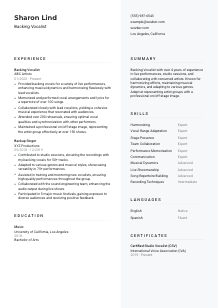
If the posting specifies English speaking proficiency, list English prominently with an accurate level. That immediately addresses a stated requirement and helps the reader move on to your vocal qualifications.
Additional languages can be useful for multilingual performances, international collaborations, or broader audience engagement. Spanish, for example, may add value in certain live markets or artist lineups, but it should remain secondary to the required language.
Stick with standard terms such as Native, Fluent, Advanced, or Conversational. Hiring teams need a quick read on how well you can communicate in rehearsal rooms, studio settings, and professional interactions.
If your repertoire, touring history, or collaboration network spans multiple markets, language skills can support that story. Keep them if they connect to actual performance opportunities rather than just personal interest.
For some singers, language study improves access to new repertoire, new audiences, or broader session work. If you are actively developing a language that supports your musical path, it can become a practical asset over time.
This section works best when it reflects real communication ability that supports rehearsals, lyrics, studio work, or live performance. Clear language levels keep it credible and useful.
The summary should give a fast, specific read on your experience level, vocal strengths, and the performance environments you know well. For this role, that usually means live shows, rehearsals, recording sessions, and close coordination with lead vocalists.
Read the posting closely, then identify the few points that matter most. Here, the essentials are professional backing vocal experience, harmonizing ability, genre adaptability, stage presence, and studio familiarity. Those should guide the opening lines.
Start with who you are and how much relevant experience you bring. A line such as
Follow with specifics that show how you perform. You might mention memorizing large repertoires, supporting live arrangements, contributing in studio sessions, or collaborating closely with lead vocalists. The sample summary works because it ties years of experience to live performance, studio work, and professional presentation.
Aim for three to five lines with no filler. This section should sound polished and grounded, not dramatic. A hiring team should be able to understand your core value before reading the first bullet in your experience section.
A sharp summary frames the rest of the CV around the work you do best. Once it clearly establishes your vocal range, ensemble value, and live or studio experience, the rest of the document can prove it. Wozber's AI CV builder can help refine that wording, strengthen ATS optimisation, and organise the final version in an ATS-friendly CV format that keeps your performance background easy to follow.
A Backing Vocalist CV should leave no doubt that you can blend, rehearse, adapt, and perform with control. When each section points to real ensemble work, live credits, studio exposure, and professional reliability, the hiring team can picture you in the lineup.
Use Wozber to shape that experience into a focused, ATS-compliant CV, check alignment with the job through an ATS CV scanner, and present it in an ATS-friendly CV template. The finished CV should make one thing clear fast: you are ready to support the performance at a professional level.




