



Use Wozber and land your dream job
Create CV
No registration required
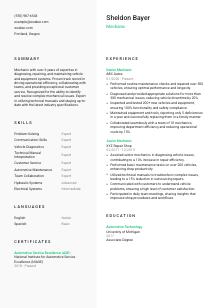
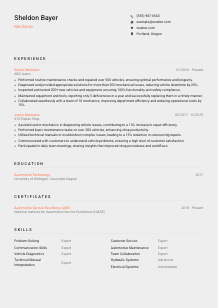
Greasing gears, but your CV's running rough? Check out this Mechanic CV example, built with Wozber free CV builder. It shows how you can tune your technical skills to match job profiles, driving your career toward top performance!
Mechanic hiring moves quickly when a CV makes the work visible. Shops and fleet teams want to see what you actually maintain, how you diagnose faults, whether you can work across mechanical, hydraulic, and electrical systems, and how your repairs affect uptime, safety, and service quality. If those details stay vague, even solid hands-on experience can read as entry-level general labour instead of skilled mechanical work.
CV tailoring changes that first read by making your technical scope easy to recognize in both ATS screening and human review. With Wozber's free CV builder, you can align your wording with the posting and keep an ATS-compliant CV organised around the systems, repair work, and maintenance outcomes that matter most for mechanic roles. That helps a hiring manager quickly see whether you can diagnose issues accurately, keep equipment running, and work well with the rest of the shop.
This section is simple, but it still affects whether your application moves forward. For mechanic roles, hiring teams need clear contact details, a matching job title, and in some cases confirmation that location or relocation will not delay scheduling, onboarding, or shift coverage.
Use your full name as the header in a clean, readable format. Keep it slightly larger than the rest of the text so the document feels organised from the start, much like a service record that is easy to scan when a vehicle comes back into the bay.
Place "Mechanic" directly under your name if that is the role you are applying for. This instantly positions your background for the opening and helps ATS systems connect your CV to the posting. If your recent title was "Senior Mechanic" or "Diesel Mechanic," keep the CV title aligned with the target job unless the specialization is important to the role.
List a phone number you answer, a professional email address, and only links that support your application. For most mechanics, that means skipping unnecessary social profiles. If you do include a website or LinkedIn page, make sure it supports your CV with certifications, work history, or equipment experience rather than empty placeholders.
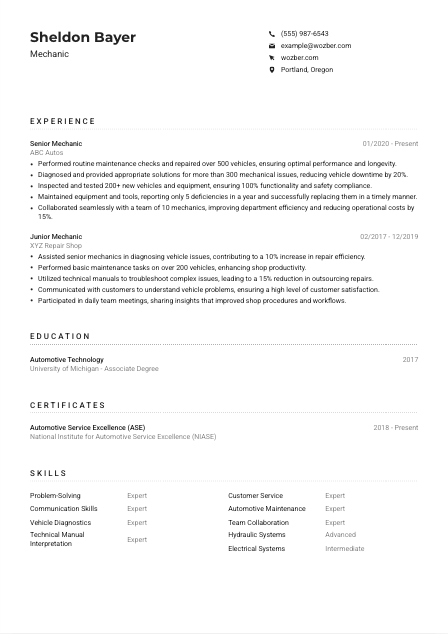
If the employer asks for candidates in a specific area, include your city and state. Here, Portland, Oregon matters because the job description names it. If you are relocating, say so clearly. That removes an avoidable question before anyone gets to your experience section.
A mechanic usually does not need a portfolio, but an updated LinkedIn profile can still help if it includes ASE credentials, equipment types, or shop experience. Only include a link if the information matches your CV and gives a clearer picture of your technical background.
Your personal details should answer the practical basics fast: who you are, what role you want, how to reach you, and whether your location works for the job. For a mechanic opening, that early clarity keeps the focus on your repair experience instead of avoidable admin questions.




For mechanics, experience carries most of the decision. Hiring managers look for evidence that you can inspect equipment, diagnose faults correctly, complete maintenance and repair work safely, and keep vehicles or machinery in service without creating repeat issues. This section should read like a record of work completed, not a generic list of duties.
Read the posting like a work order. Highlight the systems, responsibilities, and operating conditions it repeats. In this case, the employer calls out routine maintenance, accurate diagnosis, repair across mechanical, hydraulic, and electrical systems, safe inspections, and teamwork that reduces downtime. Those are the themes your bullets should echo if they match your background.
List jobs in reverse chronological order with employer, title, and dates. That structure helps the reader quickly understand the level of equipment you have worked on and how your responsibilities have grown. If you moved from a junior shop role into a senior mechanic position, that progression is worth making easy to follow.
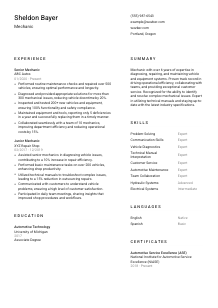
Use bullets that show what you maintained, repaired, diagnosed, or improved. The sample CV does this well by tying routine maintenance to more than 500 vehicles and connecting diagnostic work to reduced downtime. That is stronger than writing "responsible for repairs" because it shows volume, technical activity, and outcome in one line.
Quantify the work where you can. Good mechanic metrics include vehicles serviced, equipment inspected, repair turnaround, downtime reduction, safety compliance, first-time fix rates, and shop efficiency improvements. The example's 20% downtime reduction and 15% efficiency gain work because those are measures a service manager or fleet lead actually cares about.
Cut experience details that do not help prove you can succeed in the target environment. Prioritise diagnostics, preventive maintenance, system repair, tool and equipment care, technical manual use, and collaboration with other mechanics or departments. If the role leans automotive, keep automotive work near the top. If it leans heavy equipment, give that equipment and system exposure more space.
A mechanic's experience section should show the kind of equipment you handled, the systems you worked on, and the operational results of your repairs. When those bullets connect hands-on work to uptime, safety, and efficient shop performance, your value becomes much easier to judge.
Education usually will not outweigh shop experience for a mechanic, but it still adds useful context. A relevant degree or trade program tells employers you were trained in core systems, diagnostics, safety procedures, and technical fundamentals that support practical repair work.
Some mechanic postings ask directly for a degree or trade-school background, while others focus more on years of experience and certifications. Even when education is not the headline requirement, a credential like an Associate Degree in Automotive Technology still reinforces your foundation in diagnostics, maintenance procedures, and system theory.
Include degree, field of study, school, and graduation year or date. Keep the format straightforward so the section is easy to scan. For a mechanic, long descriptions are rarely necessary unless a program is directly tied to the kind of vehicles, equipment, or systems named in the posting.
If your education is directly relevant, make that clear. An automotive technology degree fits naturally for an automotive mechanic opening, just as diesel technology or heavy equipment maintenance training would matter more in other settings. The sample degree works because it supports the repair and diagnostic work shown elsewhere on the CV.
Most mechanics do not need a course list, but it can help early-career candidates or applicants switching specialties. Mention classes only when they strengthen your case, such as hydraulics, electrical diagnostics, brake systems, engine performance, or preventive maintenance.
Short programs, manufacturer training, and safety workshops can belong here or in certificates if they are recent and relevant. Continuous training matters in mechanical work because diagnostic tools, vehicle systems, and service procedures keep changing.
Keep this section focused on training that strengthens your technical credibility. It should confirm that your hands-on experience sits on a real foundation in automotive or equipment systems, not compete with the experience section for space.
Certifications matter in mechanic hiring because they show validated knowledge, current standards awareness, and in some cases job-ready specialization. They are especially useful when a posting mentions ASE, licensure, or another credential tied to safety, inspection, or repair standards.
When a posting mentions ASE or state-specific licensure, move those credentials into clear view. That does not mean every mechanic job requires the same certification, but when the employer names one, matching it on your CV makes the connection immediate.
Choose certifications that support the actual work in the role. ASE belongs on an automotive mechanic CV because it directly backs up diagnostic and repair credibility. If you have multiple certificates, list the ones tied most closely to the equipment, systems, or compliance expectations in the posting first.
Include issue dates, renewal windows, or active status when relevant. That helps employers see whether your credential is current. In the example CV, the ASE certification is listed as active from 2018 to present, which quickly communicates ongoing validity.
Mechanics work in an environment where systems, tools, and standards change. Updated certifications, inspection credentials, and manufacturer training show you are not relying only on what you learned years ago. That matters most in roles involving newer vehicle electronics, hydraulic systems, or regulated safety checks.
Use certifications to strengthen trust in your technical judgment. A well-placed ASE or similar credential tells the employer that your repair knowledge has been tested and kept current, which is valuable in any shop where accuracy and safety matter.
A mechanic skills section works best when it reflects the actual systems you diagnose and the way you work in the shop. Generic lists do not help much. Hiring teams are looking for a usable mix of technical ability, troubleshooting judgment, manual discipline, and customer or team communication where the role requires it.
Pull out the exact capabilities the employer emphasizes and reflect them naturally in your skills section. Here that includes diagnosing, repairing, and maintaining mechanical, hydraulic, and electrical systems, along with problem-solving, technical manual use, and communication. Matching that language improves ATS alignment and makes your CV feel tailored without sounding forced.
Mechanic roles are built on hard skills first, but soft skills still matter. Include the technical side such as vehicle diagnostics, hydraulic systems, electrical troubleshooting, preventive maintenance, and technical manual interpretation, then add the people-facing or operational skills the role actually uses, like customer communication, teamwork, and clear reporting.
Do not overload this section with every tool or trait you have ever used. Put the most relevant capabilities first, especially those named in the job ad. The sample CV handles this well by leading with diagnostics, maintenance, problem-solving, and collaboration, then supporting them with systems knowledge. That ordering helps the reader understand your core mechanic profile quickly.
Your skills list should back up the experience section with clear technical range and practical shop value. When the priorities match the posting, employers can quickly see whether you can handle the systems, workflow, and communication demands of the role.
Language is a practical issue in mechanic work. You may need to read repair orders, follow technical manuals, explain findings to customers, document work performed, or coordinate with teammates during a busy service day. If a posting specifies English, treat that as a real requirement, not filler.
If the job says English is essential, list your English proficiency clearly. That matters because mechanics often need to document repairs accurately, interpret manuals, and communicate recommended work without confusion. For this opening, strong spoken and written English should be visible on the CV.
Additional languages can help in customer-facing shops, mixed-language crews, or service environments with a broad client base. A second language like Spanish can be worth listing if you can actually use it in conversation, work instructions, or basic customer interactions.
Use clear levels such as Native, Fluent, Conversational, or Basic. Overstating language ability can create avoidable problems when you need to explain a repair, discuss a safety issue, or understand customer concerns accurately.
Not every mechanic opening gives languages the same weight. In a back-of-house equipment role, English fluency may be enough. In a customer-facing automotive shop, extra language ability can support service quality and smoother handoffs between diagnostics and front-desk communication.
List language ability with the same honesty you would use when describing technical skills. For mechanic roles, clear communication affects repair accuracy, documentation, and customer trust, so keep this section practical and believable.
The summary needs to tell the reader what kind of mechanic you are within a few lines. This is where you frame your years of experience, your diagnostic and repair range, and the kind of results you deliver before the reader gets into the rest of the CV.
Start by identifying the mechanical scope of the target job. If the posting centers on maintenance, diagnostics, safety inspections, and repair across multiple systems, your summary should reflect that focus instead of using broad claims about being hardworking or reliable.
Begin with your title and level of experience. The sample summary does this effectively with "Mechanic with over 6 years of expertise in diagnosing, repairing, and maintaining vehicle and equipment systems." That kind of opening tells the reader your trade, tenure, and core technical range right away.
After the opening line, mention the capabilities that matter most for the role, such as diagnostic accuracy, downtime reduction, equipment reliability, customer communication, or collaboration in a busy shop. Keep these points grounded in the work you actually do, not generic personality language.
Aim for a short paragraph that can be read in seconds. Three to five lines is usually enough. If every sentence points to mechanical systems, repair judgment, and operating results, the section will do its job without taking space away from the evidence in your experience bullets.
A good summary gives the reader an immediate sense of your repair background, technical range, and shop value. By the time they reach your experience section, they should already understand whether you work best in automotive service, equipment maintenance, diagnostics-heavy roles, or a mix of all three.
A mechanic CV works when it shows real repair work, system knowledge, and the results of keeping vehicles or equipment in service. Focus on maintenance volume, diagnostic accuracy, downtime reduction, safety checks, and the systems you know well. Those details tell a hiring manager far more than broad claims ever will.
Use Wozber's AI CV builder to tailor each section to the posting, strengthen ATS optimisation, and keep your final document clean in an ATS-friendly CV format. When the language, metrics, and technical scope line up with the job, your CV makes it much easier to judge whether you can step into the bay and deliver from day one.