



Use Wozber and land your dream job
Create CV
No registration required
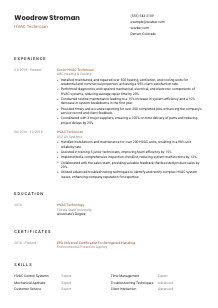
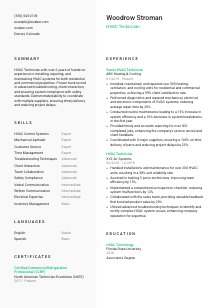
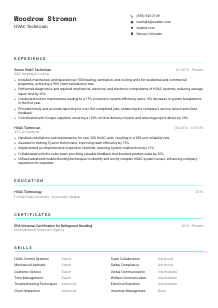
Mastering HVAC works, but your CV blows hot and cold? Dial in on this HVAC Technician CV example, created with Wozber free CV builder. Learn how to match your HVAC expertise to job criteria, setting your career's airflow to ultimate comfort!
HVAC hiring moves quickly when a CV makes the fieldwork clear. Employers want to see whether you've handled installs, preventive maintenance, and fault diagnosis on real systems, and whether you can work cleanly across mechanical, electrical, and control issues without creating callbacks or safety problems.
A tailored CV changes what gets noticed first. When your wording reflects the job's actual service mix, certifications, and troubleshooting scope, hiring teams can quickly connect your background to the calls they need covered. Wozber's free CV builder helps structure that experience in an ATS-friendly CV format, so your install volume, repair results, and reporting habits come through clearly.
For HVAC technicians, the top of the CV should read like a service ticket with no missing information. Clear contact details, the right job title, and location when relevant remove friction before anyone gets to your work history.
Use your full name in a slightly larger font than the rest of the page so it stands out immediately. Keep it simple and professional. In a trade where hiring can move fast for active openings, you want your name easy to spot when a manager is scanning several CVs between dispatches or site visits.
Place "HVAC Technician" directly under your name if that is the role you are applying for. This helps frame your experience before the reader reaches your bullets and supports ATS matching when the employer is searching for candidates with direct service, installation, and repair experience in HVAC systems.
List a reliable phone number and a professional email address. Double-check both. HVAC employers often need to reach candidates quickly to discuss schedules, field coverage, on-call expectations, or interview availability, so one typo can cost you a real opportunity.
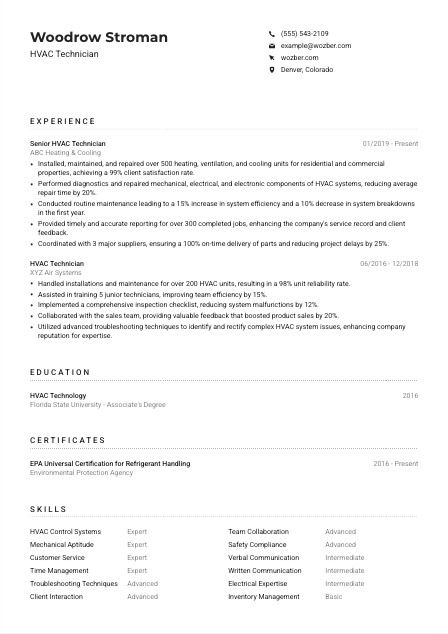
If the employer wants someone already in the area or willing to relocate, show that clearly in your personal details. In the example, listing Denver, Colorado directly supports the posting's location requirement. Use that approach when geography affects response time, licensing, or job-site coverage.
Include LinkedIn or a professional website only when it strengthens your HVAC profile. That might mean confirming your work history, certifications, or additional project details. If you link it, make sure the titles, dates, and credentials match your CV exactly.
This section should answer the practical basics in seconds: who you are, how to reach you, what role you want, and whether location is already aligned. That keeps attention on your technical background instead of avoidable questions.




Experience carries the most weight on an HVAC Technician CV because it shows what kinds of systems you've actually touched, how you troubleshoot under field conditions, and what results followed. Hiring teams want more than a list of duties. They want proof that you can install correctly, diagnose efficiently, and keep equipment running safely.
Read the posting closely and mark the work it repeats. Here, the priorities are installation, maintenance, repair, diagnostics, control systems, safety compliance, reporting, and supplier coordination. Those are the themes your experience bullets should cover first, because they reflect the day-to-day work the employer needs handled.
List your jobs in reverse chronological order with title, employer, and dates. For HVAC work, titles such as "HVAC Technician" or "Senior HVAC Technician" already signal scope, but your bullets should clarify whether you worked in residential service, commercial systems, preventive maintenance, retrofit work, or mixed environments.
Do not stop at "installed and repaired HVAC systems." Show volume, performance, or service quality. The example does this well with details such as servicing more than 500 units, reaching a 99% client satisfaction rate, and cutting average repair time by 20%. Those are the kinds of numbers that tell a hiring manager how you perform in the field.
Quantify the work in ways that make sense for the trade: units installed or maintained, response or repair time, efficiency gains, breakdown reduction, inspection volume, on-time parts delivery, or customer satisfaction. Metrics like a 15% increase in system efficiency or a 10% drop in breakdowns show the business value behind your technical skill.
Prioritise bullets that connect directly to system performance, diagnostics, controls, maintenance quality, safety, reporting, or customer-facing service. If an older bullet does not support the target role, replace it with one that does. For this kind of opening, troubleshooting complex components and documenting completed jobs matter more than unrelated general labour detail.
After reading this section, a hiring manager should understand what equipment you worked on, how you handled service and repair demands, and what results followed. Make your field experience easy to picture and your value easy to measure.
Education supports your technical foundation, even in a hands-on trade. It helps explain where your knowledge of refrigeration cycles, electrical systems, controls, airflow, and safety standards was built, especially when paired with solid field experience.
If you have a degree or diploma in HVAC technology, refrigeration, building systems, or a related trade area, list it clearly. This job posting does not require a specific degree, but relevant training still strengthens your profile by showing formal grounding behind your install, maintenance, and repair work.
Include the school, degree or diploma, field of study, and graduation year or date. A clean format is enough. In the example, an Associate's Degree in HVAC Technology quickly reinforces that the candidate has both classroom training and several years of field experience.
If your education is tightly connected to the trade, keep it prominent. If it is less related, keep it brief and let your experience carry more of the CV. Employers filling HVAC roles will care most about training that supports diagnostics, electrical troubleshooting, refrigeration handling, and equipment maintenance.
Early-career technicians can strengthen this section by listing a few relevant courses, such as refrigeration systems, HVAC controls, load calculations, electrical fundamentals, or energy efficiency. That extra detail can help when your work history is still growing.
Academic distinctions are worth mentioning if they point to real technical strength. A standout capstone on control systems, commercial refrigeration, or preventive maintenance planning is more useful here than general school activities. Keep the focus on training that supports the actual work.
Your education section does not need to be long. It needs to show that your hands-on ability is backed by relevant technical learning, especially if that learning connects to controls, refrigeration, or system diagnostics.
Certifications matter in HVAC because they speak directly to legal compliance, safety, and technical scope. Some are preferred. Others are required before you can handle refrigerants or work independently on certain systems. This section should make those credentials impossible to miss.
When a posting names a required certification, list it near the top of this section exactly as the employer would recognize it. In this case, the EPA Universal Certification for Refrigerant Handling is essential because the job specifically requires refrigerant handling authorization.
Choose certifications that strengthen your case for the target work. EPA credentials, NATE certifications, commercial refrigeration certifications, or manufacturer-specific training can all help when they match the systems or service environment involved. The CCRP in the example adds useful depth, but the EPA certification carries the most direct relevance for this opening.
Include the year earned and, where relevant, the current status or renewal period. Employers want to know your credential is active and usable now, especially when compliance and refrigerant handling are involved.
HVAC work evolves with control systems, efficiency standards, and equipment technology. Ongoing certifications in building automation, heat pumps, commercial refrigeration, or energy-efficient systems can strengthen your CV, particularly if they match the service calls or property types you target.
This section should quickly answer a practical hiring question: can you legally and competently perform the work? Lead with the certifications that affect field readiness first, then add the credentials that deepen your specialization.
The skills section should reflect how HVAC work is actually done. That means combining technical knowledge, diagnostic ability, safety awareness, and customer-facing communication instead of listing generic strengths with no service relevance.
Start with the language the employer already uses. For this opening, that includes HVAC control systems, troubleshooting techniques, communication, team collaboration, and reporting. If you genuinely have those skills, use the same wording or close variations so both ATS screening and human review connect your background to the job faster.
HVAC hiring usually looks for both system expertise and dependable field communication. Alongside technical skills like electrical diagnostics, mechanical repair, controls, and safety compliance, include customer interaction, written reporting, and coordination when those are part of your actual work. The example balances both sides well by pairing control systems and troubleshooting with client interaction and inventory management.
Order the list so the most relevant skills appear early. For this role, troubleshooting, HVAC controls, mechanical and electrical knowledge, safety compliance, and clear reporting should sit above broader traits. Keep the section selective enough that every skill points to work the employer will expect you to handle.
A useful HVAC skills section should read like a quick map of what you can diagnose, repair, document, and communicate in the field. Relevance matters more than volume.
Language skills matter in HVAC when they affect job-site communication, customer explanations, and service documentation. This section is usually brief, but it can still support the application when the posting names a required language or when your market includes multilingual clients.
If the job requires English proficiency, list English clearly with an accurate level. For HVAC work, that matters because technicians often need to explain issues to customers, document completed service, and coordinate with teammates, dispatch, or suppliers without confusion.
A second language can be valuable in residential and commercial environments where technicians speak with a wide range of clients, building staff, or subcontractors. Spanish, for example, may help with customer communication in some markets, even when it is not required.
Choose straightforward labels such as Native, Fluent, Intermediate, or Basic. Overstating language ability can create problems quickly in the field, especially when discussing equipment issues, safety instructions, or repair recommendations with customers.
Only include languages that can realistically support the work. If a language helps you explain maintenance needs, confirm scheduling details, or improve customer trust during service visits, it has a place on the CV.
Do not overdevelop the language section unless multilingual communication is a meaningful part of the role. For most HVAC applications, one required language plus one additional useful language is enough to show the point clearly.
This section works best when it reinforces your ability to communicate on the job, whether that means writing service notes in clear English or speaking with a broader customer base during calls.
The summary should quickly place you in the right part of the HVAC field. In a few lines, it needs to show your experience level, the kind of systems you work on, and the technical strengths that match the opening most closely.
Anchor the summary in your core HVAC background. Mention your years of experience and your main service scope, such as installation, maintenance, repair, diagnostics, or mixed residential and commercial work. That gives immediate context before the reader reaches your employment history.
A clean first line such as "HVAC Technician with 6+ years of experience" works because it establishes level and role without wasting space. If your background is more specialised, you can refine it with terms like commercial service, refrigeration, or controls.
Pull in two or three requirements that truly match your background. For this posting, that could include EPA Universal Certification, HVAC control systems, troubleshooting, reporting, and customer communication. The example summary also works because it mentions both hands-on system work and supplier coordination, which links directly to the employer's stated responsibilities.
Aim for 3 to 5 lines with concrete wording. Skip broad claims and focus on what you can handle: diagnosing mechanical and electrical issues, improving system performance, working across residential and commercial properties, or maintaining strong service documentation. Every phrase should support the target role.
Your summary should make the reader expect a capable HVAC technician who can step into service, maintenance, and repair work with minimal ramp-up. If those strengths are clear in the first few lines, the rest of the CV has a strong foundation.
A strong HVAC Technician CV makes practical things easy to see: your service background, your troubleshooting range, your required certifications, and the results of your work in the field. When those details are tied closely to the posting, the CV reads like someone who can handle the calls, the equipment, and the documentation the job requires.
Use Wozber to tighten that alignment from top to bottom. Its free CV builder, ATS CV scanner, and ATS-friendly CV templates help you organise your experience, match the language of the job description, and present an ATS-compliant CV that shows where you can contribute right away. The final read should make one thing clear: you are ready to work on the systems this employer needs covered.




