



Use Wozber and land your dream job
Create CV
No registration required
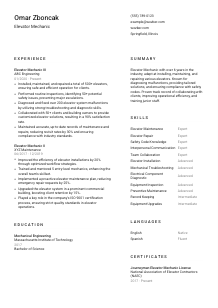
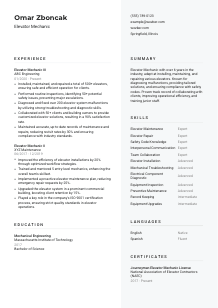
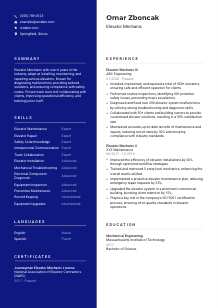
Riding high, but your CV feels stuck on the ground floor? Ascend to success with this Elevator Mechanic CV example, built with Wozber free CV builder. Learn how to align your vertical expertise with job specifics, raising your career trajectory as smoothly as your elevators!
Elevator mechanic CVs are judged quickly on one thing: whether they show safe, code-aware field work on real equipment. Hiring teams want to see that you can install, maintain, inspect, and repair elevators or escalators without creating risk for passengers, buildings, or service schedules. If your CV stays vague about system types, troubleshooting depth, or safety compliance, it can undersell strong hands-on experience.
A tailored CV makes your background easier to sort from adjacent trades like general maintenance, electrical work, or industrial mechanics. Using Wozber's free CV builder and an ATS-friendly CV format helps you line up your experience with terms such as inspections, diagnostics, repairs, and code compliance so both the ATS and the hiring manager can quickly see your relevance for elevator service work.
This section should be clean, practical, and easy to scan. For an Elevator Mechanic, the basics matter because field service roles often move fast once a qualified candidate is identified.
Use your full name in a larger, readable font so it anchors the page immediately. Skip nicknames unless they are part of your professional identity. In a trade where licenses, service records, and certifications matter, your name should match the documents employers will later verify.
Place the target title directly under your name. If you are applying for an "Elevator Mechanic" role, use that wording unless your current title is a closer match such as Elevator Mechanic III or Journeyman Elevator Mechanic. This helps position you correctly from the first line and supports ATS alignment with the posting.
Include a phone number you answer, a professional email address, and only links that support your application. Trade hiring can move quickly when a team needs coverage for inspections, maintenance routes, or repair volume, so accuracy here matters. One missed digit can cost you an interview.
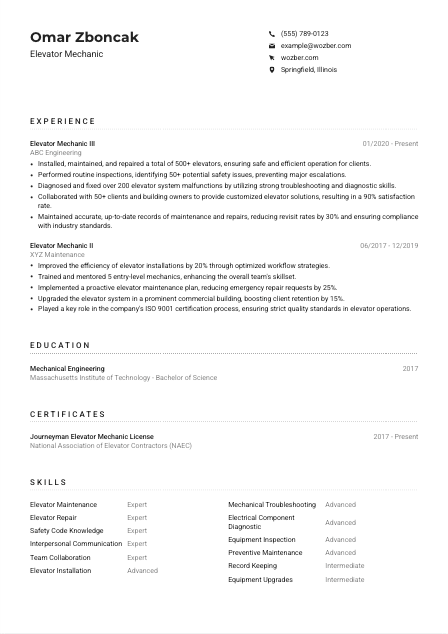
If a posting specifies a city or relocation requirement, address it directly in your location line. Here, Springfield, Illinois is specifically mentioned, so listing Springfield or noting planned relocation removes an immediate point of doubt. Keep it brief and factual.
A website or LinkedIn profile is useful when it reinforces your trade background with certifications, employment history, or related projects. If the profile is thin or outdated, leave it off. For this profession, a clean CV with accurate licensing and field experience carries more weight than a weak online presence.
Your personal details should confirm that you are reachable, local or relocation-ready when required, and clearly positioned as an Elevator Mechanic. Keep the section efficient, because the real proof starts in the experience and credentials that follow.




This is the section that decides most Elevator Mechanic interviews. Employers want to see the equipment you worked on, the problems you solved, the safety standards you followed, and the scale of the service or installation work you handled.
Before writing bullets, isolate the work themes in the job description. Here, the priorities are clear: 3+ years of installation, maintenance, and repair work, strong mechanical and electrical diagnostics, routine inspections, code compliance, client communication, and accurate maintenance records. Those themes should shape which jobs and accomplishments you emphasize first.
List your most recent position first, then work backward. For each job, include title, employer, and dates so the reader can quickly track your progression from junior service work to higher-responsibility repair, inspection, or lead mechanic duties. Clear chronology matters in skilled trades because employers often look for increasing equipment complexity and independence.
Describe what you installed, maintained, inspected, repaired, or upgraded, then tie that work to outcomes. Good Elevator Mechanic bullets mention system malfunctions, preventive maintenance, service reliability, safety findings, shutdown avoidance, or customer-specific solutions. The sample CV does this well by pairing duties with concrete actions such as routine inspections, malfunction diagnosis, and customised solutions for clients and building owners.
Metrics help when they sound native to the work. Useful numbers include units serviced, malfunctions resolved, safety issues identified, emergency calls reduced, revisit rates lowered, installation time improved, or client satisfaction scores. The example's "500+ elevators" and "200 malfunctions" work because they show volume and troubleshooting depth, not because they simply add big numbers.
Cut details that do not strengthen your case for this opening. If you have broader mechanical, electrical, or facility experience, keep only the parts that support elevator installation, maintenance routines, code-driven inspections, controls troubleshooting, or customer-facing service. The hiring team should come away with a clear picture of a mechanic who can keep vertical transportation systems safe and operational.
Your experience section should make it easy to picture you on the job: diagnosing faults, completing maintenance, documenting work properly, and keeping equipment compliant and in service. If those points are obvious at a glance, this section is doing its job.
Education usually supports an Elevator Mechanic CV rather than leading it, but it still adds useful context. It can show mechanical foundation, electrical understanding, or formal training that complements your field experience and licensing.
If the posting does not require a degree, list your strongest completed education without overplaying it. A mechanical engineering degree, trade school program, apprenticeship coursework, or technical diploma can all be relevant if they support your understanding of systems, components, and service work. In the example, a mechanical engineering degree adds depth, but the CV still correctly relies on field experience and licensing as the main proof.
Include the school, degree or program, field of study, and graduation year or date. Keep this section straightforward so the employer can scan it in seconds. Elevator hiring tends to focus more on what you can service and troubleshoot today than on long academic descriptions.
If you completed coursework in electrical systems, mechanical systems, controls, industrial safety, or code-related instruction, include it when it adds value. This is especially useful early in your career or when your formal education is stronger than your job titles alone suggest.
Honors, scholarships, or notable technical projects are worth listing if they connect to the work, such as applied mechanical design, electrical diagnostics, or safety-focused engineering study. If they do not support your candidacy for elevator installation and repair work, they can stay off the page.
For experienced mechanics, education should stay concise unless the employer specifically values a technical degree. Once you have several years of inspections, repairs, and code-based maintenance behind you, your daily work history carries more weight than expanded academic detail.
Use education to support your trade profile, not to compete with it. A short, relevant education section works best when your experience and credentials already show you can perform the job safely and effectively.
For Elevator Mechanics, certifications are not a minor add-on. They often determine whether you can be considered at all, especially when a posting names a required license or equivalent credential.
When a job asks for a valid state-issued Journeyman Elevator Mechanic license or equivalent certification, that credential should be listed first and clearly. Do not bury it below optional courses. This is one of the first items a hiring manager will look for because it directly affects legal eligibility and job readiness.
Focus on certifications tied to elevator installation, maintenance, repair, inspections, and safety standards. In the example, the Journeyman Elevator Mechanic License and Certified Elevator Technician credential both strengthen the fit because they relate directly to the trade. General credentials belong lower or can be omitted if space is tight.
Show when the certification was earned and whether it is current. Active licenses and recently maintained credentials matter in a field governed by code compliance, inspection standards, and regulated work. If a credential expires, make renewal status easy to understand.
Additional training in safety codes, controls, diagnostics, or equipment-specific systems can help, especially if you are targeting service-heavy roles or more complex modernization work. Recent learning signals that you stay current with code changes, equipment updates, and safe maintenance practices.
Your certifications should answer two questions immediately: are you qualified to do the work, and are your credentials current. For this trade, those answers often decide whether the rest of the CV gets serious attention.
A skills section should reinforce the technical and service strengths already shown in your experience. For Elevator Mechanics, that means practical capabilities tied to equipment uptime, diagnostics, safety compliance, and day-to-day coordination with clients or building staff.
Start with the skills the employer names directly. In this posting, those include troubleshooting, diagnostics, installation, maintenance, repair, communication, and safety code knowledge. Use wording that reflects the actual trade so the section aligns naturally with both ATS screening and human review.
Elevator work is highly technical, but it also involves explaining issues to building owners, coordinating access, and working with teammates on service or repair jobs. Pair hard skills such as electrical component diagnosis, preventive maintenance, and equipment inspection with soft skills like client communication and team collaboration. The example CV handles this balance well.
Lead with the capabilities that match the opening most closely. Safety code knowledge, elevator maintenance, repair, installation, and mechanical or electrical troubleshooting should usually appear before broader skills like record keeping or mentoring. This order helps the employer see your strongest match before they reach the lower half of the section.
This section should confirm that your hands-on experience is backed by the specific trade skills the job requires. When the list is focused and well ordered, it strengthens the rest of the CV instead of repeating it.
Language ability matters when the job requires clear communication around safety, service explanations, scheduling, and documentation. That makes this section more practical than decorative for many Elevator Mechanic roles.
If the posting requires English fluency, list English clearly and use an honest proficiency level such as Native or Fluent. For a mechanic role that involves client conversations, inspection notes, and coordination with team members, this is a direct job requirement rather than a bonus detail.
Extra languages can be useful when you work across diverse buildings, crews, or customer groups. They are especially helpful in service environments where clear explanations during repairs, maintenance visits, or shutdown coordination improve the customer experience.
Choose simple, standard labels such as Native, Fluent, Intermediate, or Basic. Avoid vague descriptions. Hiring teams need a realistic sense of how well you can speak with clients, understand instructions, and document or relay technical issues.
Only emphasize languages when they genuinely add value to the role. If the employer serves multilingual tenants, commercial properties, hospitals, campuses, or public facilities, additional language ability can be useful in day-to-day service communication. If not, keep the section brief.
Do not overstate proficiency. In a trade that depends on accurate communication about safety issues, equipment status, and service recommendations, inflated language claims can backfire quickly. List the languages you can actually use on the job.
Language skills should support real communication needs, not fill space. For Elevator Mechanics, that usually means showing you can communicate clearly in the language the job requires and, if relevant, with a broader customer base.
Your summary should read like a concise field profile, not a generic objective. In a few lines, it should tell the employer how long you have worked in elevator service, what kind of technical value you bring, and why your background matches the opening.
Start from the job description and identify the two or three themes that matter most. For this role, those are hands-on elevator installation, maintenance and repair experience, strong troubleshooting across mechanical and electrical components, and safety-code awareness. Build your summary around those points instead of broad statements about being hardworking or passionate.
Begin with a clear line such as "Elevator Mechanic with 6+ years of experience" or a similar formulation that reflects your actual background. This quickly places you at the right seniority level and helps distinguish you from general maintenance technicians or adjacent mechanical trades.
Mention one or two strengths that connect directly to the opening, such as diagnosing elevator malfunctions, maintaining safe operation, reducing emergency repairs, or working with clients on tailored solutions. The sample summary works because it combines years of experience with practical strengths and outcomes rather than relying on generic self-description.
Aim for 3 to 5 lines. That is enough space to cover your years of experience, core technical scope, safety or code awareness, and one differentiator such as client-facing service or training junior mechanics. Every line should help the reader understand what kind of Elevator Mechanic you are.
A strong summary gives the hiring team a fast, accurate read on your trade background before they move into the details. It should frame you as someone who can step into elevator service work with the right mix of technical judgment, safety discipline, and field experience.
An Elevator Mechanic CV works best when it shows exactly how you keep equipment safe, compliant, and running reliably. Prioritise licensed trade status, hands-on maintenance and repair experience, code knowledge, diagnostic ability, and clear service documentation so the employer can quickly recognize a mechanic who can contribute on day one.
Use Wozber's AI CV builder to tailor each section around the posting, strengthen ATS optimisation, and present your background in an ATS-compliant CV that is easy to scan. The finished document should make one thing clear right away: you know how to maintain, repair, and troubleshoot elevator systems in the field.