



Use Wozber and land your dream job
Create CV
No registration required
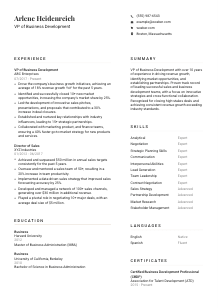
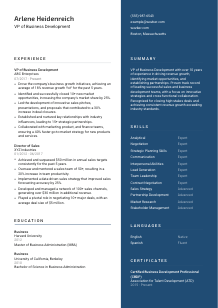
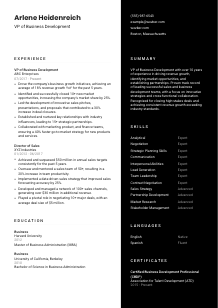
Forging strategic partnerships, but your CV feels like a solo act? Check out this VP of Business Development CV example, created with Wozber free CV builder. Learn how to spotlight your growth acumen and market mastery to align with job requirements, turning your career trajectory into a blockbuster collaboration!
A VP of Business Development is hired to create growth that is both strategic and commercial. That means your CV needs to show more than relationship-building or sales leadership in isolation. It should connect market expansion, partnership strategy, deal execution, and revenue performance in a way that makes your commercial judgment easy to understand.
When that story is tailored well, hiring teams can quickly separate enterprise growth leaders from candidates whose background is limited to account management or pure sales execution. Wozber's free CV builder helps you shape that distinction into an ATS-compliant CV by aligning titles, metrics, and business development language with the role, so your CV clearly shows who has led growth strategy, closed meaningful deals, and built the partnerships that move a company forward.
For a VP of Business Development, the header needs to do one job well. It should identify you as an executive-level growth leader and remove any friction around contact details, title alignment, and practical requirements that can affect shortlisting early.
Place your name at the top in a clean, prominent format. At this level, presentation should feel polished and direct, much like an investor-facing deck or board-ready proposal. Skip decorative styling and make sure the name is easy to scan.
Use a headline that reflects the position you are pursuing, such as "VP of Business Development," especially when your recent title is adjacent, like Director of Sales or Head of Partnerships. This immediately frames your background around growth strategy, deal leadership, and commercial ownership rather than leaving the reader to infer it.
List one reliable phone number and a professional email address built around your name. Senior business development searches move through recruiter outreach, investor introductions, and executive scheduling, so your contact information should look credible and be easy to use.
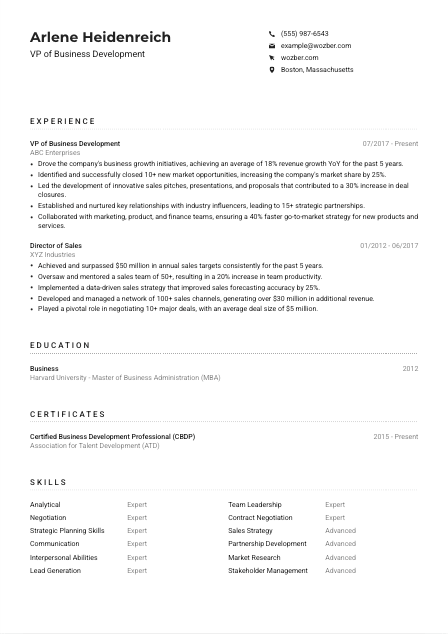
If the employer prefers or requires local candidates, include your city and state. In the provided example, "Boston, Massachusetts" addresses that filter right away. Use that approach when geography matters, but do not treat location as a universal priority for every VP of Business Development role.
Include a LinkedIn URL or professional website if it supports your executive brand. For this role, that profile should reinforce partnership wins, market expansion scope, board-level leadership, or revenue growth results. Make sure the dates, titles, and company history match the CV exactly.
Your personal details should confirm that you are accessible, senior enough for the role, and aligned with practical requirements such as title and location. That clears the way for the hiring team to focus on your growth record.




This section carries the most weight for a VP of Business Development. Hiring teams want to see how you grew revenue, opened markets, shaped deals, and worked across product, marketing, and finance to turn opportunity into commercial results.
Pull out the core demands from the job description before you write or revise bullets. For a business development executive, that usually means revenue targets, new market identification, partnership development, proposal leadership, strategic planning, negotiation, and cross-functional execution. Those themes should guide what you highlight from each role, especially in the most recent 10 to 15 years.
List positions in reverse chronological order and make the progression obvious. A VP of Business Development CV should show increasing ownership of pipeline strategy, market entry decisions, partnership portfolios, team leadership, or multimillion-dollar revenue responsibility. The sample CV does this well by moving from Director of Sales into a VP role with broader strategic scope.
Each bullet should show what you drove, changed, negotiated, or launched. Replace responsibility-only phrases with outcomes tied to revenue growth, market share, channel expansion, proposal win rate, deal size, or partnership impact. "Led business growth initiatives" is weaker than "Drove 18% year-over-year revenue growth across five years" because the second version shows scale and sustained performance.
Quantify results with metrics that reflect executive commercial impact. Strong examples include annual revenue growth, target attainment, market share gains, deal closure rate, size of partnership network, forecast accuracy, average contract value, and speed to market. In the example, gains like 25% market share growth, 30% more deal closures, and $50 million in annual sales targets tell a hiring team what level you operate at.
Prioritise roles and bullets that strengthen your case as a senior growth leader. Earlier jobs can stay brief unless they add relevant proof in sales strategy, negotiations, market development, or executive collaboration. For this level, relevance comes from scope, outcomes, and strategic influence, not from listing every responsibility you have held.
Your experience section should make one point unmistakable. You have led growth, converted opportunity into revenue, and operated at the level where partnerships, pricing, proposals, and market strategy affect company direction.
Education matters here as supporting context, not as the lead story. For a VP of Business Development, it should confirm the business foundation behind your strategic thinking and, when applicable, reinforce readiness for executive-level planning and commercial leadership.
Start with the highest and most relevant degree, especially if you hold a bachelor's in Business, Marketing, or a related field and an MBA or other master's degree. That aligns cleanly with many VP of Business Development postings, including this one, where a master's is preferred rather than mandatory.
List school, degree, field of study, and graduation year in a straightforward order. At executive level, the section should be concise and easy to scan. The sample CV handles this well by presenting the MBA first, followed by the bachelor's degree.
If your degree title or field directly supports the role, keep that wording visible. Business administration, marketing, economics, finance, and related commercial disciplines all add context for strategic planning, forecasting, and market analysis. Do not bury the field if it strengthens alignment.
Most senior candidates do not need coursework, but there are exceptions. Include concentrations, executive programs, or selected coursework only when they directly support the target role, such as corporate strategy, negotiation, pricing, or market analytics. Otherwise, keep the section lean.
Honors, leadership roles, or major academic projects can stay if they genuinely add value, especially for candidates whose early career path strongly reflects leadership or commercial initiative. For experienced VP candidates, these details should be secondary to revenue and partnership achievements in the experience section.
This section should confirm the academic grounding behind your commercial leadership. Clear degree information is enough unless a specific credential or specialization strengthens your case for the target role.
Certifications are rarely the deciding factor for an executive business development hire, but the right one can strengthen your profile. They work best when they add relevance in areas such as partnership development, negotiation, market strategy, or professional credibility within the industry.
Check whether the employer calls out a preferred credential. In this case, a certification such as Certified Business Development Professional, or CBDP, is listed as a plus. If you have it, include it clearly because it gives the hiring team an easy match on a stated preference.
Only include certifications that support business development leadership, strategic selling, partnerships, commercial operations, or industry expertise. A short, relevant list reads better than a long one filled with unrelated programs that do not strengthen your case for enterprise growth leadership.
Include the issuing organisation and the date earned, and note if the credential remains active. That adds context and shows whether the certification reflects current professional development. The example CV does this by listing the CBDP with issuer and active date range.
If you have recent executive education, negotiation training, or certification in market analysis, channel strategy, or partnership management, include it when it sharpens your positioning. This is especially useful if you are pivoting industries or want to underscore a current strategic focus.
Relevant certifications can strengthen your positioning, especially when a posting names them directly. Keep the section selective and connected to how you build revenue, partnerships, and market opportunity.
The skills section should read like a compact view of how you operate as a business development executive. Focus on capabilities that support growth strategy, commercial decision-making, negotiation, and cross-functional influence, not a generic mix of soft skills and sales terms.
Review the posting and extract the capabilities that shape performance in the role. Here, that includes analytical strength, negotiation, strategic planning, communication, relationship building, and collaboration across marketing, product, and finance. Those are better anchors than broad claims about leadership alone.
List the skills most central to VP-level business development near the top. Prioritise areas such as revenue strategy, partnership development, market expansion, contract negotiation, sales leadership, forecasting, stakeholder management, and executive communication, using the employer's wording where it reflects your actual strengths.
Avoid turning this section into a keyword dump. A shorter list of well-chosen skills is stronger, especially when those skills are already supported by achievements in your experience section. The example CV works because it stays close to the role, pairing items like negotiation, strategic planning, lead generation, and partnership development with results elsewhere on the page.
Choose skills that match how VP of Business Development performance is judged in practice: finding growth opportunities, building strategic relationships, leading deals, and turning plans into revenue.
Language skills can matter in business development when they expand your reach with partners, channels, or clients. Even when English is the only stated requirement, this section can still add value if it reflects real business fluency and supports the markets you work in.
If the job description specifies English proficiency, list English clearly with an honest level such as Native or Fluent. That matters when the role involves executive presentations, negotiations, proposals, and partner communication. In this posting, a solid grasp of English is a formal requirement, so make it visible.
Include additional languages when they are relevant to cross-border partnerships, regional expansion, or multilingual client work. For a VP of Business Development, another language can strengthen your profile if it connects to international dealmaking or relationship management, as Spanish does in the example CV.
Choose plain terms such as Native, Fluent, Intermediate, or Basic. Hiring teams need a realistic sense of whether you can negotiate, present, or build relationships in that language. Avoid vague labels that overstate capability.
If the employer operates across regions or plans to expand into new markets, relevant language skills can support your case. That is especially true in roles involving strategic partners, channel development, or enterprise accounts across multiple geographies.
For business development leaders, language ability can signal more than communication. It can point to cultural fluency, stronger trust-building, and smoother negotiations in new markets. Include it when it adds genuine strategic value to your profile.
This section is strongest when it supports the markets, relationships, and negotiations you are likely to handle. Clear proficiency levels keep it credible.
Your summary should give a fast, credible read on your level. For a VP of Business Development, that means leading with commercial scope, years of experience, and the kind of growth outcomes you are known for, not generic leadership language.
Start with your current or target professional identity and the core commercial focus you bring. Phrases tied to revenue growth, market expansion, strategic partnerships, and business development leadership work well because they position you immediately at the right level.
Mention your years of experience and one or two outcomes that establish scale. This role asks for more than 10 years in business development or sales, so that threshold belongs in the summary if you meet it. The example does this effectively by pairing tenure with revenue growth, partnership building, and high-stakes deal success.
Use language that matches the posting where it accurately reflects your background. If the role emphasizes strategic planning, negotiation, market opportunities, or cross-functional collaboration, those ideas should appear in the summary. This helps both human readers and ATS systems connect your profile to the search criteria.
Aim for a short paragraph with clear executive positioning. Four to six lines is usually enough. Cut filler, broad personality claims, and repeated buzzwords so the summary stays centered on growth leadership, dealmaking, and measurable business impact.
By the time someone finishes these opening lines, they should already understand your level, your growth track record, and the kind of commercial outcomes you have led. That is the standard for a VP of Business Development CV.
A VP of Business Development CV should leave no doubt about three things: the scale of revenue you have influenced, the markets or partnerships you have opened, and the level at which you operate across leadership teams. When each section supports that story, the CV reads like an executive business case rather than a career summary.
Use Wozber's free CV builder to turn that experience into an ATS-friendly CV template with clean structure, strong ATS optimisation, and role-aligned wording. Wozber's ATS CV scanner and AI CV builder can help you match the language of the job description, strengthen weak spots, and present your growth record in a way that is easier to evaluate. The final result should make your readiness for VP-level business development work easy to judge.




