



Use Wozber and land your dream job
Create CV
No registration required
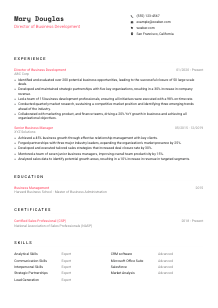
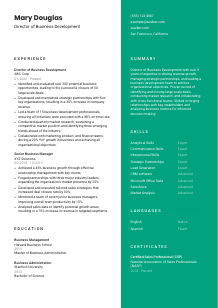
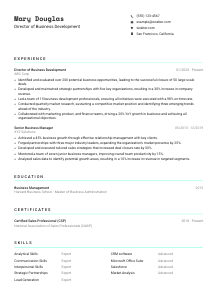
Steering strategic growth, but your CV seems adrift? Chart your course with this Director of Business Development CV example, created with Wozber free CV builder. Learn how to align your business insights with job requirements, positioning your career for prosperous horizons!
Business development leaders are hired to create growth that can be measured. That usually means opening new markets, building partnerships that produce revenue, and moving complex deals from prospecting to signed agreement while keeping internal teams aligned. A Director of Business Development CV should make that commercial scope easy to see quickly through deal size, revenue impact, partnership outcomes, and leadership range.
The first pass on your CV often comes down to whether your growth story is specific enough to survive ATS screening and executive review. Wozber's free CV builder helps you shape an ATS-compliant CV around the language of the role, so terms like strategic partnerships, market research, CRM, and cross-functional leadership connect clearly to the results you delivered and the level of business ownership you can take on.
For a Director of Business Development, the header should establish professional credibility in seconds. Keep it clean, current, and aligned with the practical filters used early in the process, especially title alignment, location, and reliable contact information.
Lead with your full name, then place the target title directly underneath it. If you are applying for a Director of Business Development role, use that wording unless your background clearly fits a close variation the employer uses. Matching the title helps position you correctly from the start and keeps your CV aligned with search filters and recruiter expectations.
Include a phone number you answer regularly and a professional email address built around your name. Executive hiring often moves through recruiter calls, leadership interviews, and follow-up scheduling, so this section needs to be frictionless. If you add a website, make sure it points to something relevant, such as a polished LinkedIn profile or professional portfolio.
Some business development openings are flexible. Others are not. Here, San Francisco, California is a stated requirement, so listing that location immediately removes a common screening obstacle. When a posting names a city or region, reflect it exactly if it applies to you rather than leaving the employer to guess about commute, market presence, or relocation timing.
A LinkedIn profile can help when it reinforces your deal history, partnership network, industry presence, or leadership progression. Keep dates, titles, and employer names consistent with the CV. For business development leaders, recommendations, strategic partnership announcements, or thought leadership can add context, but only if the profile is fully up to date.
Skip personal data that has no bearing on your ability to lead growth, negotiate partnerships, or manage a business development team. Age, marital status, and similar information do not improve your candidacy. Keep the focus on details that support executive-level communication and role eligibility.
Your personal details section should confirm three things immediately: who you are, the level you operate at, and how to reach you. For business development leadership roles, that clarity matters because recruiters are often moving quickly between candidates with similar sales backgrounds. Remove any doubt before they reach the first bullet in your experience section.




This section carries the most weight for a Director of Business Development. Hiring teams want to see how you sourced opportunities, built partnerships, closed revenue-generating deals, and led teams or cross-functional initiatives that moved the business forward.
Read the posting closely and pull out the business outcomes it emphasizes. In this case, the CV should clearly cover opportunity identification, strategic partnerships, large-scale deal closure, team leadership, market research, and collaboration with marketing, product, and finance. Use those themes to choose which achievements stay, which move higher, and which can be cut.
List roles in reverse chronological order with employer, title, and dates clearly shown. That format lets hiring teams quickly track your progression from sales or business management into broader ownership of revenue strategy, partnerships, and team leadership. For director-level candidates, a clear upward path often matters as much as the employers themselves.
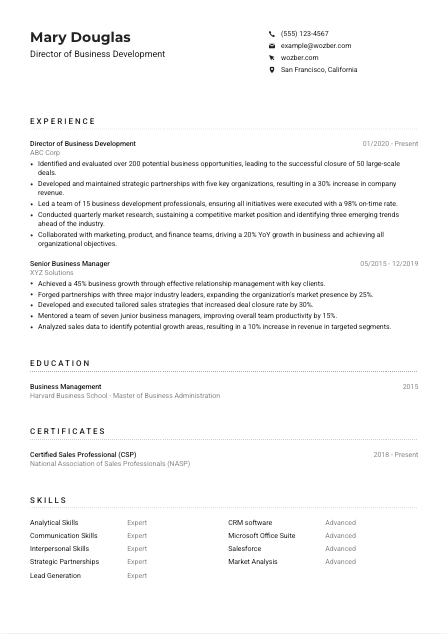
Do not stop at responsibilities. Show what changed because of your work. Strong bullets for this profession include metrics tied to deals won, revenue growth, partner expansion, market entry, sales conversion, or team execution. The example CV does this well by pairing activities with results, such as evaluating more than 200 opportunities and closing 50 large-scale deals, or building five strategic partnerships that contributed to a 30% revenue increase.
Numbers help employers gauge whether your background matches their growth targets. Include revenue growth percentages, deal counts, team size, account value, territory scope, pipeline growth, or on-time execution rates when they are accurate and relevant. Metrics like 20% YoY growth, a team of 15, or a 98% execution rate tell far more than broad claims about leadership or strategy.
A long career in sales or account growth does not need to appear in full detail. Focus on the parts that show director-level judgment: building alliances, guiding complex negotiations, setting go-to-market direction, and coordinating with finance, product, or marketing to land business. If an older role does not support that story, compress it so the most relevant achievements get the space.
A Director of Business Development CV wins attention when the experience section reads like a growth record, not a job description. Every bullet should answer a commercial question: What opportunity did you pursue, what deal or partnership did you create, how large was the impact, and what level of leadership did it require? If those answers are visible, your experience is doing its job.
Education will not outweigh your deal history at this level, but it still matters because many director roles set a degree baseline. Present it clearly, then let it support the commercial and leadership record shown elsewhere on the page.
Start by checking the degree language in the posting. Here, a bachelor's degree in Business, Management, or a related field is required, and a master's degree is preferred. If you meet both, make them easy to find. That removes a basic filter and reinforces that your profile lines up with the level of responsibility attached to the role.
List the institution, degree, field of study, and graduation year. That is usually enough for a senior business development CV. Clean formatting works better than extra commentary here because hiring teams are primarily confirming credentials, not looking for a detailed academic narrative.
When your education connects naturally to the role, let that alignment show. An MBA in Business Management and a bachelor's degree in Business Administration, like the example, fit the posting closely and strengthen the leadership profile. If your degree is in a related field, you do not need to force the match. Just present it clearly and let your experience carry the rest.
Executive education, negotiation coursework, leadership programs, or strategy training can be useful if they connect to partnership development, sales leadership, or market expansion. Add them only when they sharpen your positioning for the role rather than turning this section into a full learning history.
Academic distinctions can stay, especially if they are notable and you are earlier in your leadership career. For more established candidates, they should be brief and secondary to your revenue and partnership achievements. Keep the emphasis on qualifications that still matter in current business decisions.
For director-level business development roles, education is usually a confirmation point rather than the lead argument. State the credentials cleanly, satisfy the degree requirements, and let the rest of the CV show how you have turned that foundation into commercial results.
Certifications are optional in many business development searches, but the right ones can strengthen your profile. They work best when they support how you sell, negotiate, lead, or manage partnerships rather than simply filling space.
Prioritise certificates that support sales execution, negotiation, account growth, leadership, or partnership strategy. A credential like Certified Sales Professional fits naturally because it reinforces a core part of business development work: converting opportunities into revenue.
A short, relevant certificate section is stronger than a long list of unrelated courses. Hiring teams will care more about credentials that complement large-deal leadership, market development, or strategic selling than about general learning badges. Include only the certifications that add useful context to your candidacy.
If a certificate has an active date range, renewal cycle, or current standing, include it. That is especially helpful for sales and professional development credentials that signal ongoing engagement with current methods, frameworks, or industry standards.
Business development changes with market conditions, buyer behaviour, and partnership models. Relevant certifications can show that you keep sharpening how you approach growth strategy, relationship management, and team leadership. They are most persuasive when they support the experience section rather than repeat it.
Certifications should strengthen your story as a business development leader with current, practical expertise. If a credential helps explain your approach to selling, partnerships, or leadership, keep it. If not, use the space for measurable achievements instead.
The skills section should capture the mix of commercial judgment, leadership capability, and operating tools expected in business development leadership. Keep it tightly aligned with the language of the role and the way you actually work.
Use the job description to identify the skills the employer has already signaled as important. Here, that includes analytical, communication, and interpersonal strengths, along with CRM software and Microsoft Office Suite. Bringing those exact terms into your CV helps with ATS optimisation and shows that your background maps to the role's working demands.
A Director of Business Development needs more than relationship skills alone. Include a mix of strengths such as strategic partnerships, market analysis, lead generation, deal negotiation, team leadership, CRM usage, and pipeline management when they reflect your real experience. The example CV handles this well by combining executive capabilities with tools and execution skills such as Salesforce and market analysis.
Do not overload this section with every sales or management skill you have ever used. A concise set of targeted skills gives a clearer picture of how you drive growth. Grouping the right capabilities also helps recruiters quickly distinguish a director-level business builder from a general sales candidate.
Your skills section should read like the operating toolkit of someone who can build revenue, manage partnerships, and lead execution across teams. If the list feels generic, refine it until the commercial and leadership focus of the role is obvious.
Language ability matters in business development when it affects client communication, partnership building, regional coverage, or executive collaboration. Even when the role is domestic, the posting may still require a clear language baseline for negotiations, presentations, and internal leadership communication.
This role calls for strong English fluency, so English should appear clearly with an honest proficiency level. For a business development leader, that requirement usually connects to presenting proposals, handling negotiations, writing executive communication, and working across departments without friction.
If you speak additional languages, include them when they could support partner relationships, international expansion, or multicultural client work. Spanish, for example, can be a useful asset in many growth roles, even when it is not required. Treat added languages as business-relevant capabilities, not decoration.
Terms such as Native, Fluent, Intermediate, and Basic give hiring teams a practical understanding of what you can handle. Be straightforward. Overstating language ability can become a problem quickly in client-facing or cross-border business development work.
If the target role involves global alliances, regional expansion, or international accounts, language skills may carry more weight and deserve stronger placement. If the position is focused on one market, keep the section concise and let it support the broader story rather than lead it.
Language capability can support trust-building, market understanding, and smoother relationship management, especially in partnership-heavy environments. Include it when it helps explain how you can develop business across audiences, regions, or stakeholder groups.
For business development leaders, language skills matter most when they improve communication with clients, partners, or internal stakeholders. Lead with the required language, add others with honest proficiency, and keep the section tied to business value.
Your summary should give a fast, executive-level view of the value you bring. For a Director of Business Development, that usually means combining years of experience with the commercial outcomes you influence most, such as revenue growth, strategic partnerships, market expansion, and team leadership.
Before writing the summary, identify the few themes that define the job. In this case, the central threads are growth, large-scale deals, partnerships, market insight, and team leadership. Those should shape the opening lines more than generic statements about ambition or professionalism.
Begin with a direct line that establishes your seniority and depth, such as more than 8 years in business development, sales, or growth leadership. The example summary does this effectively by pairing years of experience with core strengths in revenue growth, partnerships, and team management. That quickly tells the reader they are looking at a candidate within range for a director seat.
Use the next sentence to highlight the work that best defines your candidacy. Focus on results and scope, such as closing large-scale deals, expanding strategic alliances, leading high-performing teams, or using market research to identify growth opportunities. Keep it broad enough to introduce your profile, but specific enough to sound credible.
Aim for a short paragraph that can be scanned in seconds. Three to five lines is usually enough. Every phrase should earn its place by pointing to revenue impact, partnership leadership, operational range, or decision-making strength. If a sentence could apply to any manager, tighten it until it sounds distinctly business development-focused.
A well-written summary should tell a hiring team, almost immediately, that you understand how growth happens and have led it before. If your summary points clearly to deal leadership, partnership strategy, and revenue results, it is setting the right expectation for the rest of the CV.
A Director of Business Development CV should make commercial leadership easy to judge. When your experience shows market opportunity work, partnership building, deal closure, team leadership, and measurable growth, the document starts doing what the role itself requires: making a persuasive case with numbers and strategy.
Use Wozber's free CV builder to organise that story in an ATS-friendly CV format, then refine the wording with its ATS CV scanner and AI CV builder features so the language of the posting connects naturally to your real achievements. The final result should make one thing clear without extra interpretation: you can lead growth at scale.




