



Use Wozber and land your dream job
Create CV
No registration required
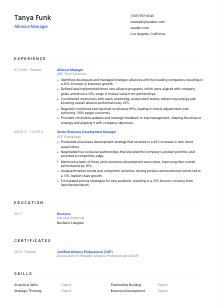
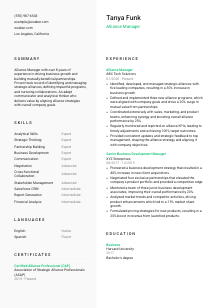
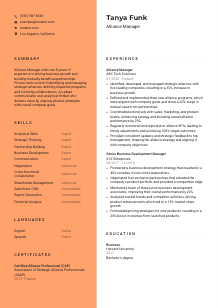
Forging strategic alliances, but your CV feels like a lone ranger? Check out this Alliance Manager CV example, created with Wozber free CV builder. Learn how to match your partnership prowess with job demands, positioning your career as a formidable alliance at the heart of success!
Alliance management sits at the intersection of revenue, product strategy, and partner trust. Hiring teams want to see more than relationship-building language. They look for proof that you can source the right partnerships, align internal teams around joint goals, and keep alliance programs producing measurable business value over time.
When your CV is tailored well, it quickly separates alliance leadership from general business development by showing partner strategy, cross-functional execution, and performance tracking in the employer's language. Wozber's free CV builder helps structure that into an ATS-compliant CV, so terms like strategic alliances, partner programs, and KPI reporting are easy to read by both the system and the people deciding whether you can lead growth through partnerships.
This section should read like a clean business card for someone who works across internal stakeholders and external partners. For an Alliance Manager, that means clear contact details, a role title that matches the target position, and only the information that helps a recruiter move your application forward.
Use your full name in a slightly larger font than the rest of the header so it stands out immediately. Keep the styling simple and professional. Alliance roles often involve senior stakeholder interaction, so your CV should open with the same clarity and polish you would bring to a partner-facing meeting.
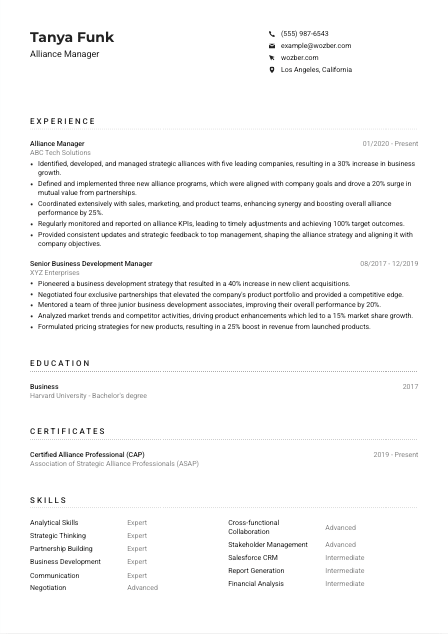
Place "Alliance Manager" under your name if that is the role you are pursuing. This creates immediate alignment with the posting and helps ATS matching. If your current title differs, such as "Senior Business Development Manager," you can still target the CV toward alliance management by making the headline match the job you want while the experience section explains the relevant overlap.
Include a reliable phone number, a professional email address, and, when relevant to the posting, your city and state. In the example, "Los Angeles, California" matters because the employer specifically requires candidates to be based there. When a posting includes a location condition, showing that detail up front removes an avoidable question early in the review.
If your LinkedIn profile supports your candidacy with partnership achievements, industry visibility, or consistent role history, include it. For alliance work, this can reinforce your credibility through partner ecosystem exposure, business development background, or visible recommendations tied to negotiation and cross-functional leadership.
Do not add age, marital status, headshot, or other details that do not help a hiring team assess your partnership and growth experience. Keep the header focused on professional access points only. The cleaner this section is, the faster the reader gets to the substance of your alliance track record.
Your personal details should confirm that you are reachable, relevant, and properly aligned with the target opening. Then the CV can move straight into what matters most for alliance hiring, your ability to build and grow strategic partnerships.




For Alliance Manager roles, the experience section carries most of the decision weight. Hiring teams look for partnership scope, business outcomes, internal coordination, and evidence that you can turn alliances into repeatable growth rather than one-off deals.
Before writing bullets, mark the recurring priorities in the posting. Here, those include identifying strategic alliances, launching alliance programs, coordinating with sales, marketing, and product, and reporting performance to leadership. Your experience should reflect those same working patterns using language that matches your actual background.
List each position with title, company, and dates in a consistent format. In partnership roles, career progression matters. A move from business development into alliance leadership, as shown in the example, tells a useful story about growing ownership from deal sourcing to broader partner strategy and program execution.
Each bullet should show what you drove, improved, negotiated, launched, or expanded. Instead of saying you were responsible for partner management, show the result of that work. The example does this well with bullets about managing alliances with five companies, implementing three new programs, and shaping strategy through regular executive updates.
Numbers help hiring teams understand the scale and effectiveness of your alliance work. Use metrics that fit the role, such as revenue growth, partner-sourced pipeline, program adoption, renewal rate, joint campaign performance, or KPI attainment. In the sample CV, gains like 30% business growth and 25% stronger alliance performance make the impact concrete.
Not every accomplishment belongs here. Keep bullets that show partnership development, negotiation, cross-functional execution, market expansion, or strategic planning. If you come from adjacent work like business development, choose achievements that translate clearly into alliance management, such as exclusive partnerships, pricing strategy input, or market analysis that influenced partner value.
A hiring manager should be able to scan this section and understand the kind of alliances you handled, how you worked across teams, and what commercial outcomes followed. That is the clearest path from interest to interview in alliance hiring.
Education is usually a checkpoint rather than the headline for an experienced Alliance Manager, but it still matters. Recruiters often verify degree alignment quickly, especially when the posting names business, marketing, or a related field as a requirement.
If you hold a Bachelor's degree in Business, Marketing, or a related discipline, state it plainly. The example lists a Bachelor's degree in Business, which aligns directly with the posting. When your degree matches the requirement this closely, make that easy to confirm at a glance.
Include degree, field of study, school, and graduation year or date. That is usually enough for this level of role. Alliance hiring rarely depends on long academic detail unless you are early in your career or the employer places unusual emphasis on industry-specific study.
If your studies included strategy, marketing, channel development, finance, or negotiation, that can strengthen the connection between your academic background and alliance work. You do not need a long course list, but a related field can help explain your foundation in market analysis and business growth.
Honors, relevant coursework, or leadership activities are worth mentioning when they support the role and your experience is still developing. For a candidate with 5+ years in partnerships or business development, these details should stay secondary to commercial results and partner-facing work.
The more established your alliance track record is, the leaner the education section can be. One clear entry is often enough when your experience already shows negotiation strength, strategic thinking, and cross-functional leadership in live business settings.
This section should quickly answer one question: do you meet the stated academic baseline for the role? Once that is clear, the reader can stay focused on your alliance results and strategic execution.
Certifications are not always required for alliance roles, yet the right one can strengthen your profile. They are most useful when they show formal training in alliance practice, partner program structure, or relationship governance that supports your day-to-day experience.
Choose certificates tied to strategic partnerships, channel programs, business development, or partner operations. A credential such as Certified Alliance Professional, shown in the example, is directly relevant because it reflects recognized practice in alliance management rather than general professional development.
Only include certifications that help explain why you can manage partner ecosystems, structure programs, or work effectively across sales, marketing, and product. A short, relevant list is stronger than a long catalogue that distracts from your core alliance experience.
Show the certificate name, the issuing organisation, and the active or earned dates. This gives hiring teams enough context to understand the credential's credibility and whether it reflects current knowledge. In fields shaped by changing partner models and go-to-market motions, recency carries weight.
Alliance management rewards people who keep refining how they negotiate, govern partnerships, and measure mutual value. Updated credentials can support that story, especially if the rest of your CV also shows structured reporting, program design, and partner performance management.
A relevant certificate can strengthen your positioning, especially when it complements a proven record of alliance growth and cross-functional execution. It should reinforce the expertise already visible in your work history.
Alliance Manager skill sections work best when they reflect how partnerships are actually built and maintained. That means a mix of strategy, commercial judgment, communication, and the operational discipline needed to track partner performance and coordinate internal teams.
Start with the skills the employer names directly, then add closely related strengths you genuinely use. In this job description, analytical ability, negotiation, strategic thinking, collaboration, and familiarity with alliance tools or methodologies are central. Mirror that language naturally so the match is clear in both ATS screening and human review.
Prioritise skills that support partnership strategy and execution over broad generic traits. Strong examples include partnership building, stakeholder management, business development, cross-functional collaboration, KPI reporting, financial analysis, and CRM fluency when those tools support partner tracking or pipeline visibility.
Put the most role-relevant skills first so the section reads in the same order a hiring manager would evaluate the job. In the sample CV, strategic thinking, partnership building, negotiation, collaboration, and reporting-related skills all support the core responsibilities of program design, partner coordination, and performance monitoring.
This section should confirm that you have the commercial, collaborative, and analytical range to run alliances effectively. Keep it tight, accurate, and consistent with the achievements in your experience section.
Alliance managers often work across regions, cultures, and executive audiences, so language ability can matter beyond simple fluency labels. Even when the role is domestic, strong written and spoken communication affects negotiations, partner updates, and internal alignment.
If the posting requires fluent English speaking and writing, list English clearly and near the top of the section. This role does exactly that, so the CV should remove any doubt. If English is your native language, say so directly.
Extra languages can strengthen your profile when they are relevant to customer markets, partner regions, or cross-border collaboration. The sample CV includes Spanish, which can be useful in many partnership environments, though the value will depend on the employer's market and alliance footprint.
Terms such as Native, Fluent, Conversational, or Intermediate are usually enough. Be accurate. In alliance management, overclaiming language skills becomes obvious quickly when the job involves negotiations, presentations, or written communication with partners.
Include languages that help explain your ability to work across international alliances, regional expansion efforts, or multicultural stakeholder groups. If the role is heavily domestic and English-only, this section can stay brief without hurting your candidacy.
You do not need to treat language learning as a separate accomplishment unless it directly supports the job you are targeting. For most Alliance Manager CVs, concise and credible language entries are enough to support the broader story of communication and partnership leadership.
Language skills are most useful when they reinforce your ability to manage partner relationships clearly and credibly. Lead with the required proficiency, then add other languages only when they support the role.
The summary sits at the top of the CV, so it should tell a hiring team what kind of alliance leader you are before they read the details. For this role, that usually means years of relevant experience, the kind of partnerships you manage, and the business outcomes you are known for delivering.
Start with a direct line that identifies you as an Alliance Manager or a closely related partnership leader, followed by your years of experience. The example summary does this effectively by leading with more than 8 years in business growth and partnerships, which immediately establishes seniority and role relevance.
Choose two or three strengths that map closely to the posting. For this position, that could include strategic alliance development, program implementation, cross-functional coordination, and performance reporting. Keep the wording specific enough to distinguish alliance management from broader sales or BD backgrounds.
Aim for a short paragraph that captures your value in three to five lines. Use business language, not broad self-description. Terms like growth, mutual value, partner strategy, market expansion, and executive reporting work well when they reflect your real track record.
Adjust the phrasing for each application so the top of the CV reflects the employer's priorities. If the role leans heavily on program design and KPI reporting, bring that forward. If it centers on sourcing new strategic partners, lead there instead. This is one of the fastest ways to improve ATS alignment and the first human read.
A strong summary gives the reader an immediate picture of your alliance scope, your commercial impact, and the level at which you operate. When it is tailored well, the rest of the CV reads as proof of that opening claim.
An effective Alliance Manager CV shows how you build strategic partnerships, work across sales, marketing, and product, and measure whether those alliances are producing real business growth. When each section supports that story with clear outcomes, relevant terminology, and credible scope, the application reads like someone ready to own partner strategy rather than just support it.
Use Wozber to turn that experience into a polished ATS-friendly CV format, refine role-specific wording with its AI CV builder, and check alignment with an ATS CV scanner before you apply. The result should make one thing easy to judge: you can create, grow, and manage alliances that move the business forward.




