



Use Wozber and land your dream job
Create CV
No registration required
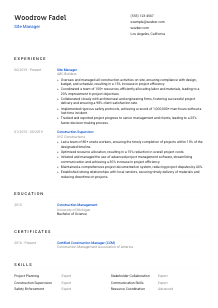
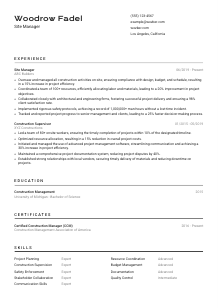
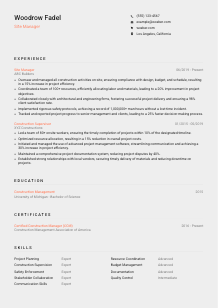
Juggling construction sites, but lost in your CV blueprint? Check out this Site Manager CV example, created with Wozber free CV builder. Learn how to lay out your managerial mastery to match job specifics, ensuring your career foundation stands as sturdy as the projects you oversee!
A Site Manager CV has to show control of the jobsite, not just time spent on one. Hiring teams want to see how you keep construction moving against plan, resolve field issues before they affect schedule or budget, and maintain safety and quality while multiple trades are active. Your CV should make that operating range visible through real project outcomes, team scope, and site leadership decisions.
When that experience is tailored to the posting, the first read becomes much clearer. Wozber's free CV builder helps you line up your wording with the role's priorities and build an ATS-compliant CV that surfaces project planning, resource coordination, schedule control, and stakeholder reporting in the language construction employers already use. That makes it easier to see whether you can run a site from mobilization through closeout.
In construction hiring, small mismatches can create unnecessary friction before anyone reads your project history. Your personal details should confirm that you are reachable, professionally presented, and available for the practical requirements attached to the role.
Use your full name as the main heading, then place "Site Manager" directly underneath. That immediately frames your CV around site leadership rather than a broader construction title such as superintendent, coordinator, or supervisor, unless the target posting uses one of those terms and your background genuinely matches it.
List one phone number you answer regularly and a professional email address. On a fast-moving construction hire, delays happen when a hiring manager cannot quickly schedule a call about availability, project scope, or start date. Check every detail carefully. A typo here can cost you an interview before your field experience is even reviewed.
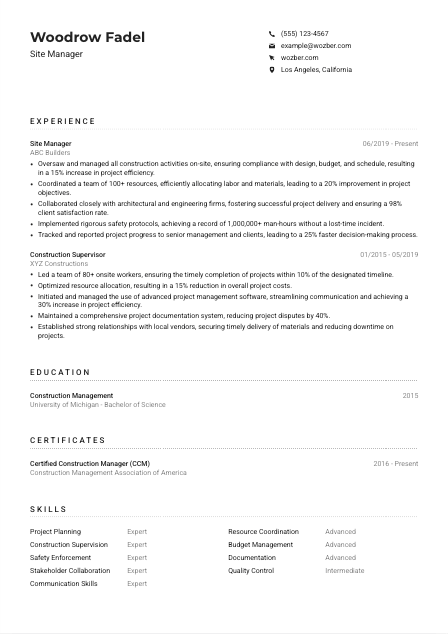
If the employer expects local presence or regional availability, show your city and state clearly. In the example here, "Los Angeles, California" matters because the posting specifically asks for a candidate based there. Treat location this way whenever it affects site access, commute expectations, or local project coverage, but do not overstate it when the job does not require it.
Include LinkedIn or a professional website only if it strengthens your candidacy. For a Site Manager, that could mean a profile that supports your project history, certifications, trade coordination experience, or construction leadership progression. If the link is sparse or outdated, leave it off and keep the focus on your CV content.
This section should be easy to scan in seconds. Avoid full mailing addresses, extra personal details, or decorative labels. Site Manager hiring moves quickly, and this header should help the reader confirm who you are, how to reach you, and whether basic logistics match the role.
Your header does not need personality flourishes. It needs to confirm that you are a credible Site Manager candidate who is easy to contact and properly aligned with the practical basics of the opening.




This is the section that carries the most weight for a Site Manager. Employers look for evidence that you have coordinated labour, materials, subcontractors, safety, documentation, and daily execution under real project pressure, not that you were simply present on a construction site.
Read the posting like a field brief. Mark the responsibilities that define success in the role, such as managing construction activities, keeping work aligned with design and budget, coordinating resources, enforcing safety protocols, and reporting progress to leadership or clients. Those are the experiences your bullets should echo first, using wording that fits your actual work.
List your most recent construction leadership role first, then work backward. For Site Manager hiring, progression matters. A CV that moves from construction supervision into full site management helps the reader quickly understand how your authority, team size, and project responsibility have grown over time.
Each role should show what you were responsible for and what changed because of your decisions. Strong bullets for this profession often cover schedule adherence, labour allocation, material flow, subcontractor coordination, safety performance, documentation control, and client or senior management reporting. The sample CV does this well by pairing duties with outcomes such as improved project efficiency, faster decision-making, and high client satisfaction.
Quantify scope and results where you can. Team size, cost savings, timeline performance, incident reduction, efficiency gains, punch-list improvement, inspection pass rates, or downtime avoided all give hiring teams a more accurate view of your impact. Metrics like managing 100+ site resources or reaching 1,000,000+ man-hours without a lost-time incident feel credible because they reflect how site performance is actually tracked.
Cut details that do not help prove site leadership. The strongest bullets are the ones that connect directly to field execution, resource coordination, stakeholder communication, quality control, safety enforcement, and schedule performance. If you have experience with project software, vendor coordination, or document control, include it when it supports those outcomes rather than as a separate list of tasks.
A Site Manager CV earns attention when the experience section reads like a record of controlled delivery. Prioritise work that shows how you kept projects moving, teams aligned, and jobsite standards intact.
Education matters here because many Site Manager roles use it as an early qualification filter, especially when the work involves construction management theory, civil systems, or formal project controls. Present it clearly so the reviewer can confirm that baseline without hunting for it.
If the posting asks for a bachelor's degree in Construction Management, Civil Engineering, or a related field, show that information plainly. Use the full degree name, field of study, school, and graduation year. In the example, a Bachelor of Science in Construction Management aligns directly with what the employer requested.
Your education section does not need extra narrative unless you are early in your career. For experienced Site Managers, the hiring team mainly needs quick confirmation of degree level and relevance. A clean one-line or two-line entry usually works best.
If you have several qualifications, place the one most connected to construction execution first. Degrees in construction management, civil engineering, building science, or related disciplines usually carry the most weight because they support planning, sequencing, structural understanding, and site coordination.
Specific modules are optional for established professionals, but they can help if they reinforce the target role. Courses in scheduling, estimating, construction law, safety management, structural systems, or project controls can be useful when your degree title alone does not make that relevance obvious.
Honors, leadership activities, or major academic projects belong here only if they add something meaningful to your construction profile. For example, a capstone in project planning or leadership in a construction management association may help a less experienced candidate. For senior applicants, keep the emphasis on professional delivery unless those details are genuinely notable.
For this role, education is usually a checkpoint rather than the main selling point. Present the degree clearly, align it with the posting, and let your site results do the heavier work.
Certifications can sharpen your CV quickly in construction hiring because they point to recognized standards in management, safety, or technical oversight. They are especially useful when the posting names a preferred credential or when you want to show continued professional development beyond your degree.
Start with certifications that the employer explicitly values. In this case, Certified Construction Manager "CCM" is mentioned, so it should appear prominently if you hold it. When a posting references an equivalent credential, choose the one that most directly supports site oversight, project delivery, or construction leadership.
List certificates that speak to the job you want, not every training record you have ever completed. For a Site Manager, that usually means construction management, safety, quality, or compliance credentials that reinforce your ability to lead work on active projects.
Include issue dates, renewal periods, or active status when the certification is current or time-sensitive. The example CV handles this well by showing CCM with an active date range. That kind of detail helps employers understand whether the credential is current enough to matter for the role.
If you are pursuing a new certification that directly supports the target role, it can be worth noting. Keep it specific. A clearly relevant in-progress credential in safety, project management, or construction leadership can show that you are staying current with field expectations and management standards.
The right certification tells a construction employer that your site leadership is backed by recognized standards. Keep the list selective, current, and tied to the work you want to manage.
A Site Manager skills section should read like the operating toolkit behind your project results. Generic lists do very little here. Employers want to see the mix of planning, coordination, safety, communication, and control skills that keep a site productive and compliant.
Build this section from the actual demands of the role. Core skills often include project planning, construction supervision, schedule management, resource coordination, subcontractor management, safety enforcement, documentation, budget awareness, quality control, and stakeholder communication. The example CV is on the right track because it highlights planning, supervision, safety, and collaboration rather than broad corporate language.
Your skills section should support the story told in your experience bullets. Choose abilities that clearly belong to construction site leadership and that can be seen in the way you have delivered projects.
On construction sites, communication affects safety, coordination, and speed. Language skills matter when the role requires clear reporting, daily direction to crews, subcontractor coordination, or communication with clients and consultants across a mixed workforce.
If the posting specifically asks for effective English communication, show English clearly in this section. For a Site Manager, that requirement connects directly to toolbox talks, incident communication, daily reporting, coordination meetings, and client updates, so it should never be buried.
Place English first and use an accurate proficiency level such as Native, Fluent, or Professional. Construction employers need confidence that you can handle verbal instructions, written documentation, and stakeholder communication without friction.
Additional languages can be a practical advantage, especially on diverse jobsites. In the example, Spanish supports communication with a broader workforce. Use extra languages to show operational value, not just personal background.
Choose levels you can defend in real working conditions. If you can lead meetings, explain safety procedures, or resolve field issues in that language, say so with an honest rating. If not, avoid overstating it.
List languages that improve crew coordination, subcontractor communication, reporting, or client interaction. That is the relevance hiring teams care about. Language skill becomes much stronger when it clearly supports safety, productivity, and smoother daily execution.
For Site Managers, language ability is valuable when it makes site instructions clearer and stakeholder communication smoother. Keep the section accurate and tied to real jobsite use.
Your summary should give a construction employer a fast, grounded read on the level of site responsibility you have handled. In a few lines, it should connect your years of experience with the kind of projects, coordination scope, and delivery results that matter for the opening.
Start with the requirements that define the role. Here, that means site management experience, project planning, resource coordination, schedule control, stakeholder collaboration, and safety oversight. Those points should shape the content and wording of your opening lines.
Open with your title and years of relevant experience. For example, "Site Manager with 7+ years in commercial construction" gives immediate context. If your background is split across titles such as Construction Supervisor and Site Manager, summarise that progression in a way that still centers site leadership.
Choose strengths that matter on active projects, such as coordinating labour and materials, keeping work aligned with schedule and budget, managing subcontractor and consultant communication, or enforcing jobsite safety standards. The sample summary works because it stays close to those operational realities rather than drifting into generic management language.
End with one measurable or credible point that supports your value. That could be efficiency gains, strong safety performance, client satisfaction, on-time delivery, or success managing large field teams. Keep it concise. A summary should read like a sharp project overview, not a full career history.
A good summary quickly tells the reader what level of site leadership you bring and what results tend to follow your oversight. Keep it specific enough that the rest of the CV feels consistent from the first sentence onward.
A well-tailored Site Manager CV shows more than construction experience. It shows who can coordinate labour and materials, keep work on schedule, maintain safety standards, and report progress with confidence when the project gets complicated.
Use Wozber's free CV builder to organise that story in an ATS-friendly CV format, then refine the wording with the ATS CV scanner so the final version reflects the posting's language without losing the reality of your field experience. The result should make your site leadership easy to recognize.