



Use Wozber and land your dream job
Create CV
No registration required
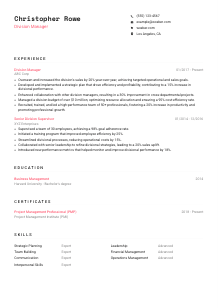
Leading teams and territories, but your CV doesn't command the same attention? Check out this Division Manager CV example, made with Wozber free CV builder. Learn how to align your executive accomplishments with job criteria, ensuring your career ascent stays on track with the growth trajectory!
Division managers are trusted with performance that shows up everywhere at once: day-to-day execution, budget discipline, team output, and the division's contribution to company goals. Hiring teams look for proof that you can run a business unit, not just supervise people. Your CV should make that managerial scope visible quickly, especially through revenue growth, efficiency gains, resource decisions, and the way you lead managers or large teams.
When the CV is tailored well, it becomes much easier to separate broad management experience from true divisional leadership. Wozber's free CV builder helps you shape that story into an ATS-compliant CV by aligning your wording with the job description and keeping the structure clean for both people and applicant tracking systems. That matters here because the first scan usually decides whether your background looks like department oversight or full division-level accountability.
For a Division Manager, the top of the CV should immediately communicate professionalism, seniority, and practical availability. This section is short, but it still carries useful screening information, especially when the employer has a location requirement or wants candidates already operating at division level.
Use your full name in a larger, clean font so the document feels executive-level from the first line. A Division Manager CV usually represents someone handling budgets, strategic plans, and cross-functional leadership, so the presentation should feel polished and direct rather than decorative or overly casual.
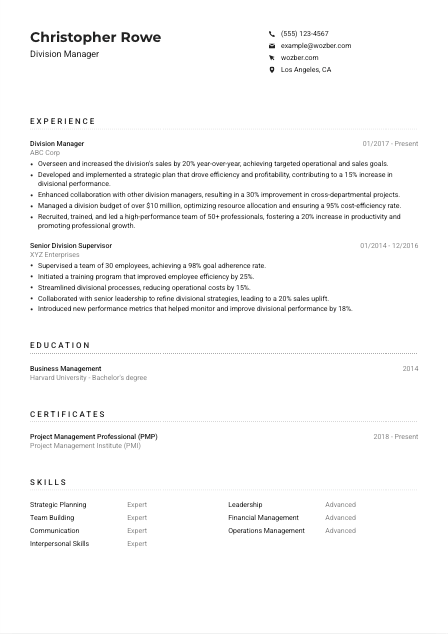
Place "Division Manager" directly under your name when that is the role you are pursuing. This creates immediate alignment with the posting and helps the reader categorize your experience correctly. If your most recent title is close but not exact, such as Senior Division Supervisor in the sample CV, your headline can still reflect the target role while the experience section shows the progression.
List a reliable phone number and a professional email address that looks appropriate for a senior management candidate. Straightforward contact details matter because these roles often involve several interview stages with recruiters, senior leadership, and peers from other divisions, and no one should hesitate over how to reach you.
If the employer specifies a location, show your city and state clearly. In this example, Los Angeles, CA belongs in the header because it answers a direct requirement and removes any uncertainty about relocation. For other Division Manager roles, include location when it helps confirm local availability or regional market familiarity.
A LinkedIn profile or professional website can strengthen your candidacy if it supports the same leadership story as the CV. Keep the content consistent, especially around titles, dates, scope of responsibility, and measurable results such as budget size, sales growth, or team size. If the link adds no value, leave it out.
This section does not need personality flourishes. It needs to confirm who you are, what role you are targeting, and whether you meet practical requirements such as location. For a Division Manager application, that kind of clarity helps the rest of the CV land faster.




This is where Division Manager CVs are won or lost. Hiring teams want to see that you have run operations, improved performance, managed managers or large teams, and made decisions that affected revenue, cost, or profitability. General supervision is not enough. Your bullets need to show ownership, scale, and outcomes.
Pull out the responsibilities that define the operating scope of the role before you write a single bullet. In this description, the priorities are clear: oversee daily operations, execute strategic plans, manage budgets and resources, hit divisional goals, and recruit and coach a high-performance team. Your experience section should answer those points directly with examples from your own division, department, or business unit.
Use reverse-chronological order and make each entry easy to scan with title, company, and dates. For senior management roles, readers often look first at recency and level of authority. If you moved from a supervisor role into full divisional leadership, as the sample CV does, that progression supports your readiness for broader accountability.
Each bullet should show what changed because of your leadership. Metrics matter here because Division Managers are evaluated on performance, not activity. The sample CV does this well with results like 20% year-over-year sales growth, a 15% increase in divisional performance, a $10 million budget, and a team of 50+ professionals. Use numbers that fit your own work, such as revenue, margin, cost reduction, productivity, forecast accuracy, retention, or project delivery improvements.
Choose verbs and phrasing that reflect full operational ownership. Words like "oversaw," "implemented," "optimised," "allocated," "coached," and "drove" carry more weight than vague terms like "helped" or "supported" when you were the decision-maker. If the job emphasizes strategic planning and collaboration with senior leadership, make sure your bullets include examples of setting direction, coordinating across functions, and translating company goals into divisional action.
Not every past responsibility belongs here. Prioritise experience that supports divisional oversight, financial accountability, team development, and goal attainment. Earlier roles can stay brief unless they show a clear step toward larger operational control. A leaner experience section is more persuasive when every bullet reinforces your ability to lead a division.
A Division Manager CV should make it easy to see the size of what you led and the business outcome you delivered. If the reader can quickly identify your operational ownership, financial impact, and leadership range, your experience section is doing its job.
Education usually will not carry the application on its own for a Division Manager role, but it still matters because it confirms the academic foundation behind your business judgment. When a posting asks for a bachelor's degree in Business Management or a related field, make that qualification easy to find and easy to verify.
Start by checking whether the posting names a specific educational requirement. Here, a bachelor's degree in Business Management or a related field is part of the baseline. If you hold that degree, present it clearly so the match is immediate rather than buried under less relevant academic details.
List degree, field of study, school, and graduation year in a simple structure. Senior candidates rarely need a long education section. Clear formatting is enough to confirm the credential and keep the focus on your management track record.
If your degree directly supports the role, let that alignment do the work. The example CV lists a bachelor's degree in Business Management, which connects neatly with responsibilities like strategic planning, financial oversight, and operational leadership. If your field is adjacent, such as finance, operations, or organizational leadership, the relevance can still be strong.
Most experienced Division Managers do not need to list classes, but it can help if your background is less conventional or if a course project speaks directly to budgeting, operations, leadership, or strategic analysis. Keep it selective and practical. One relevant line is enough.
Honors, leadership roles, or business organisation involvement can stay if they add useful context and do not distract from your professional record. For someone with 7+ years of management experience, these details should support the story quietly rather than compete with experience and results.
Your education section should answer the degree requirement with minimal friction. Once that box is checked, the rest of the CV can stay focused on the operational, financial, and leadership results that carry more weight in Division Manager hiring.
Certifications can strengthen a Division Manager CV when they reinforce how you lead projects, improve operations, or manage teams at scale. They are rarely the main reason someone is hired into a divisional leadership seat, but they can add useful credibility, especially when the posting calls them out as a plus.
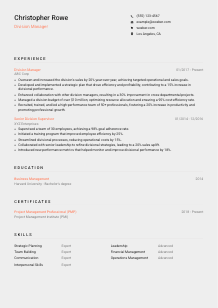
If the employer mentions specific credentials, move those to the top of the section. This job description references Project Management Professional and Certified Manager, so candidates who hold either should list them prominently. That signals formal training in execution, planning, and management discipline.
Keep the section tight. For a Division Manager, the most relevant certifications usually support leadership, project execution, operations, process improvement, or financial stewardship. Skip outdated or unrelated credentials that do not strengthen your case for running a division.
Dates help the employer understand whether a certification is current and actively maintained. The sample CV includes ongoing date ranges for both PMP and CM, which works well because it shows continued professional standing. Use the format that best reflects your credential status.
A certification section also shows that you keep sharpening your management toolkit. That matters in divisional leadership, where planning methods, project governance, and performance management practices keep evolving. Update the section as you complete relevant programs so it reflects your current level, not just past activity.
Relevant certifications should support the same message as your experience section: you can plan, execute, and lead at division scale. If you want to check whether those credentials are surfaced clearly in the document, Wozber's ATS CV scanner can help you align them with the employer's wording.
A Division Manager skills section should look like it belongs to someone running part of the business. The best mix combines strategic thinking, people leadership, and operational control. Generic soft skills on their own will not do much unless the rest of the CV shows how they were applied to budgets, goals, process improvements, and cross-functional work.
Start with the skills the employer actually needs. In this posting, that includes leadership, communication, interpersonal strength, strategic planning, budget oversight, resource allocation, and operational management. Those are not filler keywords. They describe how a Division Manager is expected to perform across people, performance, and profitability.
List the capabilities you can back up in your experience bullets. If you claim financial management, your work history should show budget size, cost control, or profitability improvement. If you list team building, your CV should show hiring, coaching, succession planning, or productivity gains. The sample CV connects these points well by pairing strategic planning and financial management with measurable divisional outcomes.
Do not overcrowd this section. A shorter list of relevant, senior-level skills is more convincing than a long catalogue of generic abilities. For Division Manager roles, skills such as operations management, performance management, forecasting, leadership development, cross-functional collaboration, and strategic execution usually carry more value than broad terms with little managerial context.
This section works best when it echoes the language of the role and matches the proof in your experience. The reader should come away seeing a manager who can lead people, run operations, and move business results.
Language listings are simple, but they can still matter in management hiring. Division Managers spend a large part of the job communicating goals, coaching teams, handling conflict, reporting performance, and working across functions. If a posting names a required language, your CV should answer that requirement directly.
When English fluency is listed as a requirement, include it in plain terms. Do not make the employer infer it from your work history or education. A clear entry such as "English - Native" or "English - Fluent" addresses the requirement immediately.
Additional languages can strengthen your profile when they are relevant to the workforce, customer base, or operating region. In the example CV, Spanish is a useful addition because it can support communication across teams and local business relationships, even though the posting specifically requires English.
Choose ratings that reflect how you actually operate in meetings, presentations, negotiations, and written communication. Terms like "Native," "Fluent," and "Intermediate" are more useful than vague wording. Accuracy matters because senior managers are often expected to present clearly and lead conversations without support.
For some divisions, extra language capability helps with employee engagement, vendor communication, or regional growth. It is not a universal requirement for Division Managers, but when it supports operations or people leadership, it is worth including.
Languages on a management CV suggest more than translation ability. They can point to stronger team rapport, smoother communication across cultural lines, and better leadership in diverse environments. Keep that benefit implicit by listing relevant languages cleanly and credibly.
For this kind of role, language information should first confirm you can operate in the required business language. Any additional fluency should strengthen your leadership profile without overstating its importance.
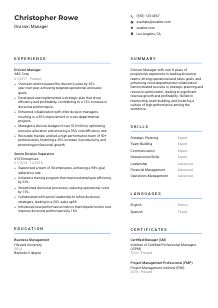
The summary should quickly establish your level, your operating strengths, and the kind of business results you deliver. For Division Manager roles, that usually means years of management experience, leadership scope, and a short line on performance improvement, sales growth, operational efficiency, or team development. Keep it compact, but make every phrase earn its place.
Before writing the summary, identify the few themes that define the opening. Here, the emphasis is on divisional operations, strategic planning, budget and profitability management, and leadership of a high-performance team. Those priorities should shape your opening lines so the summary feels tied to the role rather than copied from a generic management CV.
Your first sentence should establish who you are in business terms. Mention your title or management level, your years of experience, and the kind of environment you have led. The sample CV handles this well by positioning the candidate as a Division Manager with more than 8 years of progressive leadership experience.
The summary becomes more credible when it refers to actual results, not just traits. You might mention revenue growth, stronger profitability, improved efficiency, successful budget control, or team productivity gains. Keep the examples broad enough for a summary, then let the experience section carry the detailed metrics.
Aim for a brief paragraph that reads smoothly and sounds like an operator, not a slogan. Avoid stacked buzzwords. Use terms that belong in divisional leadership, such as strategic planning, operational performance, resource optimisation, cross-functional collaboration, and team development, if they reflect your real background.
A well-written summary helps the reader understand your management scope before they reach the first bullet. For a Division Manager application, that means making your leadership level, performance record, and operational credibility clear within a few lines.
A Division Manager CV should read like the profile of someone trusted with results, resources, and people at scale. When your sections line up around operational control, strategic execution, financial responsibility, and team leadership, the document becomes much easier to evaluate for senior management roles.
Use Wozber's free CV builder to shape that story in an ATS-friendly CV format, then refine it with the ATS CV scanner so the language reflects the posting naturally. The finished CV should make one conclusion easy to reach: you are prepared to lead a division and improve its performance.




