




Use Wozber and land your dream job
Create CV
No registration required
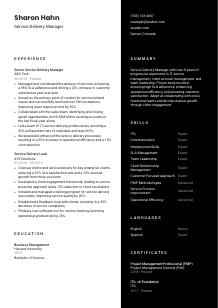
Orchestrating service excellence, but your CV doesn't hit the note? Check out this Service Delivery Manager CV example, created with Wozber free CV builder. Learn how to lead services in line with job standards, turning your professional crescendo into a standing ovation!
Service Delivery Managers are trusted with the part of the client relationship that becomes visible when delivery slips, escalations rise, or service commitments are at risk. Your CV needs to show that you can keep operations steady, protect account health, and improve service quality through disciplined execution, not just that you have worked in support or account-facing roles.
When the CV is tailored well, hiring teams can quickly see whether your background lines up with the service model they run, from SLA ownership to escalation handling and process improvement. Wozber's free CV builder helps you shape that experience into an ATS-compliant CV that uses the right delivery language and makes your operational track record easier to read at a glance.
The top of your CV should identify you quickly and remove any friction around contactability, role focus, or location requirements. For a Service Delivery Manager, that matters because employers often screen early for account-facing credibility, communication readiness, and whether you can step into the required market without delay.
Use your full name as the clearest text on the page so it anchors the document immediately. Keep the styling clean and professional. This role deals with client communication, escalations, and executive updates, so even simple presentation choices should reflect control and clarity.
Place "Service Delivery Manager" directly under your name if that is the role you are pursuing. It helps frame the rest of the CV around service governance, SLA performance, stakeholder management, and team leadership instead of leaving recruiters to infer your direction from past titles alone.
List one phone number and one professional email address that you actively monitor. Service delivery work depends on responsiveness and dependable communication, so avoid casual email handles or cluttered contact sections. If you include a website, make sure it supports your professional profile rather than distracting from it.
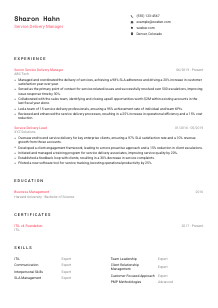
If a posting asks for a specific location or relocation readiness, state it plainly in your contact block. For the example here, being in Denver, Colorado supports an immediate match. Use this only when it is relevant to the role you are targeting, especially for positions tied to local client coverage or hybrid delivery teams.
A current LinkedIn profile can reinforce your account portfolio, certifications, leadership scope, and progression from delivery lead to management roles. Include it only if the dates, titles, and achievements align with the CV. Consistency matters when employers are reviewing client-facing leadership candidates.
This section should answer basic screening questions fast: who you are, what role you are targeting, how to reach you, and whether any location requirement is already covered. Once that is clear, the reader can move straight to your delivery record.




Experience is where Service Delivery Manager candidates separate themselves from general operations, support, or project profiles. Hiring teams look for proof that you have owned service performance, handled escalations, managed customer relationships, led teams, and improved the delivery engine behind those results.
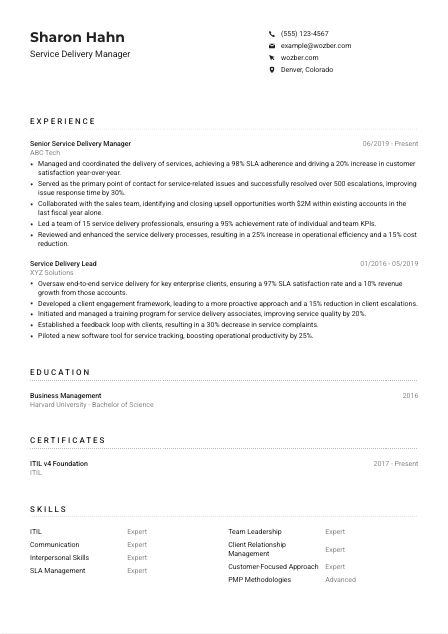
Start by identifying the performance themes in the posting, then choose experience bullets that answer them directly. For this role, that includes SLA adherence, client satisfaction, escalation ownership, cross-functional collaboration, team KPIs, and service improvement. The sample CV does this well with metrics like 98% SLA adherence and a 20% customer satisfaction increase, which immediately map to the employer's priorities.
For every position, list your title, company, and dates first, then follow with concise accomplishment bullets. That structure helps readers track progression into larger accounts, broader delivery scope, or bigger teams. A move from Service Delivery Lead to Senior Service Delivery Manager, for example, signals growing ownership over both operations and client outcomes.
Replace generic statements such as "responsible for service delivery" with actions and results. Strong bullets show what you managed, what changed, and what the business gained. Good examples for this profession include improving response times, reducing escalations, increasing renewal or upsell revenue, raising customer satisfaction scores, or lifting KPI attainment across the team.
Numbers carry real weight in service delivery because the work is measured constantly. Use SLA percentages, CSAT or satisfaction gains, escalation volumes, revenue tied to account growth, team size, cost reduction, process cycle improvements, or productivity gains. In the example, resolving more than 500 escalations and generating $2M in upsell opportunities gives clear scope to both the operational and commercial side of the role.
Prioritise achievements that show account stewardship, service continuity, process discipline, and leadership under pressure. Trim bullets that do not support that narrative. Even if you have broader operations or project work, the CV should keep returning to the outcomes that matter most in service delivery: stable performance, retained clients, improved processes, and teams that hit their targets.
A strong experience section should leave no doubt that you can manage delivery in a live client environment. If the reader can quickly see your SLA results, escalation handling, leadership scope, and improvement work, the core hiring questions are already being answered.
Education will rarely carry the whole application for a Service Delivery Manager, but it does help confirm the business, technical, or operational foundation behind your experience. When a posting asks for a bachelor's degree, make that requirement easy to verify without forcing the reader to search for it.
If the role asks for a bachelor's degree in Business Management, IT, or a related field, list your degree prominently with the field of study. The sample CV does this directly with a Bachelor of Science in Business Management, which aligns neatly with the employer's stated requirement.
Present degree, field, school, and graduation year in a consistent format. Service Delivery Managers are expected to run orderly reporting and dependable processes, so a clean layout supports the professional impression without needing extra explanation.
When your education connects naturally to service operations, business management, IT, or leadership, let that connection show. You do not need to overstate it. A directly relevant degree simply helps reinforce that your delivery decisions rest on more than hands-on experience alone.
Academic honors, projects, or coursework are worth mentioning if they support client management, process improvement, systems thinking, or team leadership. Skip filler. For experienced candidates, this section should stay concise unless a specific credential or project clearly supports the target role.
If you completed later coursework in IT service management, operations, leadership, or project delivery, include it when it strengthens your profile. That is especially helpful if you want to show progression from a general business background into more formal service management capability.
This section does not need to be long. It needs to show that you meet the stated academic requirement and that your background supports the operational and client-facing demands of service delivery leadership.
Certifications carry extra weight in Service Delivery Manager hiring when they connect directly to the operating model of the role. ITIL, project delivery credentials, and current service management training help show that you understand structured delivery, incident flow, continual improvement, and governance expectations.
Start with any credential named in the job description. Here, a valid ITIL certification is specifically required, so it should appear clearly and early. If you also hold PMP, include it when the role involves project coordination, cross-functional planning, or service transition work.
Choose certifications that support service operations, client delivery, process governance, or team leadership. A short list of well-matched credentials is stronger than a long list of unrelated courses. For this profession, relevance matters more than volume.
Add issue dates and, if applicable, active status or renewal timing. That helps the employer understand whether your training is current. In the example, listing ITIL v4 Foundation and PMP with dates reinforces that the candidate has maintained recognized frameworks over time.
Service delivery environments evolve through new tooling, reporting expectations, and customer success models. Continued certification or training shows you stay current with the frameworks that shape incident management, change control, service improvement, and structured execution.
Certifications matter most when they support how you actually run delivery. Put the frameworks that match the role in clear view, and let them reinforce the methods behind your results.
A Service Delivery Manager skill section should read like the operating toolkit behind your results. Employers expect to see a mix of service management frameworks, client-facing strengths, leadership capability, and process improvement skills that match the daily realities of the role.
Pull out the capabilities the employer repeats or implies through responsibilities. For this job, that includes ITIL, PMP methodologies, SLA management, communication, interpersonal skills, team leadership, customer satisfaction, and process improvement. These are better anchors than generic terms such as "hardworking" or "detail-oriented."
List the capabilities you have actually used in live service environments. If you claim SLA management, your experience section should show adherence results. If you list client relationship management or operational efficiency, there should be bullets that tie those skills to retention, satisfaction, or process gains.
Put the highest-value service delivery skills near the top. In the example, ITIL, SLA Management, Team Leadership, Client Relationship Management, and Service Process Improvement create a clear match with the role before secondary capabilities appear. That ordering helps both human reviewers and ATS parsing focus on the right themes first.
Treat this section as a summary of tools and strengths you have already demonstrated through delivery outcomes. The best skill lists make the experience section easier to interpret, not more generic.
Language skills matter in service delivery because the work depends on clear updates, issue handling, stakeholder communication, and client trust. If a posting names a required language, include it in a way that removes ambiguity immediately.
If English proficiency is required, list English first and state your level clearly. For this position, that is a direct requirement, so it should be easy to spot. Use an honest label such as Native or Fluent rather than vague wording.
Lead with the language you will use for client calls, escalations, reporting, and internal coordination. In service delivery, communication quality affects customer satisfaction and issue resolution speed, so this is more than a formality.
Additional languages can support work across regions, multilingual client bases, or cross-border teams. In the example, Spanish adds useful range, but it remains secondary because English is the stated requirement for the role.
Choose straightforward levels such as Native, Fluent, Conversational, or Basic. That gives hiring teams a realistic sense of how you can operate in client meetings, escalation calls, and written updates without overselling your fluency.
If language capability is central to the account mix or delivery region, give it proper visibility. If not, keep the section concise. The main purpose is to confirm that you can communicate effectively in the environment the role requires.
For Service Delivery Managers, language details support a practical hiring question: can this person handle client communication clearly and confidently. State your level plainly and let the rest of the CV show how you have used it.
Your summary should give a fast, credible read on the kind of service leader you are. In a few lines, it should connect your experience level, delivery strengths, client-facing scope, and operating results so the reader immediately understands where you can add value.
Before writing, identify the few themes that define the role most clearly. For a Service Delivery Manager, that is usually service performance, customer satisfaction, account stewardship, team leadership, and process improvement. Those should shape the summary more than broad management language.
Start with your title or close equivalent, then note your years of relevant experience and industry context if it helps. The sample summary does this effectively by positioning the candidate as a Service Delivery Manager with more than 8 years in IT service management, account management, and team leadership.
Use terms that match the role when they genuinely describe your background. If the employer stresses SLA adherence, customer satisfaction, cross-functional collaboration, or operational efficiency, incorporate those themes naturally. This improves both ATS alignment and relevance for the hiring manager reading the first few lines.
Aim for 3 to 5 sentences that cover your scope and strongest results without repeating the whole CV. A summary works best when it gives a quick read on your delivery record, leadership range, and customer impact, then invites the reader into the details below.
A strong summary should make your professional identity clear within seconds. For this role, that means showing that you can lead service delivery, manage clients confidently, and improve performance in measurable ways.
A Service Delivery Manager CV should make one story easy to follow: you keep services on track, manage client relationships well, and improve the systems and teams behind delivery. When each section supports that story, the document feels focused instead of fragmented.
Use Wozber to turn that experience into a polished, ATS-friendly CV format with language that matches the role, stronger section structure, and practical ATS optimisation. The result should make your SLA results, escalation ownership, process improvements, and leadership scope easy to judge before the first interview.