




Use Wozber and land your dream job
Create CV
No registration required
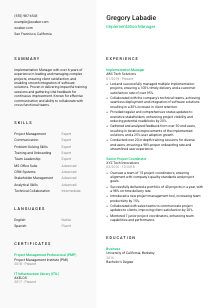
Driving projects forward, but your CV hits roadblocks? Check out this Implementation Manager CV example, created with Wozber free CV builder. Learn how to map out your execution expertise to match job requirements, paving a clear path to career accomplishments!
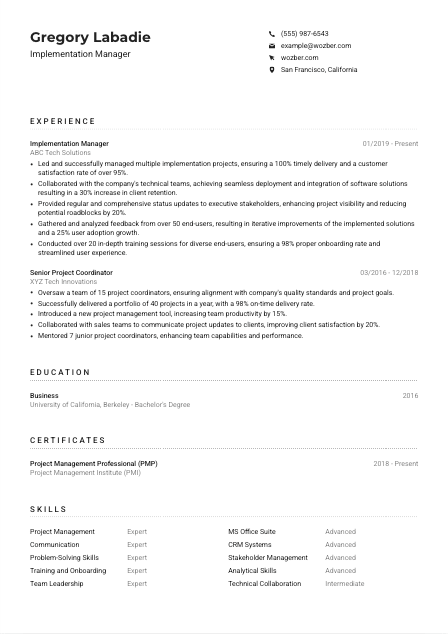
Implementation Managers sit at the point where a signed deal becomes a working rollout. Hiring teams want to see whether you can move a project from kickoff through deployment, manage cross-functional coordination, keep stakeholders informed, and drive user adoption when issues surface. Your CV should make that operating range visible quickly, with concrete scope, delivery results, and customer-facing impact.
The first screening pass often comes down to whether your CV clearly connects project delivery with software implementation work, rather than reading like a generic project management profile. Wozber's free CV builder helps shape that story into an ATS-compliant CV by aligning your wording with the job description and keeping structure clean, so a reviewer can quickly see implementation ownership, client communication, and rollout results.
Implementation work depends on dependable communication and practical logistics. Your header should confirm who you are, how to reach you, and whether you meet any location requirement without adding clutter or personal data that does not help a hiring decision.
Use your full name as the most prominent text on the page. Keep it easy to scan and consistent with your LinkedIn profile, email, and other professional records so there is no confusion when recruiters move between your application, interview notes, and CRM.
Place "Implementation Manager" directly under your name when that matches the role you are pursuing. This is especially useful when your recent title is broader, such as Project Manager or Senior Project Coordinator, because it immediately frames your experience around implementation, deployment, and client onboarding work.
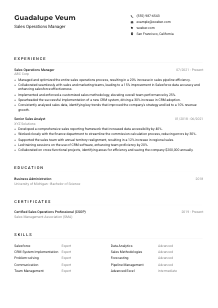
If a posting requires you to be in a specific city or region, include that clearly in your header. In the example, listing "San Francisco, California" addresses a stated requirement right away. For other roles, city and state are usually enough unless the employer asks for more.
Include LinkedIn or a professional website if it strengthens your application. For Implementation Managers, this can reinforce your background in software rollouts, project delivery, certifications, and industry experience. Make sure the dates, titles, and major achievements match your CV exactly.
Your personal details should remove friction. A hiring team should be able to confirm your identity, contact route, and any location requirement in seconds, then move straight to your implementation experience.




This section carries the most weight for an Implementation Manager. Hiring teams look for proof that you have led implementation plans, coordinated technical and client-facing work, handled status reporting, solved rollout issues, and supported adoption after go-live. Keep the focus on delivery outcomes, stakeholder management, and software deployment context.
Read the job description closely and identify the recurring implementation responsibilities behind the wording. Typical priorities include project planning, deployment coordination, integration support, stakeholder updates, end-user training, and post-launch issue management. Build your bullets around those real workflows so your background reads as directly relevant instead of generally managerial.
List positions in reverse chronological order with job title, company name, and dates. For implementation roles, the title matters because employers often distinguish between candidates who supported projects and candidates who owned rollouts. If an earlier title was adjacent to implementation work, your bullets should clarify that scope.
Each bullet should show an action, the implementation context, and a result. Good examples include leading implementation timelines, coordinating with technical teams during deployment, running client status meetings, or delivering onboarding sessions that improved adoption. The sample CV handles this well by showing direct ownership of implementation projects rather than only listing general coordination tasks.
Numbers make implementation performance easier to judge. Prioritise metrics such as on-time delivery rate, customer satisfaction, adoption rate, training completion, client retention, number of end-users supported, or reduction in project roadblocks. The example uses results like 100% timely delivery, over 95% customer satisfaction, and 25% user adoption growth, all of which are native to how this work is evaluated.
Keep older or less relevant roles brief unless they show transferable value such as project delivery, stakeholder communication, systems rollout, or team leadership. For this profession, the strongest experience sections stay close to implementation planning, software deployment, customer onboarding, and cross-functional execution. Everything listed should help explain why you can manage a successful rollout.
Your experience section should show that you can lead an implementation from plan to adoption. When the bullets make delivery pace, client communication, deployment coordination, and measurable outcomes easy to follow, your candidacy becomes much easier to place.
Education will not outweigh implementation results, but it still matters when a role calls for a specific academic background. Keep this section clean and factual, and make sure it reflects the business, technology, or operational grounding the employer asked for.
If the posting asks for a Bachelor's degree in Business, Information Technology, or a related field, list your degree in a way that makes the match obvious. In the example, "Bachelor's Degree in Business" aligns directly with the requirement and needs no extra explanation.
Include degree, field of study, school name, and graduation year or date. This is enough for most Implementation Manager applications and keeps the section readable in an ATS-friendly CV format.
When your degree connects clearly to implementation work, let that connection show through the field name itself. Business, information systems, computer science, and operations-related degrees all help frame your ability to work across clients, technical teams, and delivery processes.
Most mid-level Implementation Managers do not need a course list, but it can help if you are earlier in your career or if your coursework directly supports the role. Examples might include project management, information systems, business process analysis, or enterprise software implementation.
Honors, major academic projects, or relevant student leadership can stay if they reinforce implementation-related skills and you do not yet have deep experience. Once your professional track record is established, keep this section compact and let delivery outcomes lead the CV.
Education should confirm that you meet the baseline academic requirement and have a credible foundation for implementation work. After that, let your project results carry the argument.
Certifications can add useful weight in Implementation Manager hiring, especially when they support structured delivery, service management, or process discipline. They are most effective when they align with the role's environment rather than appearing as a generic list of credentials.
When a role calls out credentials such as PMP or ITIL, move those to the front of this section if you have them. That makes it easy for both recruiters and ATS filters to connect your background with the employer's preferred implementation framework or service environment.
List certifications that reinforce project execution, software delivery, change management, service management, or platform expertise. In the provided example, PMP and ITIL are strong choices because they support implementation planning, process control, and post-deployment operational thinking.
Add earned dates and renewal status where relevant. For certifications that require active maintenance, current dates help show that your methods and knowledge are up to date, which matters in technology implementation roles.
If you work in software delivery, enterprise systems, or client onboarding, ongoing certification can strengthen your profile over time. Focus on credentials that sharpen implementation leadership, workflow design, service transition, or product-specific rollout knowledge rather than collecting unrelated badges.
Relevant certifications support the story your experience already tells. They work best when they reinforce structured delivery, stakeholder confidence, and the ability to manage implementation work in real operating environments.
An Implementation Manager skills section should read like the toolkit behind a successful rollout. The mix usually spans project execution, stakeholder communication, software deployment collaboration, training, and the systems used to track work and client activity. Keep it focused on what you genuinely use.
Start with the exact capabilities the employer named, then add closely related skills you can support with experience. For this role, that includes project management software, MS Office Suite, CRM systems, communication, problem-solving, and cross-functional collaboration. This helps with ATS optimisation while keeping the content grounded in real work.
Lead with skills that sit at the centre of implementation work, such as project management, stakeholder management, training and onboarding, technical collaboration, and issue resolution. The sample CV does this well by pairing broad delivery skills with tools and client-facing capabilities instead of relying only on soft-skill language.
Avoid turning this section into a dump of every system and trait you have ever used. A shorter list with real relevance is stronger. Balance delivery skills, collaboration skills, and platform or tool familiarity so the section reflects how implementations are actually managed day to day.
Your skills list should make it easy to picture you running an implementation plan, coordinating teams, managing stakeholders, and supporting adoption. Relevance matters more than volume.
Implementation Managers often work across customer teams, internal specialists, trainers, and executives. If language ability affects communication, onboarding, or regional support, list it clearly and use realistic proficiency levels.
Some roles specify one required language because it affects client communication, training delivery, or documentation. Here, English proficiency is explicitly required, so it should appear clearly on the CV.
List English first when it is required for the role and note your level accurately, such as Native or Fluent. This quickly addresses a screening point without forcing the reviewer to hunt for it.
Additional languages can be useful when implementations involve multilingual users, international clients, or regional support teams. In the example, Spanish adds practical value, especially for training or customer communication in diverse environments.
Choose standard levels such as Native, Fluent, Intermediate, or Basic. Clear labels are more useful than vague descriptions because they help employers judge whether you can handle meetings, documentation, or end-user training in that language.
If multilingual ability is central to the role, give this section more attention. If it is secondary, keep it concise. For most Implementation Manager roles, language skills support the application best when they strengthen communication range rather than distract from delivery experience.
Language skills should help an employer understand how well you can communicate with users, clients, and cross-functional teams during rollout and onboarding. Keep the section accurate and practical.
Your summary should quickly establish the kind of implementation work you handle, the level of experience you bring, and the business results you tend to deliver. Skip generic adjectives and use the space to frame your track record in software rollouts, stakeholder management, and user adoption.
Read the posting for the priorities that define the opening, then reflect those themes in your first few lines. For an Implementation Manager, that usually means implementation leadership, cross-functional coordination, customer communication, deployment support, and successful onboarding.
Start with your title and years of experience, then add the implementation context you know best. A line such as "Implementation Manager with 6+ years leading software deployments and client onboarding programs" gives a clearer picture than a broad management statement.
Use the summary to surface strengths that the role repeatedly emphasizes, such as stakeholder communication, problem-solving, training, and collaboration with technical teams. The example summary works because it ties implementation management to client satisfaction, integration support, and end-user training rather than listing generic leadership claims.
Aim for a few lines that make someone want to read your experience section next. Focus on implementation outcomes such as timely delivery, adoption, client retention, or customer satisfaction, and leave the detailed metrics for the bullets below.
Your summary should position you as someone who can lead implementation work with control and credibility. When it clearly connects your experience to delivery, deployment, and adoption, the rest of the CV has a strong opening to build on.
An Implementation Manager CV works best when every section supports the same story: you can organise a rollout, work effectively with technical and client-facing teams, keep stakeholders informed, and help users adopt the solution successfully.
Use Wozber's free CV builder to shape that story into a clean ATS-friendly CV, align your language with the job description, and present your experience in a format that makes delivery history and implementation scope easy to judge.
The final version should make one thing clear fast: you know how to get software implementations across the line and into real use.