



Use Wozber and land your dream job
Create CV
No registration required
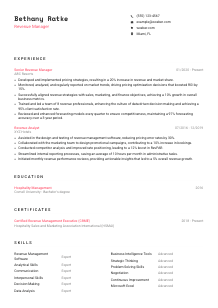
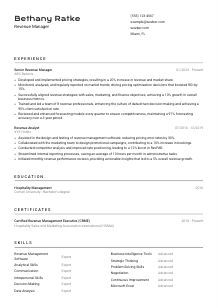
Maximizing profit forecasts, but your CV isn't in the green? Check out this Revenue Manager CV example, created with Wozber free CV builder. It shows how to spotlight your revenue optimisation savvy in step with job demands, ensuring your career portfolio reflects the financial success you orchestrate!
Revenue management sits at the point where pricing decisions, demand patterns, and inventory control directly shape hotel performance. Hiring teams want to see how you turn market data into action, whether that means adjusting transient rates, protecting group business, improving forecast accuracy, or guiding a team toward sharper commercial decisions.
A tailored CV changes how quickly that commercial judgment comes through. When your experience mirrors the language of forecasting, rate strategy, market analysis, and cross-functional planning, it becomes much easier for both recruiters and an ATS to place you in the right tier. Wozber's free CV builder helps you organise that story in an ATS-friendly CV format, so your background reads clearly as revenue leadership rather than general hospitality operations.
For a Revenue Manager, the top of the CV should establish professional alignment fast. This section is simple, but it still carries screening weight, especially when a posting includes a location requirement or expects someone already operating at revenue-management level in hospitality.
Use your full name as the clearest identifier on the page, with formatting that makes it immediately visible. Revenue leadership roles often move through several reviewers, including recruiters, commercial leaders, and hiring managers, so clarity at the top matters.
Place "Revenue Manager" under your name if that is the role you are pursuing. This helps frame your background around pricing strategy, forecasting, and inventory decisions from the first line, and it reinforces ATS alignment with the posting's core title.
List a reliable phone number and a professional email address. Errors here create avoidable friction, especially for roles that require coordination with sales, marketing, finance, and ownership teams where communication is part of the job itself.
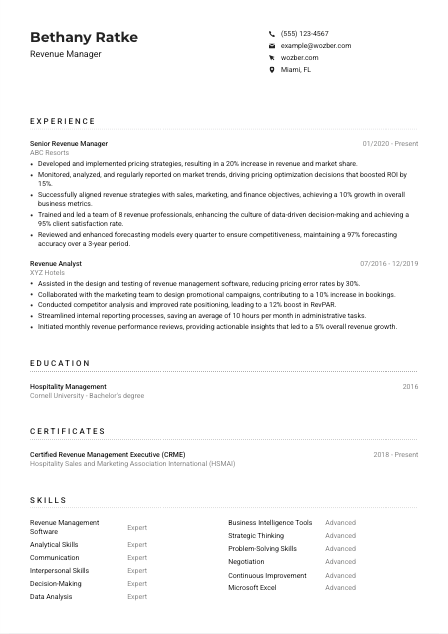
If a job calls for local availability, include your city and state clearly. In the example, "Miami, FL" answers a stated requirement right away and removes guesswork about relocation or market presence. Use this only when location is relevant to the role you are targeting.
Include LinkedIn or a professional website if it supports your candidacy. For revenue professionals, that profile should match your CV's dates, titles, and scope, and ideally reinforce strengths in hotel analytics, pricing systems, reporting, or commercial leadership.
Keep this section direct and job-focused. It should tell the employer who you are, how to reach you, and whether you meet any practical screening requirements before they move into your pricing and forecasting experience.




This is the section where a Revenue Manager CV either becomes credible or stays too general. Hospitality employers are looking for commercial judgment in action: pricing moves, forecast quality, RevPAR gains, market share growth, reporting discipline, and collaboration with sales and marketing that produces measurable results.
Read the job description for the actual levers the role controls. Here, that includes transient, group, and wholesale pricing, market and competitor analysis, inventory control, forecasting updates, and team leadership. Your bullets should map to those responsibilities instead of describing broad hotel support work.
List your most recent role first and make revenue-specific progression easy to follow. Titles such as Revenue Analyst, Senior Revenue Manager, or Cluster Revenue Manager show increasing ownership of pricing strategy, reporting cadence, and commercial influence across the business.
Each bullet should connect an action to a business result. The sample does this well with points like "Developed and implemented pricing strategies, resulting in a 20% increase in revenue and market share" and "maintaining a 97% forecasting accuracy." That combination tells the reader what changed and why it mattered.
Quantify impact with measures that belong in hospitality revenue work. Revenue growth, market share, RevPAR, ROI, forecast accuracy, booking lift, pricing error reduction, and reporting efficiency all carry more weight here than generic claims about success. Choose the numbers that best reflect your level of ownership.
Keep the focus on pricing, demand analysis, systems, reporting, and cross-functional commercial work. If a past responsibility does not help prove your ability to optimise rates, guide strategy, or improve revenue performance, trim it. Every line should strengthen your case for this type of role.
Your experience section should read like a record of revenue decisions that moved the business. When your bullets show pricing strategy, forecast discipline, market analysis, and measurable hotel performance, the leap to Revenue Manager feels credible.
Education will not outweigh a thin track record in revenue management, but it still matters in hospitality hiring. It helps confirm business grounding, industry relevance, and formal preparation in areas tied to pricing, finance, and hotel operations.
If the posting calls for a bachelor's degree in Business, Finance, Hospitality Management, or a related field, present that match clearly. In the example, a Bachelor's degree in Hospitality Management aligns neatly with the role's industry focus.
List degree, field of study, school, and graduation year in a consistent structure. Reviewers should be able to confirm your qualification in seconds without searching through extra wording.
Spell out the degree and concentration rather than relying on abbreviations alone, especially when your education supports the commercial side of hospitality. A clear field such as Hospitality Management or Finance helps place your background in the right context.
Early-career candidates can include coursework, projects, or academic work related to hotel operations, finance, forecasting, analytics, or market analysis. For more experienced candidates, this is usually optional unless it directly supports a specialty area.
Academic distinctions, leadership roles, or industry-related extracurriculars can help if they reflect analytical ability, leadership, or hospitality focus. Once you have several years of revenue experience, keep these details brief so the section stays proportional.
Education should confirm that you meet the baseline requirement and that your academic background makes sense for revenue work in hospitality. Present it cleanly, then let your pricing and forecasting record carry the heavier weight.
Certifications can add useful weight in revenue management because they point to formal training in pricing strategy, forecasting, and commercial discipline. They are most valuable when they connect directly to the role, not when they read like a general list of professional development items.
Start with credentials that speak directly to hotel revenue work. A certification such as Certified Revenue Management Executive is especially relevant because it supports your expertise in the same discipline the role is hiring for.
Do not crowd this section with unrelated courses. If the employer mentions revenue certification as a plus, put your strongest hospitality or commercial credential first and leave out items that do not help explain your pricing, forecasting, or analytical capability.
Listing the year earned, or a validity range if applicable, helps show whether the credential is current. In a field shaped by changing demand models, distribution strategy, and revenue systems, recency can matter.
If you have renewed a certification or completed newer training in business intelligence tools, pricing systems, or commercial strategy, include it when relevant. That tells employers you stay current as revenue practices and platforms evolve.
Use this section to reinforce specialised revenue knowledge, not to decorate the page. The best certifications make your background look more grounded in hotel pricing, forecasting, and commercial decision-making.
Revenue Manager skills should look practical, not generic. Employers expect a mix of analytical tools, pricing knowledge, systems fluency, and communication skills strong enough to influence sales, marketing, finance, and property leadership.
Start with the language the employer uses. Here, that includes revenue management software, business intelligence tools, analytical strength, strategic thinking, problem-solving, negotiation, and communication. Build your list from those priorities rather than from a generic hospitality template.
If you work in platforms such as Duetto, IDeaS, STR, Excel, or reporting tools, name them when they reflect real experience. Pair technical skills with role-specific capabilities such as forecasting, inventory control, market analysis, and pricing strategy so the section reflects actual revenue work.
A shorter skill list with clear relevance is more convincing than a long inventory. The sample balance works well by combining software knowledge with analytical and commercial skills like forecasting, data analysis, negotiation, and strategic thinking. Choose skills that support the responsibilities you already proved in experience.
Your skills should make it obvious that you can handle the systems, analysis, and cross-functional conversations behind revenue performance. Keep the list focused enough that every item supports the role.
Language skills matter in hospitality when they help you communicate across teams, ownership groups, vendors, or guest-driven markets. For Revenue Manager roles, English proficiency is often essential because reporting, presentations, pricing recommendations, and cross-department decisions all depend on precise communication.
If the role requires fluency in English, list English clearly and indicate your level. That immediately answers a stated requirement and supports the communication side of revenue leadership, from weekly reporting to strategy discussions.
Additional languages can be valuable in hospitality, especially in markets with international guests or multilingual teams. In a city such as Miami, Spanish can strengthen your profile, but treat extra languages as supporting advantages unless the posting specifically requires them.
Describe your level with clear terms such as Native, Fluent, Intermediate, or Basic. Revenue roles involve precise communication around rates, forecasts, and performance data, so overstating proficiency can quickly become a problem.
If your experience includes international demand patterns, regional sales coordination, or reporting to global stakeholders, language skills can reinforce that scope. Use them to support the business environment you have worked in, not as filler.
Extra languages are most persuasive when they connect to operations or market context. They can suggest adaptability, stronger collaboration, and better communication across a diverse hospitality setting, which is useful in many revenue teams.
List languages with the same clarity you use elsewhere on the CV. The key point is simple: can you communicate effectively in the environment where pricing, reporting, and commercial decisions happen?
A Revenue Manager summary should quickly place you at the right level of responsibility. It needs to show industry background, core commercial strengths, and one or two outcomes that make a hiring manager expect stronger detail in the experience section.
Read the posting closely before you write the summary. If the role centers on pricing strategy, forecasting, competitor analysis, and team leadership, those themes should shape your opening lines rather than a broad statement about hospitality experience.
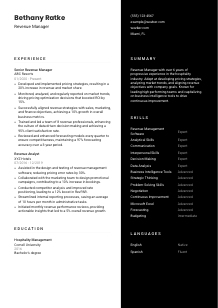
Lead with your title or career level, years of experience, and hospitality focus. The sample summary does this effectively by establishing more than 6 years of progressive experience in the hospitality industry, which gives the reader immediate context.
Mention two or three strengths that reflect the job, then anchor them in outcomes or scope. Pricing strategy, market trend analysis, business intelligence use, and team leadership are all strong choices when they align with the rest of your CV.
Aim for a compact paragraph, usually three to five lines. You want enough detail to establish credibility, but not so much that the summary repeats your bullet points. Save the full evidence for the experience section.
Your summary should make the reader expect a CV full of pricing wins, forecasting discipline, and commercial judgment. When it is tailored well, it sets up the rest of the document to read like a natural match for the Revenue Manager opening.
A Revenue Manager CV works best when every section supports the same story: you understand hotel demand, you make sound pricing decisions, and you can turn analysis into commercial results. That means aligning your title, experience, skills, and summary around the work that actually drives revenue performance.
Use Wozber's free CV builder and ATS CV scanner to tighten that alignment, surface the right keywords, and shape an ATS-compliant CV around the role's priorities. The finished CV should make it easy to judge your readiness for pricing strategy, forecast ownership, and cross-functional revenue leadership.




