



Use Wozber and land your dream job
Create CV
No registration required
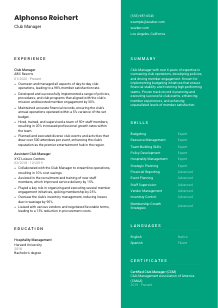
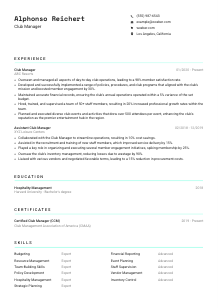
Orchestrating nightlife, but your CV's guestlist stays empty? Check out this Club Manager CV example, created with Wozber free CV builder. Learn how to match your strategic venue leadership with job blueprints, ensuring your career always boasts packed floors and thriving vibes!
Club management is operational work with little room for drift. Hiring teams want to see that you can keep service standards high, staff performance steady, events running smoothly, and budgets under control while members experience the club as polished and consistent. Your CV should make that operating range visible from the start.
A tailored Club Manager CV helps separate broad hospitality experience from direct club leadership. When the language reflects member satisfaction, staffing oversight, financial reporting, and program execution, it reads more clearly in an ATS-compliant CV and gives Wozber's free CV builder more precise material to shape around the posting. That makes it easier to recognize whether you've already managed the kind of day-to-day environment this role depends on.
This section is simple, but it carries practical screening value. For a Club Manager, clear contact details, the right title, and location alignment remove friction early and keep attention on your operations background, service leadership, and financial management experience.
Use your full name in a clean, readable format at the top of the page. It should be the easiest element to find, especially when hiring teams are reviewing multiple hospitality candidates in a short session.
Place "Club Manager" directly under your name when that is the role you are pursuing. This immediately frames the rest of the CV around club operations, member experience, event oversight, and team leadership instead of leaving your background open to broader hospitality interpretation.
List a phone number you answer reliably and a professional email address, ideally based on your name. Club leadership hiring can move quickly when an employer is filling an operations-critical role, so accuracy matters here.
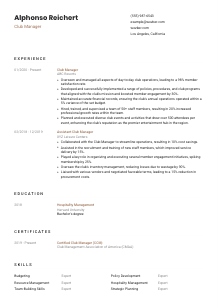
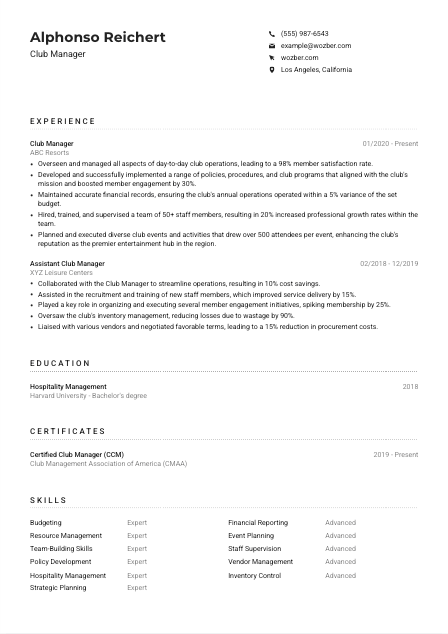
If the employer asks for a specific location or relocation readiness, say so clearly. In this example, listing Los Angeles, California directly supports the requirement and avoids unnecessary questions about local availability for an on-site management role.
Include a LinkedIn profile or personal site only if it reinforces your candidacy with career history, certifications, recommendations, or hospitality leadership achievements. Keep the information consistent with your CV, especially job titles, dates, and credentials.
Your personal details should confirm that you are reachable, role-aligned, and ready for the logistics of the position. Once that is clear, the rest of the CV can stay focused on how you run a club well.




For Club Manager hiring, experience carries the most weight. This is where you show how you handled service operations, staffing, budgeting, member programs, vendor coordination, and event delivery, with enough detail for a hiring manager to understand the scale and consistency of your work.
Start by identifying the operating responsibilities that define the role. Here, the clearest priorities are day-to-day club operations, policy and program development, financial reporting, staff leadership, and member engagement. Those themes should guide which achievements you choose and how you word them.
List your most recent position first, then work backward. For each entry, include the job title, employer, and dates so the reader can quickly trace your progression from supporting leadership roles into full operational ownership, as shown by the move from Assistant Club Manager to Club Manager in the sample CV.
Your bullets should show what changed because of your work. Instead of writing that you were responsible for club operations, show outcomes such as member satisfaction scores, staff development gains, event attendance, cost savings, or improved engagement. The sample does this well with results like a 98% member satisfaction rate and a 30% lift in member engagement.
Numbers make management scope easier to understand. Include figures tied to budgets, attendance, membership growth, staff headcount, procurement savings, inventory loss reduction, or service performance. Metrics such as managing within a 5% budget variance or supervising 50+ staff members tell a hiring team far more than general claims about leadership.
Prioritise experience that supports club leadership over general hospitality tasks. If a bullet does not show operations oversight, member experience, financial control, event execution, or team management, trim it or rewrite it. The goal is a section that consistently reads as "ready to manage the whole club," not "helpful in a hospitality setting."
A Club Manager CV stands out when the experience section shows control of people, programs, budgets, and service outcomes. Make the reader see the scale of the operation you handled and the results you maintained.
Education matters here because the role specifically asks for a bachelor's degree in Business Administration, Hospitality Management, or a related field. Present it clearly so the requirement is easy to confirm, then let your experience carry the heavier operational story.
Read the posting carefully and mirror the level and field when you meet it. For this role, a bachelor's degree in Hospitality Management or a related discipline directly supports your fit, so that information should be easy to spot.
List the degree, field of study, school, and graduation year or completion date in a simple structure. Hiring teams do not need extra formatting here. They need to confirm your academic background quickly and move on to your management history.
If your degree closely matches the requirement, name the field in full. In the example, "Bachelor's degree in Hospitality Management" is worth stating plainly because it maps directly to the employer's request and supports the candidate's club operations background.
Coursework is usually most useful for earlier-career candidates or career changers. If you have limited management experience, classes in hospitality operations, accounting, event management, food and beverage management, or organizational leadership can add context. Senior candidates can usually leave coursework out.
Add academic honors, leadership roles, or major projects only when they strengthen your management story. For example, a capstone in hospitality operations or leadership in a student events organisation may help if it connects to member programming, service delivery, or business administration.
For a Club Manager application, education should be brief, relevant, and easy to verify. If your degree aligns well, let it do that job cleanly and keep the spotlight on your operating results.
Certifications are especially useful in club management because they show industry commitment beyond general hospitality experience. They can reinforce your credibility in operations, governance, member service, and professional standards, particularly when the posting mentions a preferred credential such as CCM.
Review the listing for preferred or required certifications before deciding what to include. In this case, Certified Club Manager (CCM) is named, so it should appear prominently if you hold it. That kind of direct match immediately strengthens your profile.
Choose certifications that support club operations, hospitality management, safety, leadership, or financial oversight. A short list of directly relevant credentials is more persuasive than a long list of unrelated training.
Add the organisation and the date earned, or the active date range when applicable. This gives the credential context and helps show whether it is current. The example handles this well by naming the issuing body for the CCM certification.
Club environments change with service expectations, compliance needs, and management standards. Ongoing professional development tells employers that you stay current on best practices in member experience, staff leadership, and operational oversight.
Certifications will not replace experience, but they can sharpen your management profile and show commitment to the field. Include the credentials that directly support how you lead a club and maintain service standards.
A Club Manager skills section should read like the operating toolkit for the job. Focus on the abilities that support member satisfaction, staff performance, financial discipline, event execution, and the practical running of the facility.
Start with the posting and note both stated and implied skills. Here that includes budgeting, financial reporting, resource management, team building, policy development, event planning, and staff supervision. Those are the capabilities the rest of your CV should reinforce.
Choose skills that map to the work itself rather than listing broad personality traits. A strong set for this profession often combines financial control, hospitality operations, vendor management, inventory oversight, member engagement, and strategic planning. The sample CV does this effectively by balancing budgeting and financial reporting with event planning and team supervision.
Do not crowd this section with every skill you have picked up across hospitality roles. Emphasize the ones you can back up through accomplishments elsewhere on the CV. If you list membership growth strategies, policy development, or vendor management, make sure your experience bullets show where you used them and what they achieved.
The best skills section for a Club Manager sounds practical and specific. It should match the language of the role and connect cleanly to the budgets, teams, programs, and service results in your experience section.
Language ability matters in club management because the role is visible, service-oriented, and often member-facing throughout the day. If the posting requires English, make that easy to find, then add other languages that genuinely support communication with members, staff, vendors, or event guests.
If the job description names a language requirement, list it first with an accurate proficiency level. Here, English is required, so it should appear prominently and clearly.
Use plain labels such as Native, Fluent, Advanced, or Conversational so the employer can quickly understand your working ability. For member-facing management roles, clarity matters more than creative wording.
Other languages can strengthen your profile when they help with member relations, staff communication, or community engagement. In a diverse hospitality market, a language like Spanish may be valuable even when it is not explicitly required.
Only claim the level you can use comfortably in real situations such as resolving service issues, leading staff conversations, handling vendors, or speaking with event attendees. Overstating fluency becomes obvious quickly in an interview or on the job.
Some clubs serve a highly local membership, while others host international guests, private events, or a multilingual workforce. When extra language skills support that environment, they can add practical value to your application rather than acting as a side note.
For Club Manager roles, language skills are most useful when they support service delivery and staff communication. Keep them honest, clear, and tied to the realities of the club environment.
A Club Manager summary should quickly establish your level, your management scope, and the outcomes you are known for. This is where you frame yourself as someone who can run the club smoothly, lead staff well, and maintain a strong member experience.
Review the posting and identify the few themes that define success in the job. For this one, those themes include club operations, financial oversight, staff leadership, and member engagement. Use them to shape the summary instead of writing a broad hospitality profile.
Begin with your title or professional identity and your years of relevant experience. A line such as "Club Manager with 6+ years in club and hospitality operations" gives immediate context and places you in the right hiring lane.
Choose two or three strengths that are backed by your record, such as maintaining budget discipline, raising member satisfaction, building strong teams, or executing high-attendance events. The sample summary works because it connects budgeting, team leadership, and member experience rather than relying on generic management language.
Aim for a concise paragraph of a few lines. It should be detailed enough to sound grounded in real club operations, but short enough that the reader can absorb it before moving to your experience section.
Your summary should tell the reader, in a few lines, what kind of club leader you are and what outcomes tend to follow your management. If it is specific enough, the rest of the CV will feel consistent from the first section onward.
A well-tailored Club Manager CV should make four things clear without forcing the reader to hunt for them: you can run daily operations, manage people effectively, keep finances under control, and create a club experience members want to return to. When those points show up consistently across your summary, experience, skills, and credentials, the application reads with much more authority.
Wozber's free CV builder can help you organise that story in an ATS-friendly CV format, and its ATS CV scanner can help you align your wording with the posting's actual priorities. The final result should make it easy to judge whether you are ready to step into the club, lead the team, and deliver the level of member experience the role demands.