



Use Wozber and land your dream job
Create CV
No registration required
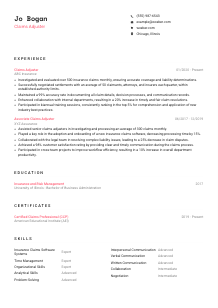
Reviewing damages, but your CV doesn't settle well? Check out this Claims Adjuster CV example, created with Wozber free CV builder. It shows how to detail your appraising expertise to meet the policy of any job, ensuring your career trajectory is as smooth as a fair settlement!
Claims adjusting work is reviewed through decisions. Hiring teams want to see how you investigate loss details, interpret coverage, document claim activity, and move files toward fair resolution without losing control of accuracy or authority limits. Your CV should make that judgment visible through claim volume, dispute complexity, negotiation work, and the quality of your documentation.
A tailored CV quickly separates candidates who have handled active claim files from those with broader insurance support experience. Using Wozber's free CV builder to align your wording with the posting and create an ATS-compliant CV helps surface the right terms, from coverage evaluation to settlement negotiation, so your background reads clearly to both the ATS and the people deciding who can manage claims with confidence.
Claims employers do not need personal trivia. They need clear contact information, a role-aligned title, and any practical detail that removes friction from the hiring process.
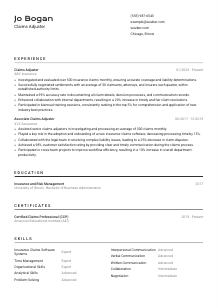
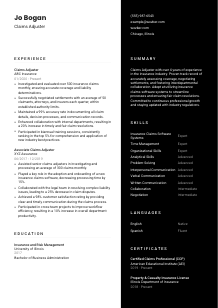
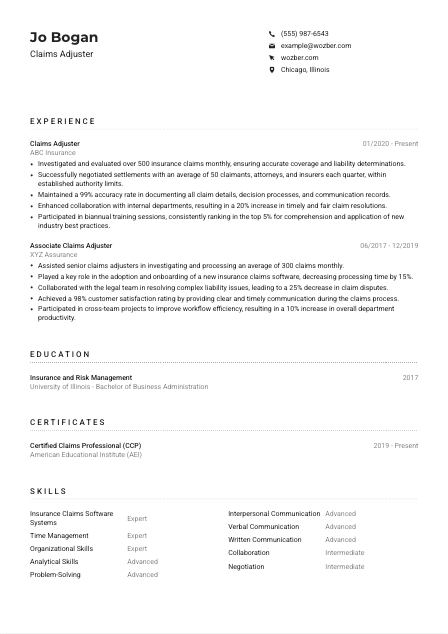
Use your full name as the main heading, then place "Claims Adjuster" directly beneath it if that matches the role you are pursuing. This keeps your CV aligned with the posting from the first line and helps frame your experience around claim investigation, liability review, and settlement work rather than general insurance support.
List a reliable phone number and a professional email address. Accuracy matters here more than style. If a claims manager cannot reach you to discuss file volume, authority level, or licensing status, the rest of the CV does not get a chance to work for you.
If the posting calls for a local candidate, include your city and state. In this example, "Chicago, Illinois" addresses a specific requirement and saves the employer from guessing about relocation or response time. Use location this way only when it supports the application directly.
A LinkedIn profile can help if it matches your CV and reflects insurance experience clearly. Keep dates, titles, licenses, and claim-related responsibilities consistent. Claims hiring often involves careful detail checks, so mismatched information can raise unnecessary questions.
Do not add personal data that has no bearing on claims handling performance. Save the space for details that matter in this field, such as your adjusting title, location when requested, and a clean path for follow-up communication.
This section should remove practical objections immediately. When your contact details, title, and location are clear, the reader can move straight to your claim handling experience.




This is the section that carries the most weight for a Claims Adjuster. Employers want to see how you handled investigations, evaluated coverage, negotiated outcomes, documented decisions, and worked across underwriting, legal, or customer-facing teams to move files forward.
Mark the responsibilities that define the role, then mirror them where they match your actual work. For a Claims Adjuster, that usually means investigation, coverage analysis, liability determination, settlement negotiation, documentation quality, and collaboration with legal or underwriting. These are the phrases that should shape your bullets, not generic statements about being hardworking or detail-oriented.
Start with your most recent position and include job title, employer, and dates. That simple structure helps the reader track progression from support-level claims work to independent adjusting responsibility. If you moved from an associate role into full file ownership, make that growth easy to see.
Claims leaders pay attention to volume, cycle time, settlement activity, documentation accuracy, dispute reduction, and customer communication. The sample CV does this well with points like handling more than 500 claims monthly, documenting with 99% accuracy, and negotiating settlements each quarter. Numbers like these show pace and control, not just activity.
Lead with work that overlaps directly with the posting. If the employer emphasizes liability review and settlement negotiation, those bullets should appear before broader process-improvement points. If you have collaborated with legal on disputed files or with underwriting on coverage issues, include that because it reflects how claims decisions are actually made inside an insurer.
Claims work changes with regulations, policy interpretation, internal procedures, and software updates. Mention training, continuing education, or process adoption when it had a practical outcome. In the example, training performance and software onboarding both strengthen the case that the candidate can adapt while maintaining file quality and resolution speed.
Your experience section should show the scale of claims you handled, the quality of your judgment, and the results you produced. When those elements are specific, the employer can picture you managing their caseload.
Education will not outweigh hands-on file handling, but it still matters, especially when the posting asks for a bachelor's degree or equivalent experience. Present it clearly and connect it to the insurance work you do.
If the job asks for a bachelor's degree in a related field, list that information in a straightforward way. A degree such as Business Administration, Risk Management, Finance, or a similar discipline can reinforce your understanding of policy structure, business risk, and regulated decision-making. In the example, Insurance and Risk Management is an especially relevant fit.
Include degree, field of study, school, and graduation year. Claims hiring is often fast-moving, and this section should answer the requirement without slowing the reader down. Keep the layout clean so attention stays on your adjusting background.
If you are earlier in your career, a few relevant courses can help connect your education to claims work. Topics such as insurance law, risk management, business communication, or property and casualty operations are worth noting when they support limited experience.
Honors, scholarships, or relevant student associations can add value if they point to analytical ability, business discipline, or insurance interest. Keep this brief. Once you have several years of claims experience, education should support the CV, not dominate it.
If you completed newer coursework tied to policy interpretation, compliance, fraud awareness, or claims technology, include it when it adds something your experience section does not already cover. This works especially well for adjusters who are expanding into more complex lines or regulated environments.
Use this section to satisfy the degree requirement and reinforce your insurance foundation. Then let your claim handling results do the heavier lifting.
In claims, credentials matter most when they connect to authority, technical knowledge, or regulatory compliance. A focused certifications section can quickly reinforce that you understand the standards behind fair and defensible claim decisions.
List certifications and licenses that support adjusting work directly. A claims-specific credential or a Property and Casualty license can add weight because it reflects practical industry knowledge, not general professional development. The example's CCP and Illinois license are useful illustrations of the kind of credentials that strengthen this profile.
Do not pad this section with unrelated badges. Prioritise credentials that relate to coverage interpretation, casualty or property claims, investigation standards, negotiation, or state licensing requirements. Each item should help explain why you can manage files responsibly.
Licenses, renewals, and active certifications should show the date earned or active period. That matters in insurance because procedures, regulations, and continuing education requirements change over time. Current credentials reassure the employer that your knowledge is not outdated.
As your career develops, add certifications that match the kinds of claims you want to handle, whether that is property, casualty, litigation-heavy files, or complex commercial losses. Ongoing credentialing shows professional discipline and can support moves into higher-severity or broader-authority roles.
A well-chosen certification section tells the employer that your claim decisions rest on current knowledge, proper licensing, and continued development in the field.
A Claims Adjuster skills section should read like the toolkit behind sound claim decisions. Focus on the technical and interpersonal skills that affect investigation quality, file handling speed, negotiations, and communication with claimants, attorneys, and internal partners.
Start with the capabilities the role depends on every day: insurance claims software, analytical thinking, liability assessment, written documentation, negotiation, and professional communication. Then compare them with the posting and use matching wording where it reflects your real background. This keeps the section aligned with both hiring expectations and ATS optimisation.
If the job description says "insurance claims software systems" or "analytical and problem-solving skills," use those exact phrases if they describe your experience. The sample CV does this effectively. Matching terminology helps your CV surface in ATS review and makes your qualifications easier to recognize immediately.
Resist filling this section with broad business skills that do not distinguish an adjuster. Prioritise the abilities that support file outcomes, such as coverage review, documentation accuracy, settlement negotiation, and collaboration with underwriting or legal. A shorter, sharper list says more than a long inventory of generic strengths.
Every skill listed here should connect to how you investigate, decide, document, or resolve claims. If a skill would not help you run a file, it probably does not belong.
Claims work depends on precise communication. Policy explanations, claimant updates, negotiation exchanges, and file notes all rely on language that is clear, accurate, and professional.
When the posting specifies English proficiency, list it clearly. For this role, strong written and verbal English matters because coverage letters, recorded statements, claim notes, and settlement communication all need to be handled without ambiguity.
If you speak another language well enough to use it professionally, include it. In many claims environments, an additional language can improve claimant conversations, reduce misunderstandings, and support smoother intake or resolution, especially in diverse markets.
Use clear labels such as "Native," "Fluent," or "Conversational" only if they reflect how you actually communicate. In claims, overstating language ability can create real risk when conversations involve liability facts, policy interpretation, or settlement terms.
Some employers will value multilingual ability more than others, depending on claimant demographics and service model. It is an advantage worth listing when it supports better client handling, but it should remain secondary to your core adjusting qualifications.
If you are actively improving a language that is useful in your market, you can include it at an appropriate level. Just keep the emphasis on practical communication, not aspirational claims about fluency.
List languages when they strengthen your ability to communicate clearly with the people involved in a claim. Accuracy matters more than range.
Your summary should quickly establish the kind of claims work you handle, the level of experience you bring, and the outcomes you are trusted to deliver. Keep it grounded in the realities of file investigation, coverage review, documentation, negotiation, and resolution.
Before writing, identify the parts of claims work you know best. That might be high-volume personal lines, complex liability files, negotiation-heavy caseloads, or cross-functional collaboration with underwriting and legal. Your summary should reflect your real operating range, not a generic insurance profile.
Lead with a direct line such as "Claims Adjuster with 4+ years of experience" if that is accurate. This works because it establishes professional identity immediately and aligns with a posting asking for at least 3 years in claims adjusting or a similar role.
Choose achievements or strengths that reflect how you work, such as accurate coverage assessment, successful settlement negotiation, strong documentation discipline, or efficient use of claims software. The sample summary is effective because it combines core adjusting functions with process and collaboration strengths rather than relying on vague traits.
Aim for a short paragraph of three to five lines. That is enough space to show your claims background, your main strengths, and the value you bring to claim resolution without repeating bullets that already appear in the experience section.
A strong summary tells the reader what kind of adjuster you are and what sort of results follow your involvement. Keep it specific enough that the rest of the CV feels consistent from the first paragraph onward.
When each section supports the same hiring story, your CV becomes much easier to trust. The title matches the role, the experience shows investigation and settlement work, the skills reflect actual file handling, and the summary ties those pieces together in language that fits both ATS screening and human review.
Wozber's free CV builder, ATS-friendly CV templates, and ATS CV scanner can help you tighten that alignment by highlighting missing requirements, refining role-specific wording, and improving ATS optimisation across the whole document. The finished CV should make one thing clear fast: you can evaluate claims carefully, document them accurately, and move them toward fair resolution.