



Use Wozber and land your dream job
Create CV
No registration required
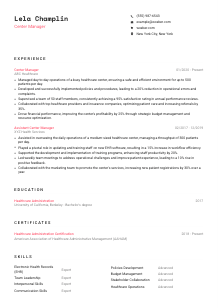
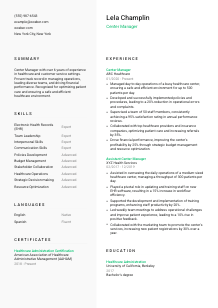
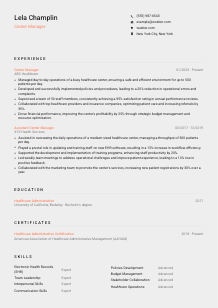
Nurturing centers, but your CV feels off-centre? Check out this Centre Manager CV example, created with Wozber free CV builder. It shows how to position your leadership and organizational acumen to match job requirements, making sure your career compass always points to the heart of success!
Centre managers are trusted with the part of healthcare operations patients and staff feel every day. When scheduling slips, policies are unclear, or frontline teams are unsupported, service quality drops fast. Your CV should make it easy to see that you can keep a centre safe, efficient, compliant, and financially steady while leading people through the pace of daily operations.
A tailored CV changes how quickly that operational range comes through. In healthcare management hiring, vague leadership claims often blur together, while concrete details about patient volume, staff oversight, EHR use, policy execution, and budget results stand out in both ATS screening and human review. Wozber's free CV builder helps you align that language in an ATS-friendly CV format so the hiring team can quickly recognize whether you've already managed the kind of centre they need.
This section does not need much space, but it does need accuracy. For a Centre Manager opening, hiring teams often check role alignment, location, and contact details before they even reach your operations history. Keep it clean, current, and consistent with the job requirements.
Your name should be the clearest element at the top of the CV. Use a professional font and enough visual weight to make it easy to find, especially when the document is scanned quickly alongside other healthcare management applicants.
Place "Centre Manager" beneath your name if that is the role you are pursuing. This immediately frames your background around centre operations, staff supervision, patient service, and financial oversight instead of leaving the reader to infer your direction.
Hiring teams should be able to reach you without hunting for information or second-guessing whether it is current.
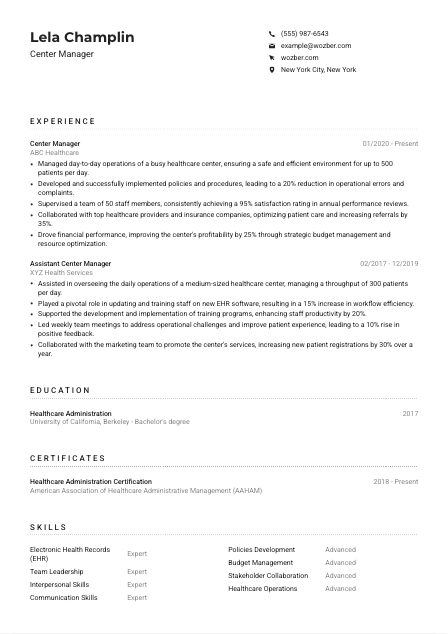
If the employer requires a specific location, include your city and state. In this example, listing New York City, New York directly answers a stated requirement and removes uncertainty about commute or relocation for a role tied to on-site centre leadership.
A LinkedIn profile or professional website can help if it reflects the same titles, dates, and healthcare management scope shown on your CV. If it is outdated or incomplete, leave it off until it matches.
Personal details should confirm the basics fast: who you are, what role you are targeting, and whether you meet any stated location requirement. For a Centre Manager CV, that early clarity helps the reader get to your operations and leadership record without distraction.




This is the section that carries the most weight for a Centre Manager. Employers want to see what kind of centre you ran, how many people or patients you supported, what systems you worked with, and what changed because of your leadership. Keep the focus on operating results, team management, compliance-related process work, and financial performance.
Before writing or revising bullets, identify the work that appears repeatedly in the job description. For this role, that includes day-to-day operations, policy and procedure oversight, staff supervision, stakeholder coordination, EHR proficiency, and budget management. Those themes should shape which accomplishments you choose and how you phrase them.
Start with your most recent position and include company name, title, and employment dates. That format lets the reader follow your growth from support or assistant management roles into full centre leadership, which is especially useful when evaluating whether you meet a 5+ year managerial threshold.
Generic bullets like "responsible for operations" do not say enough in healthcare management. Use action-driven statements that show scope and function. The example CV does this well by stating responsibility for a busy healthcare centre, policy implementation, team supervision, and collaboration with providers and insurers. That language mirrors the posting without sounding copied.
Numbers help hiring teams understand scale and outcome. Patient throughput, staff headcount, satisfaction scores, referral growth, workflow efficiency, complaint reduction, and profitability improvements are all natural measures here. In the sample, managing up to 500 patients per day and improving profitability by 25% quickly conveys both operational scale and business impact.
Prioritise achievements tied to healthcare operations, staff development, patient experience, compliance-minded procedures, software adoption, and financial decisions. If a bullet does not show leadership, service quality, efficiency, or centre performance, it is probably taking space from a stronger example.
Your experience section should leave no doubt about the kind of operation you can run. When the bullets show patient volume, staff oversight, policy execution, stakeholder coordination, and measurable financial or service results, the CV reads like a Centre Manager application rather than a general leadership profile.
Education is usually a straightforward section for experienced Centre Managers, but it still matters because many postings set a degree requirement. Present it clearly and make sure the field of study supports the administrative, business, or healthcare side of the role.
If the job asks for a bachelor's degree in Business, Healthcare Administration, or a related field, list that credential exactly as earned. A directly relevant degree, such as the Healthcare Administration degree in the example, immediately supports your candidacy for healthcare operations leadership.
Include degree, field of study, school, and graduation year. This keeps the section easy to review and easy to parse in ATS systems, which matters when employers are screening for minimum qualifications first.
When your education directly connects to centre operations, patient services, or healthcare administration, do not bury it. Keep the field of study visible so the reviewer can quickly connect your academic background to the role's operational and regulatory demands.
If you are early in your career, selected coursework in healthcare administration, finance, operations, or compliance can help fill out your profile. If you already have several years of centre leadership experience, those details usually matter less than your results on the job.
Leadership positions, healthcare-related projects, or honors can be useful if they strengthen the story of management readiness. Keep these additions selective and relevant rather than turning this section into a full academic record.
For this role, education mainly needs to confirm that you meet the stated baseline and that your training aligns with healthcare or business operations. Present it cleanly so the reader can move quickly to the experience that proves you can run a centre.
Certifications can add useful weight in healthcare management, especially when they show current knowledge of administration standards, compliance expectations, or state-specific requirements. This section is also the right place to address licensure or certification language that appears in the posting.
Choose certifications that support centre oversight, healthcare operations, compliance, or leadership. The example's Healthcare Administration Certification works because it strengthens the candidate's management profile in a clinical service environment.
You do not need a long catalogue. A short list of current, respected certifications says more than several items that do not relate to patient services, administration, or operational leadership.
If a credential is active, renewable, or time-sensitive, show the dates. That helps the employer understand whether your knowledge is current, which is important in regulated healthcare settings.
If the role mentions a state-specific Healthcare Administration certification or licensure, include it here exactly and clearly. If your target job does not require one, still list relevant credentials that strengthen your command of healthcare operations and standards.
A well-chosen certificate section tells the employer that your management background is supported by current professional development. For healthcare centre leadership, that can be especially useful when compliance, regulatory standards, and service quality are part of the job.
A Centre Manager skills section should read like the operating toolkit behind your results. Focus on the systems, management strengths, and business capabilities that keep a centre functioning well, not a generic list of soft skills detached from the work.
Pull skills directly from the posting where they match your background. Here, that includes EHR proficiency, team leadership, communication, budget management, policy development, and stakeholder coordination. Those terms are useful because they reflect how the role is actually performed and how it may be filtered in an ATS.
Lead with capabilities that matter most to centre performance. For a healthcare setting, that often means Electronic Health Records, healthcare operations, staff supervision, patient service coordination, and financial oversight before broader strengths such as strategic thinking.
Keep the list tight enough that every item supports the role. The sample CV works because it focuses on skills tied to running a centre, including EHR, leadership, policy development, resource optimisation, and communication. That gives the section practical substance instead of filler.
When this section reflects the systems, leadership demands, and operating decisions of a real centre, it strengthens the rest of the CV. The reader should be able to connect these skills directly to the results in your experience section.
Language ability can matter more in centre management than candidates sometimes realize. These roles often involve patient-facing communication, staff direction, insurance coordination, and community interaction, so clarity matters. If the posting requires English, state that plainly and then add any other languages that support the population you serve.
If the employer states that clear English communication is required, list English at the top with an honest proficiency level. That immediately addresses a stated job requirement and supports your readiness for staff leadership, policy communication, and stakeholder discussions.
Start with the language required for the role, then list others from strongest to weakest. This makes the section easy to read and avoids overstating your fluency.
In many healthcare centers, extra language capacity can help with patient communication and community outreach. Spanish, for example, may be valuable in some markets, but include additional languages based on your real proficiency and the population you are likely to serve.
Use realistic labels such as Native, Fluent, or Conversational only when they are true. Centre managers are often expected to communicate clearly in high-stakes situations, so inflated language claims can backfire quickly.
If a second language helps with patient intake, staff communication, or local outreach, it is worth listing. If it has no meaningful relevance and your CV is tight on space, keep the focus on stronger healthcare operations content.
For a Centre Manager, language skills matter when they improve communication with patients, staff, providers, or the surrounding community. Present them honestly and in a way that supports the operating reality of the role.
The summary should quickly place you at the right level. For a Centre Manager, that means stating your years of experience and then naming the parts of the job you handle well, such as centre operations, team leadership, patient service, systems use, and financial oversight. Keep it concise, but make it specific enough to distinguish you from general managers and frontline supervisors.
Start with a direct line that identifies you as a Centre Manager or healthcare operations leader and states your experience level. That gives the reader immediate context for the scale and seniority of your background.
Choose two or three strengths that match the posting closely. In this case, operations management, staff leadership, and financial performance are strong anchors. The example summary also adds patient care optimisation and a safe, efficient environment, which works well for healthcare centre roles.
Aim for three to five sentences. Use language that reflects real work rather than broad claims about being dynamic or results-driven. If possible, hint at scope or outcomes, especially if you have managed busy centers, large teams, or measurable service improvements.
Your summary should change when the emphasis of the job changes. One employer may care most about compliance and procedures, another about patient growth and insurer coordination, and another about staff development. Adjust the wording so the first paragraph of your CV points toward the priorities of the specific role.
A focused summary helps the employer place you quickly in the right lane of healthcare leadership. When it names your experience level and the operational areas you manage best, it sets up the rest of the CV to read with much more clarity.
A strong Centre Manager CV shows that you can run daily operations, guide staff performance, work comfortably with EHR and administrative systems, and make sound decisions about service quality and budget. When each section points back to those responsibilities with clear examples and measurable outcomes, the document feels grounded in real healthcare management work.
Use Wozber's free CV builder to shape that content into an ATS-compliant CV, refine the language with role-specific terms, and check alignment with an ATS CV scanner before you apply. The finished CV should make one thing easy to judge: you can step into the centre, take ownership of operations, and keep care delivery running well.




