



Use Wozber and land your dream job
Create CV
No registration required
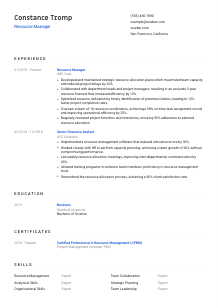
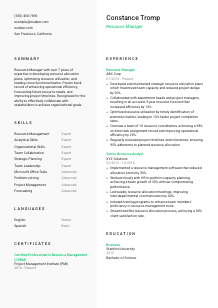
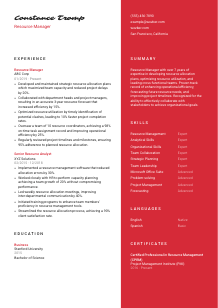
Balancing assets, but your CV seems bankrupt? Flip through this Resource Manager CV example, created with Wozber free CV builder. Learn how to showcase your resourcefulness in line with job details, replenishing your career prospects like a well-managed inventory!
Resource management sits at the point where delivery plans meet real team capacity. Hiring teams want to see whether you can balance project demand, staffing constraints, timeline changes, and competing priorities without letting utilization slip or milestones stall. Your CV needs to make that operating judgment visible quickly.
When the CV mirrors how resource decisions are actually made, reviewers can separate hands-on allocation leaders from candidates whose experience stayed closer to general operations support. Wozber's free CV builder helps you shape an ATS-compliant CV around the language of forecasting, capacity planning, and cross-functional coordination, so the first read already shows how you manage allocation pressure and execution risk.
This section is brief, but it still carries practical screening value. For a Resource Manager opening, the header should confirm who you are, what role you are targeting, and whether basic logistics such as contact details and location line up with the employer's requirements.
Use your full name in the largest text on the page so the CV is easy to identify in a recruiter inbox or ATS record. Keep the styling clean and professional. Resource management work depends on clarity and structure, and your header should reflect that immediately.
Place "Resource Manager" directly under your name if that is the role you are pursuing. Matching the job title helps frame the rest of the CV around allocation planning, forecasting, and team coordination instead of leaving reviewers to guess whether your background is closer to project support, operations, or PMO work.
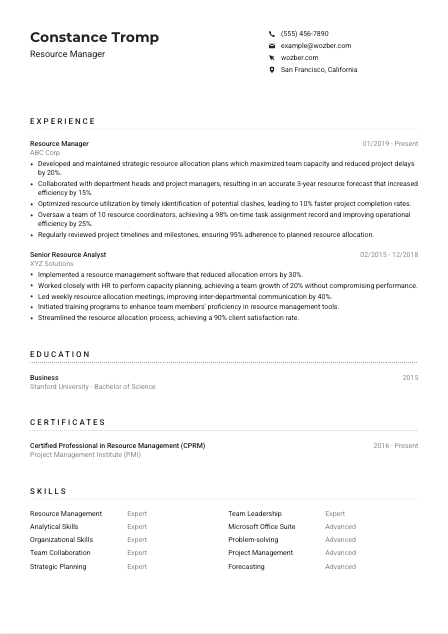
If the opening requires someone in San Francisco, CA, or willing to relocate there, show that clearly in your location line. In this example, listing San Francisco, California removes a basic eligibility question right away. Treat location this way when a posting makes geography part of the decision.
Include a LinkedIn profile or personal professional site if it supports your candidacy with consistent role history, planning tools, certifications, or leadership scope. Make sure the dates, titles, and achievements match your CV so your application reads as organised and reliable.
Your personal details should remove screening friction, not create it. When the top of the CV confirms role focus, contact accuracy, and any stated location requirement, hiring teams can move straight to your allocation and planning experience.




For Resource Manager hiring, experience is where your CV either becomes credible or stays generic. Employers are looking for proof that you have handled capacity planning, resolved resource conflicts, worked across departments, and kept projects staffed in line with timelines and business demand.
Start by marking the responsibilities that shape daily execution. In this case, that includes building resource allocation plans, reviewing timelines and milestones, forecasting future needs with department heads, resolving clashes, and mentoring resource coordinators. Those themes should guide which achievements you choose and how you phrase them.
List your most recent position first, followed by earlier relevant roles. For each job, include title, employer, and dates in a format that is easy to scan. Resource management often involves progression from analyst or coordinator work into ownership of planning and people leadership, so your structure should make that growth obvious.
Use bullet points that show what changed because of your decisions. Strong Resource Manager bullets mention allocation accuracy, utilization improvements, faster delivery, fewer scheduling conflicts, better forecasting, or stronger on-time staffing. The example does this well with results such as reducing project delays by 20% and maintaining a 98% on-time task assignment record.
Quantify performance with numbers that reflect how this function is judged. Useful measures include delay reduction, forecast accuracy, utilization gains, completion speed, staffing coverage, milestone adherence, or coordinator team performance. Metrics like a 15% efficiency increase or 95% adherence to planned allocation give your planning decisions operational weight.
Prioritise experience that shows planning judgment, cross-functional coordination, software use, and leadership over unrelated accomplishments. If a bullet cannot be tied to capacity, scheduling, forecasting, team management, or delivery support, it is probably taking space from stronger evidence of Resource Manager performance.
The best experience sections make resource management concrete. When your bullets show how you allocated people, corrected clashes, improved forecast accuracy, and supported delivery timelines, employers can picture you stepping into the planning rhythm of the role.
Education matters most here as a qualification check and as context for your business and operational grounding. A Resource Manager CV should make it easy to see whether you meet the degree expectation without forcing the reader to hunt for it.
If the posting asks for a Bachelor's degree in Business, Management, or a related field, present that information plainly. A business or management background aligns naturally with forecasting, operations, reporting, and stakeholder coordination. If your degree is adjacent, make sure the relevance is still clear through the rest of your CV.
List degree, school, and graduation year in a consistent order. This section does not need extra design or long descriptions. Hiring teams usually want a quick confirmation that the academic requirement is covered so they can return to your planning and allocation experience.
When your degree directly matches the posting, let that work for you. The example's Bachelor of Science in Business is a clean match for the requirement and reinforces the candidate's fit without extra explanation. Use the same approach when your education checks a stated box precisely.
If you are earlier in your career, relevant coursework in operations management, project management, business analytics, or organizational planning can help connect your education to resource work. If you already have 5+ years of experience, keep education concise and let your delivery record carry more weight.
Additional learning in project delivery, workforce planning, analytics, or leadership can support your candidacy, especially if the role involves mentoring coordinators or partnering with senior stakeholders. Use this section to show progression, not to list every course you have ever taken.
Education should quickly establish that you meet the baseline requirement and have a business or management foundation that fits the work. After that, your experience should take over and show how you apply it in live allocation decisions.
Certifications are rarely the first thing that wins a Resource Manager interview, but they can strengthen your profile when they connect directly to planning discipline, operational oversight, or professional development in resource management.
Even when a posting does not require a credential, relevant certifications can add depth. Resource management, project management, workforce planning, or operational leadership certifications show that your methods are grounded in recognized practices, not just informal experience.
A short, focused certification list reads better than a crowded one. Include credentials that strengthen your case for forecasting, allocation, stakeholder coordination, or team oversight. The CPRM in the example works because it is directly tied to the field rather than being a generic professional badge.
If a certification has a current status, renewal cycle, or validity range, list it. That tells employers your knowledge is current and that you maintain professional standards over time, which matters in roles tied to changing project demand and operational processes.
Resource planning tools, reporting expectations, and cross-functional delivery models evolve. Ongoing certification or training in scheduling tools, analytics, or leadership development can keep your CV relevant, especially when you are moving into broader portfolio or team-management responsibility.
A well-chosen certification section supports your experience with professional discipline and current knowledge. For Resource Manager roles, the best additions are the ones that strengthen your credibility in planning, coordination, and operational control.
A Resource Manager skills section should read like the toolkit behind your decisions. Employers expect a mix of planning capability, software fluency, analytical judgment, and collaboration skills that support day-to-day allocation work across projects and teams.
Start with the capabilities the posting calls out directly. Here, that includes resource management software, Microsoft Office Suite, analytical strength, organisation, problem-solving, communication, and cross-functional collaboration. These are the terms an ATS and a hiring manager are likely to scan for first.
List both technical and people-facing strengths. Resource management depends on tools and reporting, but also on negotiation, prioritization, and coordination with project managers and department heads. A combination like forecasting, strategic planning, Microsoft Office Suite, team collaboration, and leadership creates a fuller picture than listing software alone.
Lead with the skills most central to the role, such as resource management, forecasting, capacity planning, analytical skills, and team leadership. Then place supporting tools and secondary strengths after that. The example gets this mostly right by leading with core planning and coordination capabilities before general supporting skills.
Your skills section should help employers understand how you manage allocation work in practice. When the list reflects planning tools, analytical ability, stakeholder coordination, and leadership, it supports the rest of the CV instead of repeating it.
Language ability matters in Resource Manager roles because the work depends on clear updates, negotiation around availability, and accurate communication with project leads, department heads, and coordinators. If English is specifically required, treat it as a qualification, not a side note.
When a posting states that effective English language skills are required, list English prominently with an honest proficiency level. Resource planning meetings, timeline reviews, and conflict resolution all depend on precise communication, so this is directly relevant to the role.
Order languages by usefulness for the role. English should appear first for this opening, followed by any additional languages that may help in cross-functional or client-facing environments. In the example, Spanish is a secondary asset, while English covers the stated requirement.
Additional languages can support work with distributed teams, multinational stakeholders, or diverse internal groups. They are especially helpful when the Resource Manager role touches global delivery or client communication, but they should remain secondary to the core planning qualifications.
Choose ratings such as Native, Fluent, Intermediate, or Basic based on what you can comfortably use in meetings, written updates, and problem-solving discussions. Overstating language ability creates risk in a role where communication precision affects staffing and delivery decisions.
If the organisation works across regions or functions, language skills can help smooth coordination and reduce misunderstandings around timelines, workload, and resource availability. Include them when they support how you collaborate, not just because they are nice to mention.
For Resource Managers, language skills matter most when they support coordination, reporting, and stakeholder trust. Keep the section honest and role-relevant, with English clearly covering any stated requirement.
The summary is your fastest chance to frame yourself as someone who can manage capacity, forecast demand, and keep delivery staffed. For a Resource Manager, that means leading with scope, results, and coordination strengths instead of broad claims about being organised or hardworking.
Before writing the summary, identify what the role is fundamentally asking you to handle. Here, that is allocation planning, future resource forecasting, timeline review, conflict resolution, and team leadership. Your summary should reflect that operating scope in a few focused lines.
A useful first sentence quickly states who you are and what kind of resource work you handle. The example summary does this effectively by naming more than 7 years of experience and highlighting allocation planning, utilization optimisation, and cross-functional leadership. That gives the reader an immediate sense of level and relevance.
Use the next sentence or two to bring in the most important themes from the posting, such as forecasting future needs, collaborating with stakeholders, improving project timelines, or leading coordinators. Keep the language close to the job description where it matches your real experience so the connection is clear to both humans and ATS screening.
Aim for 3 to 5 sentences or a tight short paragraph. Focus on years of experience, planning scope, measurable strengths, and leadership range. Skip generic personality claims and use the space to show how you contribute to efficient staffing and smoother project delivery.
A strong summary should make a hiring manager expect detailed, relevant experience below. If it clearly establishes your background in allocation planning, forecasting, stakeholder coordination, and team oversight, the rest of the CV has the right frame from the start.
A Resource Manager CV works when it shows how you plan capacity, forecast demand, resolve allocation conflicts, and keep teams aligned with delivery timelines. Every section should support that picture, from the title at the top to the metrics in your experience bullets.
Use Wozber's free CV builder to shape that experience into an ATS-friendly CV template, then refine it with ATS CV scanner insights so the language, structure, and role-specific terminology match the opening. The final version should make it easy to judge your ability to run resource planning with confidence.




