



Use Wozber and land your dream job
Create CV
No registration required
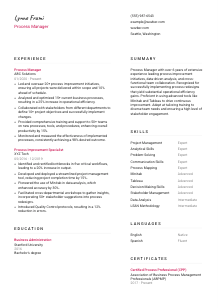
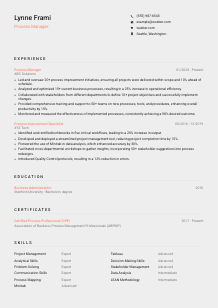
Driving operations, but your CV's in a waiting loop? Check out this Process Manager CV example, created with Wozber free CV builder. Learn how to lay out your process prowess to align with job criteria, accelerating your career beyond any bottlenecks!
Process managers are hired to bring order to messy workflows, remove friction, and keep improvement work moving after the rollout. A CV for this field needs to make that operational impact visible. Hiring teams want to see where you improved throughput, reduced errors, standardised procedures, or helped teams adopt a better way of working.
Screening gets easier when your CV connects process work to business outcomes and uses the same language the employer uses for improvement initiatives, stakeholder collaboration, and measurement. Wozber's free CV builder helps you shape that into an ATS-compliant CV, so your experience reads clearly in both an ATS and a hiring review. The result should make it obvious where you can lead change, measure results, and support teams through implementation.
For a Process Manager, the header should be clean, practical, and easy to scan. This section does not carry your whole case, but it does remove friction. Get the basics right so the hiring team can quickly confirm who you are, what role you want, and whether any location requirement is covered.
Use your full name in a larger, easy-to-read format. Keep it simple and professional so it anchors the page without distraction.
Place "Process Manager" directly under your name if that is the role you are pursuing. This helps frame the rest of the CV immediately and keeps your positioning consistent with the job description.
List a reliable phone number and a professional email address. Double-check both. For a role that depends on cross-functional coordination and steady communication, small errors here can undercut an otherwise well-run application.
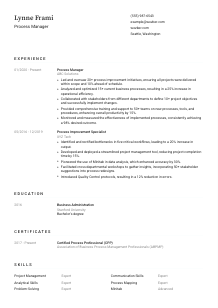
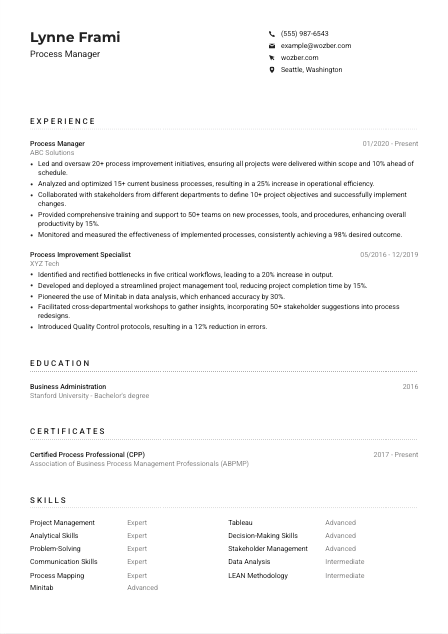
If the employer requires a specific city or relocation readiness, say so clearly. In this example, listing Seattle, Washington supports a stated hiring requirement and removes an avoidable question early in the review.
A current LinkedIn profile or professional website can reinforce your background in process improvement, project delivery, or continuous improvement work. Make sure the job titles, dates, and major achievements match your CV.
This section should confirm the basics without slowing the reader down. A precise title, accurate contact details, and any required location detail help the hiring team move straight to your process management experience.




This is the section that carries the most weight for a Process Manager. Employers look for initiative ownership, workflow analysis, stakeholder coordination, training, and measurable improvement after implementation. Your bullets should show what changed because you led the work, not just what meetings you attended or what tools you touched.
Start by identifying the recurring demands in the posting. Here, the priorities are process improvement initiatives, workflow analysis, stakeholder collaboration, on-time delivery, training, and ongoing measurement. Those themes should guide which projects and bullets you highlight first.
For every job, include your title, employer, and dates in a format that is easy to scan. Clear chronology matters in process-focused roles because hiring teams want to see progression from supporting improvement work to owning cross-functional initiatives.
Lead with what you changed and how you changed it. Strong bullets often start with actions like led, analysed, redesigned, implemented, trained, or monitored. The example CV does this well with a bullet about leading 20+ process improvement initiatives and delivering them within scope and ahead of schedule, which directly reflects the kind of project ownership this role calls for.
Use numbers where they reflect how process work is measured: cycle time, error reduction, output, efficiency gains, schedule performance, training reach, or target attainment. A result like a 25% increase in operational efficiency or a 12% reduction in errors tells far more than saying you improved workflows.
Prioritise work that shows process mapping, analysis, implementation, continuous improvement, and stakeholder management. If a bullet does not help prove your ability to diagnose bottlenecks, roll out changes, or measure effectiveness, it is probably taking space from stronger material.
A hiring team should be able to follow your track record from problem identification to rollout and measurable results. When your experience section shows scope, methods, and business impact clearly, your value as a Process Manager becomes much easier to judge.
Education is usually not the deciding section for an experienced Process Manager, but it still matters. It confirms that you meet baseline requirements and can support your credibility in operations, business analysis, engineering, or related disciplines.
Read the educational requirement carefully and make sure your degree is presented in a way that matches it. For this role, a bachelor's degree in Business, Engineering, or a related field is the baseline, so that information should be easy to find.
List your degree, field of study, school, and graduation year or date. A clean structure is enough here. Over-formatting does not add value, while clarity helps the reviewer confirm qualifications quickly.
If your degree aligns directly with the posting, name it clearly. In the example, "Bachelor's degree in Business Administration" maps well to the employer's request and strengthens alignment without extra explanation.
If you are earlier in your career or your experience is still developing, a few courses in operations management, quality improvement, data analysis, or project management can support your case. Once you have several years of results-driven experience, this detail usually matters less.
Honors, research, or projects can be worth adding if they relate to process analysis, systems improvement, or operational performance. Keep them only if they reinforce your current positioning rather than pulling attention away from your work history.
Your education section does not need a long explanation. It should quickly show that you meet the degree requirement and that your academic background supports the analytical and operational side of process management.
Certifications can add useful depth in process management, especially when they point to structured improvement methods, business process expertise, quality systems, or project leadership. They are not always required, but the right one can reinforce your technical fluency and commitment to continuous improvement.
Start with credentials that support process redesign, continuous improvement, quality management, or project delivery. When a posting does not require a certification, use this section to strengthen your professional profile rather than to fill space.
Only include certifications that are relevant to the role you are targeting. A credential such as Certified Process Professional fits naturally because it supports business process knowledge and process improvement work.
Include the issue date and, if applicable, the current status or expiration date. This helps the employer see that the certification is active and recent enough to carry weight.
Process management evolves with new tools, methods, and reporting expectations. Certifications in Lean, Six Sigma, BPM, quality, or project management can show that you keep building practical capability beyond your degree and job titles.
A focused certification section can strengthen your CV by showing formal training in the methods behind process improvement. Keep it relevant, current, and closely tied to the kind of operational work the role requires.
A Process Manager skills section should read like a working toolkit, not a generic list of strengths. Employers want to see the capabilities that support analysis, implementation, stakeholder coordination, and performance tracking. The best skills lists combine methods, tools, and business-facing capabilities.
Look for hard skills, workflow methods, and collaboration needs in the job description. In this case, that includes process mapping software, data analysis tools such as Minitab or Tableau, analytical thinking, problem-solving, decision-making, and communication across teams.
Move the most relevant skills toward the top, especially the ones named in the posting. If you have direct experience with process mapping, stakeholder management, Minitab, Tableau, or project management, make those easy to spot. The sample CV handles this well by pairing core management skills with named analysis tools and process methods.
Do not try to capture every ability you have developed across your career. Focus on the skills that support process review, redesign, rollout, measurement, and team adoption. A shorter list with strong alignment is more useful than a long list of broad business terms.
A well-prioritised skills section should support the story told in your experience bullets. When the listed tools, methods, and interpersonal strengths line up with the role's workflow demands, your CV feels grounded in real process management work.
Process Managers often work across departments, functions, and sometimes regions, so communication matters. The language section should stay brief, but it can still help if the posting names a required proficiency or if additional languages support the environment you work in.
If the employer calls out a language expectation, reflect that clearly. Here, professional-level English is explicitly required, so English should appear prominently with an accurate proficiency level.
Use straightforward labels such as Native, Fluent, Advanced, or Professional Working Proficiency. The key is clarity. Hiring teams need to know whether you can lead workshops, write documentation, and communicate process changes effectively.
Additional languages can be valuable when teams, vendors, or business units work across markets. They are not a substitute for process experience, but they can strengthen your profile when collaboration spans geographies or multilingual environments.
Do not overstate proficiency. If your role involves training teams, documenting procedures, or facilitating stakeholder sessions, language ability will show up quickly in practice.
Unless multilingual communication is a major part of the target role, this section should stay concise. Include what is true and useful, then keep the emphasis on your operational and improvement achievements.
Language skills should support the communication demands of the role, especially when a posting specifies professional English. Keep the section honest, clear, and secondary to the process work that defines your candidacy.
The summary is your fastest chance to define your process management profile. It should establish your level, your improvement focus, and the kinds of results you deliver. For this role, a strong summary points to initiative leadership, workflow analysis, data-backed decisions, and the ability to bring teams along through change.
Before writing, identify the few themes that matter most in the posting. For a Process Manager, that often means process improvement, project execution, stakeholder collaboration, measurement, and training. Use those ideas to shape the opening lines instead of writing a broad management statement.
State your title and years of experience in a direct way. The example summary does this effectively by leading with more than 6 years of experience in process improvement initiatives and cross-functional collaboration, which immediately establishes level and relevance.
Use one or two concrete details that reflect how you work. Mentioning Minitab, Tableau, continuous improvement, operational efficiency gains, or training rollout can sharpen the summary when those details are true for your background and relevant to the target role.
Aim for a short paragraph that can be read quickly but still carries specific meaning. Four tight lines are usually enough to establish your process focus, scale of experience, and strongest differentiators without repeating the experience section.
When this section is written well, the reader understands your process management profile before they reach the first job entry. Keep it specific, measured, and aligned with the kind of improvement work the role is asking you to lead.
A Process Manager CV works when every section points to the same story: you can analyse workflows, lead change, support adoption, and measure whether the new process actually works. That consistency matters in both human review and ATS optimisation.
Use Wozber's free CV builder, ATS-friendly CV templates, and ATS CV scanner to tighten the language, map your experience to the posting, and present your background in an ATS-friendly CV format. The final version should make it easy to see where you improve operations and how you deliver process changes that hold up in practice.