




Use Wozber and land your dream job
Create CV
No registration required
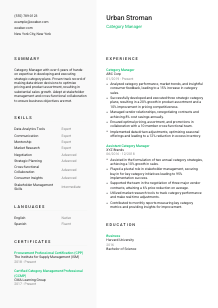
Orchestrating product assortments, but feel your CV is offbeat? Step into this Category Manager CV example, created with Wozber free CV builder. Learn how to match your market mastery to any job's category criteria, striking a professional profile that's always in demand!
Category management is judged in the numbers long before it is judged in the interview. Hiring teams look for people who can turn assortment decisions, supplier negotiations, pricing moves, and market insight into measurable category growth, margin improvement, or inventory control. Your CV should make that commercial ownership visible fast.
A tailored Category Manager CV also helps separate broad purchasing experience from true category leadership. When your language reflects category plans, consumer insight, supplier strategy, and KPI reporting, an ATS-compliant CV reads much closer to the actual work. Wozber's free CV builder helps you line up that wording cleanly for ATS optimisation, so the hiring team can quickly see whether you can run a category, not just support one.
This section is simple, but it still does real work. For a Category Manager, it should immediately show the target title, reliable contact information, and any location detail that affects eligibility for the opening.
Use your full name in the largest, clearest text on the page. Keep it easy to scan and free of extra labels or credentials unless they are standard for your field. Category management hiring often moves quickly from the header to experience, so the top of the CV should feel clean and professional.
Place "Category Manager" directly under your name if that is the role you are pursuing. This creates immediate alignment with the posting and helps frame the rest of your CV around category strategy, supplier management, pricing, and performance analysis rather than broader retail or procurement work.
Include a phone number you answer and a professional email address. Skip unnecessary personal data. If you add a website or LinkedIn profile, make sure it supports the same story as the CV, such as category wins, commercial scope, or supplier-facing responsibilities.
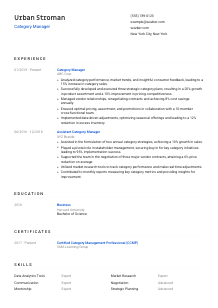
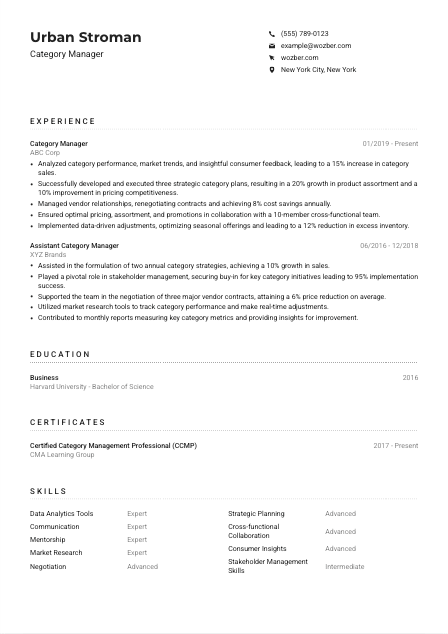
Some employers screen for local availability early, especially when the role involves close collaboration with merchandising, sourcing, or in-office stakeholders. In the example, listing "New York City, New York" directly addresses a stated requirement. Use that approach when a posting names a specific city, but do not force location detail beyond what the employer needs.
A LinkedIn profile can help if it reflects your CV accurately and includes relevant category work, vendor partnerships, promotions, or leadership scope. Broken links, outdated job titles, or mismatched achievements weaken the application, so check everything before sending.
Your personal details should remove friction, not add personality filler. A hiring team should be able to confirm who you are, what role you want, how to reach you, and whether you meet any location requirement in a few seconds.




This is the section that carries the most weight for a Category Manager. Employers want to see how you handled category performance, supplier terms, pricing decisions, product mix, and cross-functional execution, along with the business results those decisions produced.
Read the posting for the commercial levers the employer cares about most. Here, the priorities include category analysis, strategic planning, supplier negotiation, cost savings, collaboration on assortment and promotions, KPI reporting, and team guidance. Those points should shape which achievements you elevate and how you phrase them.
List your jobs in reverse chronological order with title, company, and dates. For category-focused work, the title matters because it shows whether you owned a category directly or supported one. A progression such as Assistant Category Manager to Category Manager helps a hiring team see growing responsibility in planning, vendor management, and decision-making cadence.
Generic bullets like "managed vendors" or "analysed data" are too thin for this role. Show what changed because of your work. The example does this well with lines such as increasing category sales by 15 percent, improving pricing competitiveness, and reducing excess inventory by 12 percent. Those bullets connect analysis to business performance, which is exactly what category leadership is expected to do.
Use numbers that match how category performance is measured. Sales growth, margin improvement, cost savings, pricing gains, assortment expansion, inventory reduction, contract value, promotional lift, or implementation rates all work well when they are accurate. Even one concrete metric per role makes your contribution much easier to understand than broad claims about impact.
Keep the section focused on work that strengthens your case for this function. Prioritise category strategy, supplier negotiations, market analysis, consumer insights, cross-functional planning, and reporting. If a past role included unrelated administrative work, leave it out unless it directly supports your progression into category ownership.
The reader should come away knowing what category you influenced, what levers you managed, and what results followed. That is the standard your experience section needs to meet.
Education usually is not the deciding section for an experienced Category Manager, but it still needs to match the posting cleanly. Employers often check degree relevance early, especially when the requirement is clearly stated.
If the role asks for a bachelor's degree in Business, Marketing, or a related field, make sure your education section states your degree and field clearly. In the example, "Bachelor of Science in Business" aligns neatly with that requirement. Use your real degree title, but do not bury the field of study.
List school, degree, field, and graduation year or date range in a consistent order. This section should be quick to scan. Category management CVs already carry heavy business content in the experience section, so education works best when it is clean and factual.
If your degree is in business, marketing, supply chain, economics, or another related discipline, keep that connection visible. Employers are often looking for evidence of commercial, analytical, or market-facing training, especially when they are comparing candidates from procurement, merchandising, and category backgrounds.
If you are newer to category work, relevant coursework such as consumer behaviour, pricing, statistics, supply chain, or marketing analytics can help explain your foundation. For someone with more than 5 years of experience, this is usually less important than your category results and supplier work.
Academic awards, case competitions, or relevant projects can add value if they connect to commercial analysis, market research, or retail strategy. Keep them brief. Once your CV includes substantial category experience, these details should support the story rather than compete with it.
Education should confirm that you meet the posted baseline and then step out of the way. Clear degree information is usually enough once your experience demonstrates category performance.
Certifications are rarely mandatory for Category Manager roles, but the right ones can sharpen your positioning. They are most useful when they reinforce category strategy, procurement knowledge, analytics, or supplier negotiation expertise.
Choose certifications that support the actual responsibilities of the role. A credential such as Certified Category Management Professional or a procurement certification makes sense because it connects directly to strategic planning, supplier management, and cost control. Generic certificates with little relevance add noise.
A short list of relevant certifications is stronger than a long list of unrelated learning badges. If you are targeting category roles in retail, CPG, procurement, or merchandising environments, prioritise credentials that reinforce commercial judgment, contract work, analytics, or market planning.
Include the completion year or active period when it helps demonstrate that your training is current. This matters most for certifications tied to evolving practices such as procurement standards, analytics tools, or supplier strategy frameworks.
Category management changes with pricing pressure, consumer behaviour shifts, assortment strategy, and analytics capability. Relevant ongoing learning tells employers you are staying current with the tools and methods that shape buying decisions and category performance.
The best certifications add depth to your profile, especially when they match the work you have already done. They should reinforce your category judgment, not try to replace it.
The skills section should mirror the levers you manage on the job. For Category Managers, that usually means a blend of analytical ability, commercial decision-making, supplier negotiation, and cross-functional communication.
Start with the capabilities the role truly depends on. In this posting, those include data analytics, market research, negotiation, stakeholder management, strategic planning, and communication. Build your list from skills you can back up with real examples in your experience section, because unsupported keywords are easy to spot.
Give the most space to skills that affect assortment, pricing, promotions, supplier terms, and category planning. Data analysis tools, consumer insights, market research, cost savings, vendor management, and cross-functional collaboration are often more valuable here than broad business terms that could apply to any office role.
You can group hard skills and soft skills if that makes the section easier to read. Keep the language specific. "Negotiation" is stronger than "people skills," and "market research" says more than "analysis." The example list works because it stays close to the job's commercial and collaborative demands.
A Category Manager skills section works when it previews the same strengths the rest of the CV demonstrates through pricing decisions, supplier outcomes, market insight, and team collaboration.
Language ability matters when a role calls for clear communication with suppliers, internal partners, or regional teams. In many Category Manager postings, English is a baseline business requirement rather than a bonus item, so present it clearly.
If the posting specifically asks for effective English skills, list English at the top with an accurate proficiency level such as Native or Fluent. That makes it easy for hiring teams to confirm a stated requirement without searching elsewhere on the CV.
Additional languages can be useful when the category involves international vendors, regional consumer markets, or cross-border sourcing. Include them if they are real working strengths, not casual exposure. In the example, Spanish adds useful range without distracting from the core requirement.
Choose clear levels such as Native, Fluent, Advanced, Intermediate, or Basic. Avoid vague descriptions. Straightforward labels give a more accurate picture of how comfortably you can communicate in meetings, negotiations, reporting, or written updates.
Do not overemphasize languages unless they are central to the job. For many Category Manager positions, this section is secondary to category performance, supplier work, and analytical skill. It should support the application, not take over valuable space.
If you are currently studying a language that matters to your market or supplier base, you can include it briefly. Keep it honest and practical. Employers care more about usable communication than aspirational study plans.
List language skills clearly, confirm any requirement the posting names, and keep the focus on how you communicate in real business settings.
Your summary needs to establish commercial credibility quickly. In a few lines, show the scale of your experience, the kind of category work you handle, and the outcomes you are known for delivering.
Read the posting and identify the core responsibilities behind the title. Here, the role centers on category planning, market analysis, consumer insight, supplier negotiation, cross-functional alignment, and reporting on key metrics. Your summary should reflect that operating mix rather than vague leadership language.
Start with your title and years of experience, then define your specialty. A line like the example's opening works because it establishes more than 6 years in category management and points directly to strategic category plans. That is much stronger than a broad statement about being results-driven.
Choose achievements that reflect how category success is measured. Sales growth, pricing improvement, cost savings, inventory reduction, and supplier results are all strong options. Keep the details selective so the summary stays concise while still showing commercial impact.
Aim for three to five lines with no filler. Use terms that belong in category management, such as category strategy, assortment, pricing, market research, consumer insights, supplier negotiations, or stakeholder alignment. Every sentence should help the employer picture you running a category and making sound tradeoff decisions.
A good summary gives the reader a fast, accurate read on your category scope and business impact. From there, your experience section should back up every claim with numbers, decisions, and results.
When your CV is tailored well, the hiring team can quickly connect your background to the work in front of them: category analysis, supplier management, pricing decisions, promotions, reporting, and team leadership. That is what gets a Category Manager application serious attention.
Use Wozber's free CV builder, ATS-friendly CV template, and ATS CV scanner to sharpen wording, align your content with the posting, and present your experience in an ATS-friendly CV format. The final CV should make one thing clear without effort: you know how to turn category strategy into commercial results.