



Use Wozber and land your dream job
Create CV
No registration required
Adding up figures, but your CV isn't tallying any offers? Crunch the numbers with this Purchase Accountant CV example, created with Wozber free CV builder. Learn how to match your financial expertise to specific job demands with ease, making sure your career keeps its balance sheet in the black!
Purchase accounting sits where procurement activity turns into financial truth. Hiring teams want to see that you can keep purchase orders moving through the system correctly, reconcile purchase-related accounts without loose ends, and support month-end reporting with clean numbers that stand up to review. If your CV stays too general, that operational control gets lost.
The first screening pass often looks for candidates who can connect purchasing workflows with accounting accuracy, especially in an ATS-compliant CV. Wozber's free CV builder helps you mirror the language of the job description, organise SAP or Oracle experience clearly, and surface the reporting, reconciliation, and compliance work that matters most for a Purchase Accountant.
In accounting, small details carry weight. Your contact section should look as orderly as the work you do in ledgers, reconciliations, and month-end reporting, with only the information that helps an employer contact you and confirm basic requirements.
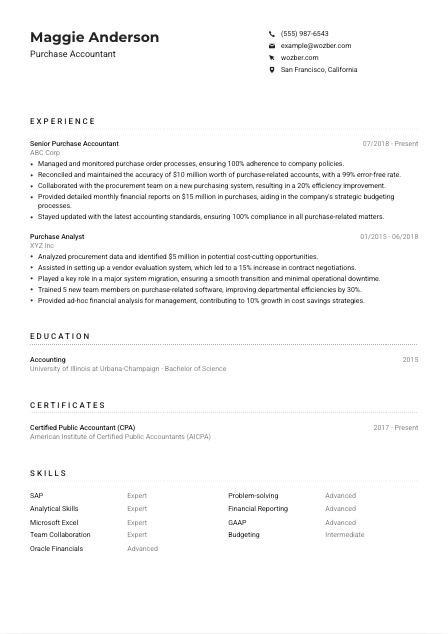
Use your full name in the largest text on the page, then place "Purchase Accountant" directly beneath it if that matches the position you are pursuing. This immediately frames your background around purchase accounting rather than broader finance or AP work, which helps when employers are sorting between adjacent profiles such as general accountants, analysts, and procurement specialists.
List one phone number and one professional email address that you check regularly. Finance hiring often moves quickly once a shortlist is formed, especially when the role supports monthly close, vendor payments, or purchasing controls, so your contact details should make it easy to reach you without confusion.
If a job asks for local availability, show your city and state in this section. In the example here, "San Francisco, California" addresses a stated location requirement right away and removes a practical question before the hiring team gets deeper into your CV.
Include LinkedIn or a professional website only if the content supports your accounting profile. That might mean a polished LinkedIn page with consistent job titles, accounting software experience, certification details, and measurable accomplishments tied to purchasing, reconciliation, or reporting.
Do not add age, marital status, photo, or other personal facts that have nothing to do with purchase accounting performance. This section should stay focused on professional identity, contact access, and any practical requirement such as location.
A clean Personal Details section tells the reader you value accuracy before they even reach your experience. For a Purchase Accountant, that quiet precision is the right first signal.




This is the section where employers look for real control over purchasing activity, account accuracy, and reporting discipline. Generic finance bullets will not do much here. Your experience needs to show how you handled purchase orders, reconciliations, systems, and cross-functional coordination in day-to-day work.
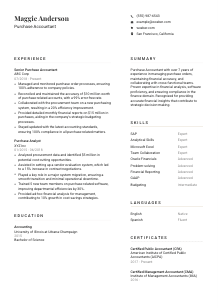
Start by identifying the responsibilities that define the role. For a Purchase Accountant, that usually includes purchase order oversight, purchase-related account reconciliation, collaboration with procurement, monthly reporting, and compliance with accounting standards. Then rewrite your bullets so they reflect work you actually performed using similar language. In the example, phrases such as "managed and monitored purchase order processes" and "provided detailed monthly financial reports" line up closely with the posting without sounding copied.
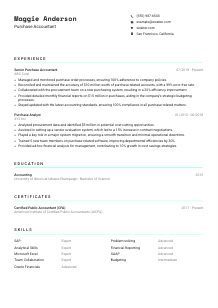
List your jobs in reverse chronological order with company, title, and dates, and make the titles work in your favor when they are relevant. A path from "Purchase Analyst" to "Senior Purchase Accountant" tells a useful story about growing responsibility across purchasing data, financial controls, and reporting. If your exact titles were broader, use your bullets to make the purchase accounting scope unmistakable.
Hiring managers want to know what changed because you were in the role. Instead of stopping at "reconciled accounts," add the scale, accuracy, timeliness, or process gain involved. The sample bullet about maintaining accuracy across $10 million in purchase-related accounts with a 99% error-free rate works because it ties accounting work to a measurable standard that matters in finance operations.
Quantify the parts of your work that reflect real purchase accounting performance. Good examples include purchase volume, account balances reconciled, reporting cadence, close timelines, compliance rates, payment accuracy, system implementation gains, or cost savings identified through analysis. Metrics like a 20% efficiency improvement after a purchasing system update or monthly reporting across $15 million in purchases make your scope much easier to understand.
Prioritise bullets that support purchase accounting, even if you have done broader finance work. That means purchase orders, accruals, vendor-related accounts, ERP usage, procurement collaboration, reporting, budgeting support, and policy compliance should take precedence over unrelated responsibilities. Each bullet should help the reader picture you handling the control points of a purchasing cycle.
When this section is tailored well, an employer can quickly see your scope, your systems exposure, and the financial accuracy you maintained. That is what moves a Purchase Accountant CV forward.
For purchase accounting roles, education is usually a qualification check first and a differentiator second. Employers want to confirm that you have the academic grounding for account reconciliation, financial reporting, controls, and budgeting support, then move on to how you applied it in practice.
If the posting asks for a bachelor's degree in Accounting, Finance, or a related field, make that easy to find. A Bachelor of Science in Accounting, as shown in the example, directly satisfies the requirement and removes ambiguity during early screening.
List degree, field of study, school, and graduation year in a simple structure. Accounting CVs benefit from orderly presentation, and this section should be readable in seconds without extra wording or decorative detail.
When your degree is directly tied to the role, name the field in full. "Accounting" carries more weight here than leaving only the degree title, because it signals formal training in financial statements, GAAP principles, reconciliations, and internal controls that support purchase accounting work.
If you are early in your career, one or two relevant details can help, especially coursework in cost accounting, financial reporting, ERP systems, audit, or procurement-related analysis. If you already have several years of experience, keep this section lean unless a specific academic project adds real value.
Recent graduates can include honors, finance society involvement, or projects tied to accounting systems or budgeting. More experienced candidates should let professional accomplishments carry the CV and keep education concise. The deeper your purchase accounting background, the less this section needs to do beyond confirming your degree.
Education should confirm that you have the accounting base for the job, then get out of the way so your experience and results can lead the case.
In accounting, certifications can sharpen your profile quickly because they signal deeper technical grounding and commitment to professional standards. For purchase accounting roles, they are especially useful when the employer values stronger accounting judgment, compliance awareness, or growth beyond a general staff role.
If a posting mentions CPA or CMA as preferred, place those credentials first. They are directly relevant to accounting rigor, reporting quality, and professional standards, so they deserve prominent placement. In the example, listing both CPA and CMA clearly strengthens the profile beyond the minimum requirements.
Do not crowd this section with unrelated short courses or generic certificates. Prioritise credentials that support accounting, finance, ERP systems, compliance, or reporting. A short, focused list is easier to scan and gives more weight to the qualifications that matter.
Include issue dates or active periods when they help confirm that a certification is current. This is particularly useful for credentials tied to continuing professional education or active standing, because it shows ongoing engagement with the standards behind the title.
Accounting standards, systems, and controls evolve, especially where purchasing processes intersect with compliance and reporting. If you are working toward a recognized credential or have completed recent role-relevant training, include it when it supports the direction of your target roles.
Relevant certifications add weight when they support the kind of work the role involves. For a Purchase Accountant, they can strengthen the impression that your judgment is as reliable as your reconciliations.
A Purchase Accountant needs more than broad finance knowledge. The skills section should show the systems, analytical strengths, and working habits that support purchase order control, accurate posting, reconciliations, reporting, and cross-team coordination with procurement and finance.
Use the job description to identify the technical and analytical skills the employer expects, then include the ones you genuinely use. In this case, accounting software, SAP, Oracle Financials, analytical ability, problem-solving, budgeting support, and professional communication are all relevant. Matching those terms helps both ATS screening and human review when they reflect your actual experience.
Place the most role-critical skills first. For purchase accounting, that usually means ERP platforms, Excel, account reconciliation, financial reporting, GAAP or internal control knowledge, and analytical skills tied to purchasing transactions. If your list starts with highly relevant tools and capabilities, the reader understands your working toolkit right away.
Do not make this section all software or all soft skills. A useful mix might include SAP, Oracle Financials, Excel, financial reporting, budgeting, analytical skills, problem-solving, and team collaboration. The example does this well by combining ERP knowledge with reporting and communication strengths that matter when working with procurement and month-end stakeholders.
Your skills should reflect how purchase accounting actually gets done, from ERP entries and reconciliations to reporting and cross-functional follow-through. That combination is what hiring teams look for.
Language ability matters when the role involves vendor communication, cross-functional coordination, or reporting to managers who expect clear written and verbal updates. For accounting positions, the key is to present language proficiency in a straightforward way that reflects business use, not personal flair.
If the employer specifies English proficiency for professional communication, list English first with an honest proficiency level. That immediately confirms you can handle reporting, policy communication, and collaboration with procurement or finance teams in the working language of the role.
After the required language, list any others that could support the work environment. In some organizations, additional languages help with vendor communication, regional coordination, or multinational reporting, but they should not overshadow the language the role explicitly needs.
A second language can be a useful asset if it supports supplier relationships or internal communication across markets. In the example, Spanish adds range without distracting from English, which remains the priority for the role.
Use clear labels such as "Native," "Fluent," "Intermediate," or "Basic." Accounting roles depend on accuracy, so vague wording around language ability can create the wrong expectation if the role includes reporting discussions, vendor calls, or policy documentation.
If the position is heavily internal and local, one required language may be enough. If the purchasing function spans regions or suppliers across borders, extra language capability can support coordination and reduce friction in day-to-day operations. Tailor the prominence of this section to that reality.
For a Purchase Accountant, language skills matter when they support accurate communication around transactions, reports, and policies. Keep the section clean, honest, and business-focused.
The summary needs to establish your purchase accounting profile fast. In a few lines, it should tell the reader how much relevant experience you bring, what part of the purchasing and accounting cycle you handle well, and which systems, reporting, or control strengths make you credible for the position.
Before writing, identify the two or three themes the role emphasizes most. For this posting, those are purchase order process control, reconciliation accuracy, collaboration with procurement, monthly financial reporting, and accounting software proficiency. Your summary should foreground the parts of your background that map to those priorities.
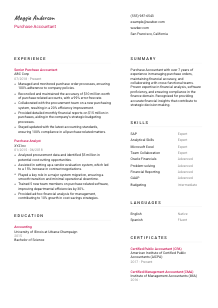
Start with a direct statement that names your profession and years of relevant experience. "Purchase Accountant with 7+ years of experience" works because it sets scope immediately and tells the reader they are looking at someone with established finance operations exposure rather than an entry-level applicant.
After the opener, add two or three role-specific strengths such as managing purchase-related accounts, supporting monthly reporting, improving purchasing workflows, or working in SAP or Oracle environments. The sample summary succeeds because it stays centered on purchase orders, financial accuracy, collaboration, and compliance instead of drifting into generic accounting language.
Aim for 3 to 5 lines that read smoothly and can be scanned quickly. This is not the place for every achievement or certification. It should give a hiring manager enough context to understand your value before they move into the experience section, where the numbers and details do the heavier lifting.
A focused summary helps the reader interpret every bullet that follows through the right lens. For a Purchase Accountant, that lens is control over purchasing activity, clean financial records, and dependable reporting.
When each section points to the same story, your CV becomes much easier to shortlist. Show the accounting degree, surface any CPA or CMA credentials, make your ERP and reconciliation skills visible, and use experience bullets that prove control over purchase orders, reporting, and account accuracy.
Wozber's free CV builder can help you shape that information into an ATS-friendly CV format, align your wording with the job description, and strengthen ATS optimisation without losing professional clarity. The result should make one thing easy to judge: you can manage purchase accounting work with accuracy, process discipline, and reliable reporting.




