



Use Wozber and land your dream job
Create CV
No registration required
Crunching budget numbers, but your CV doesn't add up? Check out this Project Accountant CV example, created with Wozber free CV builder. Learn how to showcase your financial skills alongside project milestones, putting your accounting career squarely in the black!
Project accountants sit where cost control meets project delivery. Hiring teams want to see whether you can keep budgets accurate while projects move, explain financial variance before it becomes a problem, and support invoices, approvals, reporting, and audit work without slowing operations. Your CV should make that operating range visible quickly, especially how you handle project budgets, financial analysis, and cross-functional coordination.
Screening usually narrows fast when a CV sounds like general accounting rather than project-based finance. Wozber's free CV builder helps you line up your experience with the posting language and create an ATS-compliant CV that surfaces the right terms, from budget monitoring to project profitability reporting, so a hiring manager can immediately see your relevance to project finance work.
This section is simple, but it still carries screening value. For a Project Accountant application, your header should confirm that you are easy to contact, professionally presented, and, when the posting asks for it, already based in the required market.
Use your full name at the top in a clear, readable format. Keep it more prominent than the rest of the header so the document feels professional from the first glance. In accounting and finance roles, that clean presentation matters because it sets the tone for the precision expected in your budget reports, reconciliations, and project documentation.
Place "Project Accountant" directly under your name if that is the role you are pursuing. This helps both recruiters and ATS systems categorize your application correctly and distinguishes you from general staff accountants or financial analysts. If your current title is close but not exact, use the target title only when your experience genuinely supports project budgeting, cost tracking, and financial reporting responsibilities.
Keep this information current and businesslike so there is no friction when an employer wants to schedule an interview.
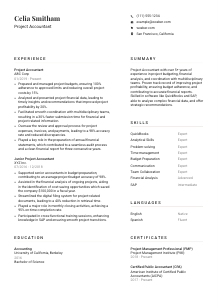
If the posting requires local residency, list your city and state clearly. Here, San Francisco, California is part of the employer's stated criteria, so showing that in the header removes an avoidable question early. For other Project Accountant roles, only emphasize location when the employer ties it to onsite work, client access, or regional compliance needs.
Include LinkedIn or a personal professional site only if it reinforces the same story told on your CV. Make sure titles, dates, certifications, and project finance experience match. A profile that shows budgeting work, ERP exposure, and progression from junior accounting support into project-focused finance can strengthen your application. A thin or outdated link can do the opposite.
Your personal details should confirm the basics without distraction. For a Project Accountant, that means a professional identity, a role-aligned title, accurate contact information, and location when the job specifically requires it. Get this section right and the reader can move straight to your project finance qualifications.




This is the section most likely to decide whether you move forward. Project Accountant CVs stand out when the experience shows control over budgets, reporting, variance analysis, approvals, billing support, and coordination with project teams, not just general accounting tasks.
Start by pulling out the recurring work from the job description: preparing project budgets, monitoring costs, analysing financial data, reviewing invoices and expenses, supporting annual statements, and helping with audit activity. Then shape your bullet points around those same functions where you have done them. If your past work included monthly close, forecasting, WIP reporting, or project cost reviews, connect those directly to project-level financial oversight rather than leaving them in broad accounting language.
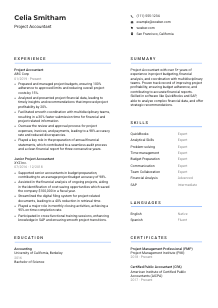
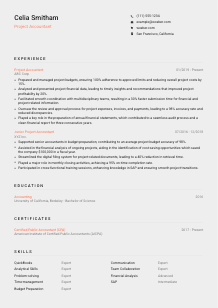
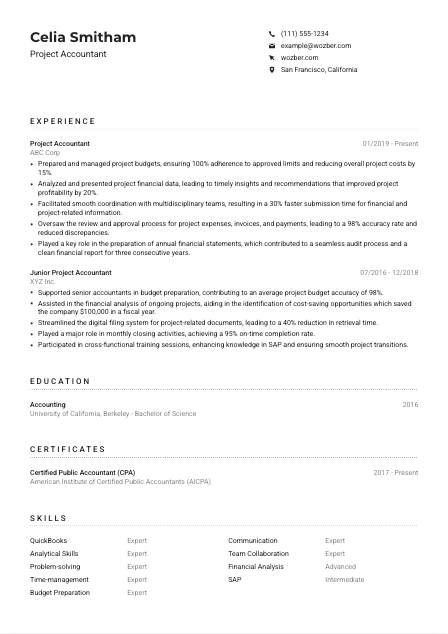
List each role with job title, employer, and dates in reverse chronological order. That straightforward structure matters in finance hiring because reviewers are checking career progression, scope, and continuity. A move from Junior Project Accountant to Project Accountant, as shown in the example, tells a useful story on its own when the responsibilities also show increasing ownership of budgets, reporting cadence, and approval workflows.
Each bullet should show what you handled and what changed because of your work. Strong Project Accountant bullets often combine a finance task with an operating result, such as monitoring budget performance, reducing cost overruns, improving reporting turnaround, or increasing invoice accuracy. The sample CV does this well by pairing responsibilities with results like faster submission times and stronger approval accuracy, which makes the day-to-day work easier to evaluate.
Whenever you can, quantify impact with numbers that make sense for the work: budget adherence, cost reduction, profitability improvement, reporting speed, invoice accuracy, audit outcomes, close timeliness, or dollar savings. The example's 15% cost reduction, 20% profitability improvement, and 98% approval accuracy are effective because they reflect measures commonly used in project accounting and financial control, not generic performance claims.
Keep older or less relevant experience brief unless it supports the position directly. Hiring teams for Project Accountant roles want to understand your relationship to project budgets, cost tracking, reporting, and cross-functional finance support. If you include broader accounting work, frame it through relevant pieces such as reconciliations, financial analysis, ERP use, close support, or audit preparation so the section stays tied to project finance.
Your experience section should leave no doubt that you can manage the financial side of active projects. When the bullets show budget control, reporting discipline, invoice and expense oversight, and measurable financial outcomes, the CV starts to read like someone who can step into project accounting work with minimal ramp-up.
For Project Accountant roles, education is usually a qualification check before it becomes a differentiator. The posting asks for a bachelor's degree in Accounting, Finance, or a related field, so your CV should make that requirement easy to confirm in seconds.
If you hold a bachelor's degree in Accounting, Finance, or a related discipline, list it clearly and exactly. That direct match matters because it confirms formal training in areas that feed this role, such as financial reporting, cost accounting, budgeting, and analysis. In the example, a Bachelor of Science in Accounting aligns cleanly with the requirement and needs no extra explanation.
Include degree, field of study, school, and graduation year. Keep the layout simple and consistent with the rest of the CV. Finance hiring teams do not need decorative detail here. They need a quick read that confirms your academic background without interrupting the flow of your more valuable sections, especially experience and certifications.
Name the field accurately instead of shortening it into something vague. "Accounting" carries more direct weight than a broad business label when the job centers on budgets, financial analysis, invoices, and statement support. If your degree is adjacent, make the relevance obvious through the exact title and, if needed, stronger supporting experience elsewhere on the CV.
Coursework is most useful for early-career applicants or candidates moving into project accounting from a nearby finance path. Include it only if it adds something the employer may be looking for, such as cost accounting, managerial accounting, auditing, financial systems, or project finance. Experienced candidates usually get more value from using that space for project results, ERP tools, or certifications.
Honors, academic projects, or finance-related leadership can help when you have limited professional experience. For someone with several years in project accounting or financial analysis, these details should stay secondary unless they directly support the target role. Prioritise the information that explains how you handle live budgets, reporting schedules, and stakeholder requests in real business settings.
Your education section should answer one immediate question: do you have the academic base for project accounting work? Once that is clear, the hiring decision shifts back to your hands-on experience with project budgets, reporting, software, and financial controls.
Certifications matter here because they can support two sides of the role. Accounting credentials reinforce technical finance depth, while project credentials show that you understand how financial controls connect to delivery schedules, scope changes, and project governance.
This employer lists CPA or PMP as a plus, so those should appear prominently if you hold them. When a posting names certifications directly, matching that language helps your CV rank better in ATS screening and makes it easier for a reviewer to see where you exceed the minimum requirements.
List credentials that support project accounting work first. CPA is especially relevant when the role includes financial statements, audit support, compliance, and accounting judgment. PMP can also add value when the position requires close work with project managers, schedules, budgets, and multidisciplinary teams. The sample CV benefits from having both because each one supports a different side of the role.
Add the certifying body and the date earned or active period, especially for recognized credentials. That gives the reader immediate context and shows whether the certification is current. For regulated or maintained credentials, date information can also support trust in your professional standing.
Project accounting sits in a space shaped by changing standards, systems, and reporting expectations. If you hold credentials that require renewal or continuing education, keep them active and list the most relevant ones. Current certification signals that your knowledge is staying aligned with live practice, whether that is in accounting standards, audit readiness, or project governance.
Relevant certifications can push your CV from qualified to noticeably stronger. They work best when they support the actual responsibilities in the role, whether that is stronger accounting judgment through a CPA or better project-side fluency through a PMP.
A Project Accountant skills section should read like the toolkit behind your experience. Focus on the systems, finance capabilities, and working habits that support budget tracking, project reporting, invoice review, and collaboration with project teams.
Start with the language the employer already used. Here, that includes accounting software proficiency, analytical ability, problem-solving, time management, and project accounting or financial analysis experience. You do not need to repeat the posting word for word, but your skills section should clearly cover those areas if they reflect your actual background.
Project accounting requires both tool knowledge and disciplined execution. On the technical side, include accounting systems such as QuickBooks or SAP, along with budget preparation, financial analysis, variance tracking, invoice review, and reporting. On the working side, include time management, communication, and team collaboration, since this role often depends on getting complete information from operations, project managers, and finance stakeholders on schedule.
Do not overload this section with every platform or generic strength you have ever used. Choose the skills that support the actual work. The example keeps the emphasis on QuickBooks, SAP, budget preparation, financial analysis, and collaboration, which closely matches the posting. That kind of alignment is much more useful than a long inventory of unrelated software or broad business traits.
Your skills section should reinforce the experience section, not repeat it loosely. When the tools and capabilities line up with project budgets, financial reporting, approvals, and analysis, the reader gets a clearer picture of how you do the work.
Language skills are usually a secondary section for Project Accountant roles, but they still matter when a posting names a required language or when the work involves diverse teams, clients, or vendors. Keep this section factual and relevant.
If the posting specifies a language, list it first with your proficiency. In this case, English is mandatory, so it should be visible. That seems basic, but it is still a stated requirement, and meeting stated requirements clearly helps prevent unnecessary screening issues.
After the required language, include any others that could support the work. For Project Accountants, extra language capability can help when coordinating with cross-functional teams, reviewing vendor communication, or supporting projects with multilingual stakeholders. The sample includes Spanish, which can be worth listing if it is truly usable in a professional setting.
There is no advantage in listing languages that you cannot comfortably use at work. Keep the section practical. If a language helps you communicate in meetings, handle written correspondence, or clarify project financial details with broader teams, include it. If not, leave it out and use the space elsewhere.
Use clear proficiency levels so employers understand how you can communicate.
For many Project Accountant openings, English and finance capability will matter far more than a long languages list. Still, in companies with international projects, multilingual vendors, or regionally diverse teams, an additional language can strengthen your profile. Include it when it adds operational value, not just extra content.
This section should quickly confirm required communication ability and, if relevant, show extra range. For Project Accountant roles, that means emphasizing professional usability over novelty.
Your summary should sound like someone who understands project-based finance, not someone pasting general accounting claims into the top of a CV. In a few lines, show your level, your specialty, and the type of financial oversight you bring to projects.
Before writing, identify the themes running through the posting. Here, those include project budgets, cost monitoring, financial analysis, reporting, software proficiency, invoice and payment review, and support for statements and audits. Your summary should reflect the mix that best matches your background rather than trying to mention every requirement mechanically.
Start with who you are professionally. "Project Accountant with 5+ years of experience" works because it gives the reader immediate context. If your background is split between project accounting and financial analysis, you can name both as long as the wording stays close to the target role.
Use the next sentence to cover the work you do best and the value you bring. Good examples for this role include managing project budgets, improving profitability, producing financial reports, supporting clean audits, and working across multidisciplinary teams. The sample summary is effective because it ties budgeting, analysis, profitability, and reporting into one coherent picture instead of listing disconnected traits.
Aim for a short paragraph, not a biography. Focus on experience, tools, and results that belong in project accounting. Mention software such as QuickBooks or SAP if it is relevant to your background and target job. Every phrase in the summary should prepare the reader for the stronger proof that follows in your experience section.
A well-written summary gives the reader an immediate sense of your project finance range. When it captures your experience level, budget and reporting strengths, software familiarity, and measurable business impact, the rest of the CV lands more quickly.
Project Accountant hiring moves fastest when your CV shows the mechanics of the job clearly: budget preparation, cost control, financial analysis, invoice and payment review, reporting accuracy, and coordination with project teams. Keep each section anchored to that work so the document reads like someone who has handled project financial oversight, not just general accounting tasks.
Wozber's AI CV builder and ATS CV scanner can help you tighten that alignment, surface missing requirements, and present everything in an ATS-friendly CV format. The finished CV should make one thing easy to judge: whether you can keep project finances accurate, timely, and useful to decision-makers.