



Use Wozber and land your dream job
Create CV
No registration required
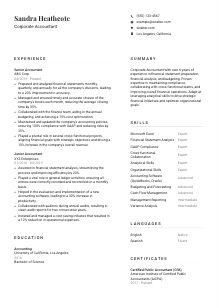
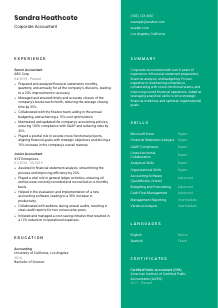
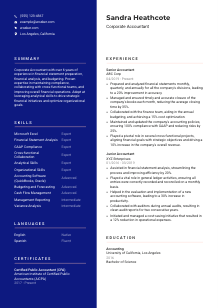
Balancing ledgers, but your CV seems off the books? Check out this Corporate Accountant CV example, created with Wozber free CV builder. Learn how to align your financial acumen with corporate requirements, making your career assets as solid as the bottom line!
Corporate accounting work gets judged in the details. A hiring team wants to see whether you can close the books accurately, keep financial statements clean, support budgeting cycles, and work comfortably inside GAAP-driven processes without slowing down the business. Your CV should make that operating discipline visible from the start.
When the CV mirrors the language of month-end close, financial statement analysis, forecasting support, and policy compliance, it is easier for reviewers and an ATS to place you in the right lane quickly. Wozber's free CV builder helps you shape that alignment into an ATS-compliant CV, so the hiring team can immediately see your reporting scope and accounting judgment.
Corporate Accountant openings usually move fast once a candidate looks technically credible, so your header needs to answer the practical questions right away. Keep this section clean, professional, and aligned with the posting, especially when the employer has a location requirement or expects a clearly stated accounting title.
Your name should sit at the top in a clear, easy-to-scan format. In accounting hiring, a polished header sets the tone for the rest of the document and matches the precision expected in reporting, reconciliations, and close work.
If you are applying for a Corporate Accountant role, place that title under your name. This helps frame your background around corporate close, financial reporting, budgeting support, and compliance work instead of leaving the reader to guess whether you are aiming at audit, AP, tax, or a broader finance track.
List a reliable phone number and a professional email address. Accuracy matters here as much as it does in a journal entry or balance sheet tie-out. One typo can block interview scheduling, so check every character before sending.
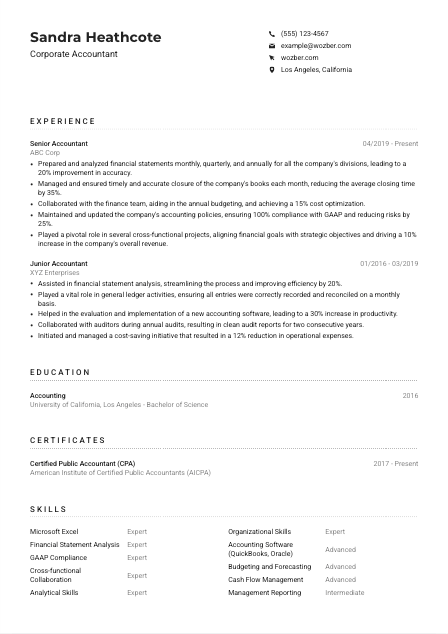
Some accounting roles are tied to office presence, local reporting teams, or employer policy. Here, the posting specifies Los Angeles, California, so showing that location in your personal details answers a screening point immediately. Sandra Heathcote's sample header does this well by listing Los Angeles, California without adding unnecessary detail.
A LinkedIn profile or professional website can help if it is current and consistent with your CV. For corporate accounting, that usually means matching titles, dates, credentials such as CPA, and finance-related experience rather than linking to anything personal or loosely relevant.
Your header should confirm who you are, how to reach you, what accounting role you are targeting, and whether you meet practical requirements such as location. That gives the reader a clean start before they reach your reporting experience.




This is where a Corporate Accountant CV earns credibility. Employers look for evidence that you have handled recurring close responsibilities, produced reliable financial reporting, supported planning cycles, and worked across departments without losing control of accuracy or deadlines.
Read the job description for the recurring work, not just the qualifications list. For this role, the core themes are financial statement preparation, monthly and year-end close, budgeting and forecasting support, cross-functional collaboration, and maintaining GAAP-aligned policies. Those are the responsibilities your bullets should echo if they reflect your actual background.
List roles in reverse chronological order with company name, title, and dates. That structure helps the reader see your progression from staff or junior accounting work into broader ownership of close, reporting, policy, or planning responsibilities. In accounting, clear chronology also helps hiring teams judge the depth of your month-end and year-end exposure.
Focus each bullet on work that matters in a corporate accounting environment. Good examples include improving close speed, increasing statement accuracy, strengthening reconciliations, supporting audits, refining policies, or contributing to forecast and budget cycles. The sample CV does this effectively by tying day-to-day accounting work to outcomes such as cleaner financial statements and stronger compliance.
Quantified impact carries weight when it reflects actual accounting performance. Reduced close time, improved reporting accuracy, cost savings, audit results, productivity gains after a system change, or revenue and margin support are all useful measures. The example's "reduced closing time by 35%" works because it points to a real operational improvement in the close process.
Prioritise experience that shows general ledger work, reconciliations, reporting cadence, compliance, budgeting support, or business partnership with finance and operating teams. If an older bullet does not strengthen your case for corporate accounting, trim or rewrite it so every line supports the role you want now.
By the end of your experience section, the reader should understand your reporting scope, your contribution to close and compliance, and the business results tied to your accounting work. That is what moves you from "accounting background" to "ready for this seat."
For Corporate Accountant hiring, education is usually a straightforward checkpoint, but it still matters. A clearly listed accounting or finance degree confirms the formal grounding behind your work in financial statements, GAAP, reconciliations, and internal reporting.
Start with the credential the employer asked for. Here, that means a Bachelor's degree in Accounting, Finance, or a related field. If your degree matches directly, make it obvious so the requirement is satisfied without the reader needing to interpret it.
List the school, degree, field of study, and graduation year. For most corporate accounting CVs, that is enough. Clean formatting matters because this section is usually reviewed quickly as part of qualification screening.
Include the major or concentration, especially if it is Accounting. A line such as "Bachelor of Science in Accounting" connects more directly to financial reporting and corporate accounting work than a generic degree label. The sample CV handles this well with a UCLA accounting degree listed plainly.
If you are earlier in your career, selected coursework in intermediate accounting, financial reporting, auditing, or managerial accounting can help. The same goes for projects involving financial analysis, forecasting models, or ERP-based accounting exercises. Once you have solid professional experience, these extras are usually less important.
Academic honors, scholarships, or leadership in accounting-related organizations can help if they support your professional story. Keep them if they reinforce discipline, technical strength, or commitment to the field. Leave them out if they crowd more relevant experience.
Your education section should confirm that you meet the academic bar for the role and that your background is rooted in accounting or finance. Once that is clear, let your experience carry the heavier weight.
Certifications matter in corporate accounting because they quickly signal technical depth, professional standards, and commitment to the field. When the posting mentions a credential such as CPA, your CV should make it easy to find.
For many Corporate Accountant openings, the CPA is the clearest value-add and sometimes a preferred qualification. If you hold it, place it prominently in the certifications section and consider including it near your name as well if that fits your format.
Choose certifications that support financial reporting, compliance, controls, analysis, or systems knowledge used in accounting environments. A shorter list of highly relevant credentials is more persuasive than a long list of unrelated coursework badges.
Dates are useful when they show that a certification is active, current, or recently earned. In the sample CV, the CPA is shown with an ongoing date range, which helps confirm current standing and continued professional relevance.
Corporate accounting changes with standards, systems, and reporting expectations. If you have recent learning in areas such as financial reporting updates, ERP systems, internal controls, or planning and analysis, include it when it strengthens your fit for the specific opening.
A well-chosen certifications section tells the employer that your accounting knowledge is formal, current, and relevant to the reporting and compliance demands of the job.
A Corporate Accountant skills section should read like the toolkit behind your reporting process. That means balancing technical accounting skills, software capability, and the communication skills needed to work with finance leaders, auditors, and cross-functional partners.
Start with the job description and extract the skills tied to execution. In this case, that includes Excel, accounting software, financial statement analysis, budgeting and forecasting support, communication, organisation, and analytical strength. Those should anchor your list if they match your experience.
Lead with skills that support close, reporting, and compliance. Financial statement analysis, GAAP compliance, reconciliations, budgeting, variance analysis, and ERP or accounting software proficiency usually matter more than broad business terms. The sample list works well because it foregrounds Excel, GAAP, financial statement analysis, and budgeting.
Do not turn the skills section into a keyword dump. Choose the capabilities you can back up in your experience section, and group them around the real demands of the job. A concise list of relevant accounting tools and competencies is stronger than an oversized menu of generic strengths.
Your skills section should confirm that you have the technical base to manage reporting cycles and the working style to coordinate with the rest of the business. Every skill listed should connect back to the accounting work described elsewhere on the page.
Language ability is usually a supporting detail in corporate accounting, but it still matters when the employer states a requirement or when the business operates across teams, entities, or regions. Keep this section simple and accurate.
If the posting names a required language, list it clearly with your proficiency level. Here, English proficiency is required, so it should appear in the language section without ambiguity.
Place the required language first so the reader can confirm it immediately. This is a small detail, but it helps when screening is moving quickly and the hiring team is checking for non-negotiable qualifications.
Additional languages can be useful in accounting teams that work with international affiliates, vendors, or multilingual stakeholders. They are not a substitute for accounting skill, but they can strengthen collaboration. In the sample CV, Spanish adds practical value without distracting from the core accounting profile.
Terms such as "Native," "Fluent," or "Professional Working Proficiency" give a more reliable picture than vague wording. Choose labels you can defend in a real workplace setting, especially if the role includes meetings, reporting, or written communication.
If a company works across regions or serves a diverse internal stakeholder base, language skills can support smoother communication around reporting requests, follow-ups, and process documentation. Include them when they add genuine business relevance, not just extra content.
List the language requirements you meet, add other useful languages honestly, and keep the emphasis where it belongs: on your accounting capability and communication in a professional setting.
The summary sets the reading lens for everything that follows. In a Corporate Accountant CV, it should quickly establish your years of experience, the accounting work you own, and the kinds of results you produce in reporting, close, compliance, or planning support.
Before writing, identify the two or three themes that define the opening. For this role, those themes include financial statement preparation, close accuracy, forecasting support, and GAAP compliance. Build your summary around the areas where your background overlaps most strongly.
Start with your title or specialty, your years of experience, and the accounting functions you handle well. A line such as "Corporate Accountant with 6+ years of experience in financial reporting, month-end close, and budgeting support" tells the reader much more than a generic statement about being results-driven.
Use the second sentence to connect your strongest skills to the employer's needs. That may include GAAP compliance, cross-functional collaboration, financial analysis, Excel, or accounting systems. The sample summary does this effectively by linking reporting and budgeting experience with compliance and strategic support.
Aim for a concise paragraph that sounds grounded in actual accounting work. Avoid broad claims that could apply to any finance professional. A good summary should make the reader expect solid experience in close, reporting cadence, and business-facing accounting support before they even reach your first job entry.
A strong summary gives the employer an immediate picture of your accounting scope and professional level. When it is aligned with the posting, the rest of the CV reads in the right context from the first line.
A Corporate Accountant CV should make three things easy to judge: your command of financial reporting, your reliability in close and compliance work, and your ability to support broader planning or operational decisions.
Use Wozber's free CV builder, ATS-friendly CV template, and ATS CV scanner to align your wording with the job description, improve ATS optimisation, and present your background in a format that keeps the accounting substance easy to read. The final result should show a hiring team that you can step into the reporting cycle with confidence.




