



Use Wozber and land your dream job
Create CV
No registration required
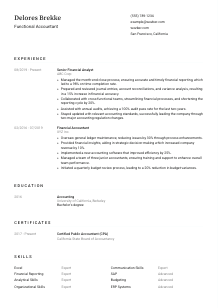
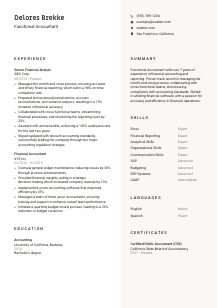
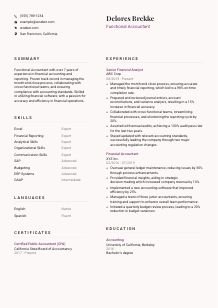
Balancing ledgers, but your CV feels off-centre? Check out this Functional Accountant CV example, created with Wozber free CV builder. Learn how to strategically highlight your financial acumen to match job expectations, keeping your accounting career always in the black!
Functional Accountant work is built around disciplined close cycles, clean reconciliations, and reporting that leaders can trust. Hiring teams look for candidates who can keep the books accurate under deadline pressure, explain variances clearly, and work across departments when financial processes break down or need tightening. Your CV should make that operating standard visible fast.
A tailored CV changes how quickly your accounting background reads as close-ready rather than broadly finance-related. When section wording reflects month-end close, journal entries, reconciliations, variance analysis, and compliance work in language that matches the posting, Wozber's free CV builder helps you shape an ATS-compliant CV that surfaces the right accounting experience early. That makes it easier for reviewers to see whether you can step into the reporting rhythm of the role.
For accounting roles, the top of the CV should read like a clean header on a financial report. Keep it accurate, professional, and aligned with any explicit application requirements so the employer can immediately place you for the role.
Place your full name at the top in a larger font than the rest of the header. In finance hiring, clean presentation matters. A simple, professional header suggests the same attention to order you would bring to reconciliations, support schedules, and reporting packs.
If you are applying for a Functional Accountant position, use that title beneath your name when it accurately reflects your background. This helps the CV line up with the role immediately and avoids looking like a generic finance application sent to several different openings.
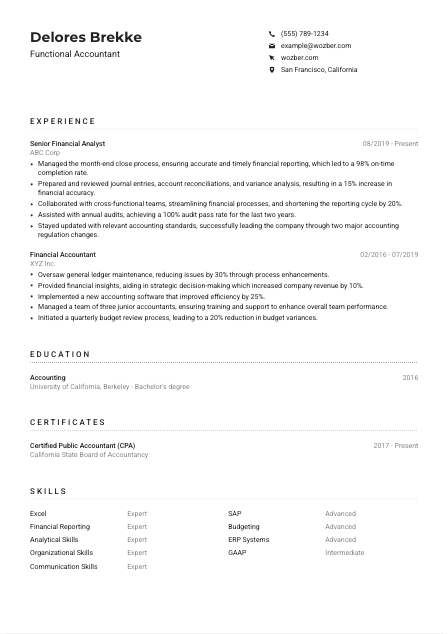
Include your city and state in the format requested by the employer. Here, San Francisco, California matters because the posting makes location explicit. When a company needs someone local for office coordination, close support, or team collaboration, this small detail can affect whether the CV moves forward.
Use a professional email address and, if relevant, a polished LinkedIn profile that matches your CV dates and titles. For accountants, inconsistencies in basic information raise questions quickly. Make it easy for employers to contact you and easy to confirm your career timeline.
Do not add age, marital status, photo, or other details unrelated to accounting performance. Save the space for information that supports hiring decisions, such as location, title alignment, and professional contact details.
Your header should confirm who you are, what role you are targeting, and whether you meet any stated logistical requirements. Keep it clean enough that nothing distracts from the accounting experience that follows.




This is the section that carries the most weight for a Functional Accountant. Employers want to see how you handled recurring accounting work, where you improved process accuracy or reporting speed, and whether your experience lines up with close calendars, reconciliations, compliance, and cross-functional finance support.
Pull the key responsibilities from the job description and map your experience to them. For this role, that means month-end close, journal entries, account reconciliations, variance analysis, audit support, and collaboration with non-finance teams. If you have done that work, say it directly instead of hiding it behind broad terms like "financial support" or "accounting duties."
List your most recent position first so employers see your current accounting scope, systems exposure, and reporting cadence without hunting for it. In finance, recent experience matters because close processes, ERP workflows, and compliance expectations evolve. A clear timeline also helps reviewers understand your progression from staff-level accounting work to broader ownership.
Each bullet should show what you handled and what improved because of your work. The sample CV does this well with results such as a 98% on-time month-end close rate, a 15% increase in financial accuracy, and a 20% shorter reporting cycle. Metrics like close timeliness, audit results, error reduction, process efficiency, and variance control are native to accounting work and make your contribution easier to judge.
Choose bullets that reinforce general ledger discipline, reporting accuracy, compliance support, system improvement, and business partnership. If an achievement does not connect to financial processes, controls, analysis, or reporting, cut it. A Functional Accountant CV should read like someone who can own recurring accounting responsibilities and keep the numbers dependable under deadline.
Tailor bullet language to reflect the employer's terminology without changing the truth of your experience. If one company emphasizes "variance analysis" and another says "financial performance review," mirror the phrasing that matches your background. Wozber's AI CV builder can help surface those accounting keywords and tighten ATS alignment while keeping your bullets grounded in real work.
By the end of your experience section, an employer should be able to tell whether you can manage close activities, maintain reporting accuracy, and work with stakeholders across the business. That level of clarity is what moves an accounting CV out of the general finance pile.
Accounting roles usually have a clear academic baseline, and this posting does too. Your education section should confirm that foundation quickly so the reader can move on to your close experience, reporting work, and technical strengths.
If you hold a Bachelor's degree in Accounting, Finance, or a related field, list it clearly and without extra wording. When a posting names a specific educational requirement, mirroring that terminology helps remove doubt. In the example, "Bachelor's degree" in Accounting aligns directly with what the employer asked for.
Include degree, field of study, school, and graduation year in a simple layout. Finance hiring does not need decorative detail here. The section works best when it is easy to scan and confirms your accounting training in a few seconds.
If your degree is closely aligned, let that be visible. A degree in Accounting needs no explanation. If your field is adjacent, such as Finance or Business with heavy accounting coursework, make sure the wording still supports your qualification for financial reporting and accounting operations roles.
If you have limited professional experience, relevant coursework can help fill in the picture. Classes in intermediate accounting, auditing, financial statement analysis, taxation, or advanced Excel can reinforce readiness for reconciliation work, reporting cycles, and audit support.
Honors, scholarships, or leadership in accounting and finance organizations are worth adding when they support your profile, especially early in your career. Once you have several years of accounting experience, these details should stay brief so the CV keeps its focus on practical results.
Your education section should quickly establish that you meet the role's academic requirement and have the accounting foundation to support the work described in your experience. Keep it direct and easy to verify.
Certifications carry real weight in accounting because they show technical depth, regulatory awareness, and continued commitment to the profession. For a Functional Accountant role, the right credential can sharpen your profile immediately, especially when the employer calls it out as preferred.
If you hold a CPA, list it first. This posting marks the Certified Public Accountant designation as highly preferred, so it should be impossible to miss. In the sample CV, the CPA is exactly the kind of credential that lifts a candidate above others with similar general accounting experience.
List the certificate name, issuing body, and date or active period. Accounting credentials are not decorative extras. They are part of how employers judge your technical grounding, especially for compliance, audit support, and roles touching regulated reporting.
Dates help employers understand whether a certification is current and active. That matters in accounting, where standards, regulations, and reporting practices change over time. An active CPA or recent continuing education entry shows that your knowledge is staying current.
If you have additional training in ERP systems, financial reporting standards, tax, audit, or advanced Excel, include it when it strengthens your fit. This can be especially useful if the role involves systems work, process improvement, or adapting to changing accounting standards.
Your certificates should reinforce technical trust. For this kind of accounting role, they help show that you bring more than experience alone. You bring recognized professional standing and current knowledge.
The best skills sections for Functional Accountants are specific enough to match the posting and grounded enough to reflect real daily work. Focus on tools, accounting functions, and professional strengths that matter in close management, reporting accuracy, and team coordination.
Start with the employer's language, then keep only the items you can support elsewhere in the CV. Here, accounting software, Microsoft Office Suite, especially Excel, analytical skill, organisation, communication, and financial accounting work all belong. The sample CV also adds role-relevant items such as financial reporting, ERP systems, SAP, budgeting, and GAAP, which deepen the accounting picture when they are backed by experience.
A Functional Accountant needs both tool proficiency and judgment. Include hard skills such as Excel, general ledger work, reconciliations, financial reporting, ERP systems, or GAAP knowledge alongside soft skills that matter in practice, such as analytical thinking, organisation, and cross-functional communication. That mix reflects how the role is actually performed during close and reporting cycles.
Put the most job-relevant skills near the top rather than listing everything you have ever used. If the role is close-heavy, emphasize reporting, reconciliations, journal entries, and Excel. If the posting leans more toward systems and process improvement, elevate ERP, workflow improvement, and controls-related skills. Organised prioritization helps both ATS screening and human review.
Read your skills list and ask whether it describes someone who can handle accounting deadlines, maintain accuracy, and work well with finance and non-finance partners. If it does, the section is doing its job.
Language matters in accounting because close schedules, audit requests, reconciliations, and reporting explanations depend on precision. If a posting requires English, your CV should make that easy to see without turning the section into filler.
When English is mandatory, list it first with an honest proficiency level. This role requires strong English speaking and writing, which matters for documentation, variance commentary, audit support, and communication with cross-functional teams.
Additional languages can be useful when a company works across regions, serves multilingual stakeholders, or has diverse internal teams. They are not always essential for accounting roles, but they can widen your usefulness in collaborative environments.
Terms such as "Native," "Fluent," or "Professional working proficiency" are easier to interpret than vague claims. Choose labels that reflect how well you can actually write emails, explain reporting issues, and participate in meetings.
Language ability is a supporting detail unless the job is especially communication-heavy across geographies. For most Functional Accountant roles, it should confirm required fluency and then stay concise.
If the job posting specifies English proficiency, do not bury it. Place it near the top of the section so there is no ambiguity about whether you meet a stated requirement.
For this role, the main point is straightforward. Your CV should show that you can communicate clearly in English in the context of reporting, documentation, and day-to-day accounting coordination. Any additional language ability is a useful bonus.
Your summary sits near the top of the CV, so it needs to establish accounting relevance quickly. Focus on the kind of work you have done, the scope you can handle, and the strengths that matter most in close, reporting, and compliance-focused environments.
Start with your title or closest equivalent and your years of relevant experience. For example, the sample summary immediately anchors the candidate as a Functional Accountant with more than 7 years in financial accounting and reporting. That gives the reader role context before they reach the detail below.
Mention the accounting functions most relevant to the job, such as month-end close, journal entries, reconciliations, variance analysis, audit support, and compliance with accounting standards. Keep it selective. A short summary works best when it points directly to the work the employer needs covered.
Functional Accountant roles often sit between accounting operations and the wider business. Show both sides of that. Mention accounting software or reporting tools where relevant, and pair them with your ability to work with cross-functional teams, explain financial issues, or improve processes.
Aim for 3 to 5 lines with concrete wording. Avoid vague claims like "results-driven professional" unless you immediately support them with specifics. Phrases such as "managed month-end close," "improved reporting accuracy," or "supported audits and compliance" carry much more weight because they relate directly to the work.
A hiring manager should finish your summary with a quick, accurate picture of your accounting scope, your reporting strengths, and the level of responsibility you can handle. That sets up the rest of the CV to confirm the details.
A Functional Accountant CV should show more than accounting knowledge. It should show that you can keep the close on track, maintain accurate records, explain financial movement, and support compliance work without losing speed or control.
Use Wozber's free CV builder to organise that experience in an ATS-friendly CV format, refine your wording with role-specific terminology, and check alignment with the posting through ATS optimisation tools such as the ATS CV scanner. The finished CV should make one thing easy to judge: you can step into the accounting cycle and deliver reliable reporting from day one.




