



Use Wozber and land your dream job
Create CV
No registration required
Crunching numbers finely, but your CV feels like an audit in progress? Tabulate success with this Financial Accountant CV example, created with Wozber free CV builder. Learn how to align your fiscal expertise with job criteria, paving the way for a career that balances both sheets and aspirations!
Financial accounting work is judged by accuracy, control, and consistency under deadline. Hiring teams want to see whether you can close the books cleanly, reconcile the general ledger without loose ends, and produce financial statements that stand up to audit scrutiny. Your CV should make that operating discipline visible, not just list accounting duties.
A tailored CV also helps separate broad accounting experience from direct financial accounting ownership. When the language clearly reflects statement preparation, reconciliations, audit support, and reporting cadence, Wozber's free CV builder helps shape that experience into an ATS-compliant CV that reads cleanly for both screening systems and finance leaders. The result should make your accounting scope and reporting reliability easy to recognize.
This section is brief, but it still affects how smoothly your application moves forward. For a Financial Accountant role, the basics should immediately show professional credibility and, when relevant, practical alignment with requirements such as location and title.
Use your full name in a clean, readable format that is slightly larger than the rest of the text. Keep it simple. Finance hiring rarely rewards decorative styling, and a polished presentation supports the impression of accuracy and order you want throughout the CV.
Place "Financial Accountant" directly under your name when that is the role you are pursuing. Matching the posted title helps position your background correctly from the first line, especially when employers are sorting candidates across adjacent profiles such as Staff Accountant, GL Accountant, or Assistant Financial Accountant.
Include a current phone number and a professional email address with no formatting errors. If you add a website or LinkedIn profile, make sure the content supports your CV with consistent dates, accounting titles, and career progression.
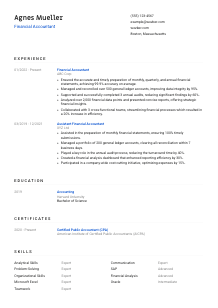
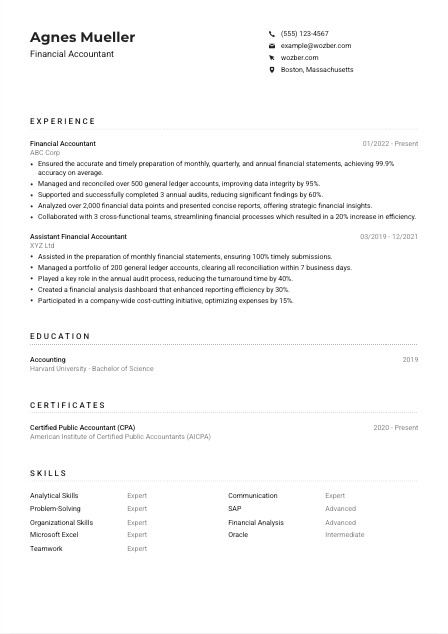
If the job requires candidates to be based in a specific city, include that location clearly in your contact details. In the example, listing Boston, Massachusetts directly answers the employer's location requirement and removes uncertainty about relocation or start logistics.
A LinkedIn profile can help if it reinforces your accounting software background, certification status, audit exposure, or reporting experience. Skip links that do not add anything useful. For this profession, consistency matters more than digital presence for its own sake.
These details should confirm that you are easy to contact, professionally presented, and aligned with any practical requirements stated in the posting. That lets the reader move quickly to your accounting experience.




This section carries the most weight for a Financial Accountant CV. Employers are looking for direct involvement in close cycles, ledger accuracy, audit support, reporting quality, and process improvement, so your bullets should show where you owned the work and what results followed.
Start by identifying the work that appears repeatedly in the job description. Here, that includes monthly, quarterly, and annual financial statements, general ledger reconciliations, audit preparation, financial analysis, and cross-functional process improvement. Build your bullets around those responsibilities if they reflect your actual experience.
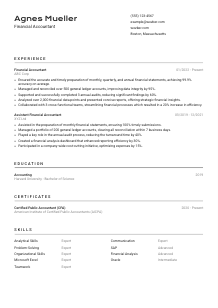
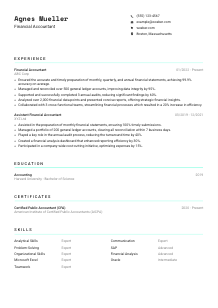
List positions in reverse chronological order and make each one clear at a glance with title, employer, and dates. Then use bullet points that show what you handled in practice, such as statement preparation, month-end close support, balance sheet reconciliations, audit schedules, or reporting packages. The example does this well by tying the Financial Accountant title to recurring deliverables rather than generic accounting support.
Quantified results are especially effective in accounting because they show scale and control. Include measures such as accuracy rates, number of ledger accounts reconciled, audit findings reduced, reporting turnaround time, close deadlines met, or efficiency gains from process changes. For example, "managed and reconciled over 500 general ledger accounts" is far stronger than simply saying you handled reconciliations.
Prioritise work that points to financial accounting judgment and reporting reliability. If an older bullet focuses on unrelated administrative tasks, replace it with experience tied to close processes, variance analysis, audit coordination, or system-based accounting work. Relevance matters more than giving every past task equal space.
Financial Accountant roles often involve improving how data moves through reporting and close workflows. Show where you partnered with operations, FP&A, or other teams to reduce manual work, tighten reconciliations, improve reporting timeliness, or strengthen controls. In the example, collaboration with cross-functional teams led to a 20% efficiency gain, which gives process improvement real business value.
When this section is tailored well, the reader can quickly see your reporting cadence, reconciliation scope, audit involvement, and contribution to cleaner financial operations. That is the core of a Financial Accountant CV.
Education matters here because many Financial Accountant openings set a clear academic baseline. You do not need to overbuild this section, but you should make it easy to confirm that you meet the degree requirement and that your studies support the role.
If the job asks for a bachelor's degree in Accounting, Finance, or a related field, list that qualification clearly. In the example, a Bachelor of Science in Accounting directly aligns with the requirement and supports the candidate's fit without extra explanation.
Present your degree, field of study, school, and graduation year in a straightforward structure. The section should be easy to verify in seconds, especially when a recruiter or hiring manager is comparing several candidates with similar years of experience.
If your degree is in Accounting, say so clearly. If it is in Finance or another related field, make sure the wording is accurate and recognizable. Financial Accountant roles rely on a solid grounding in financial reporting, accounting principles, and reconciliation logic, so the relevance of your degree should not be left implicit.
Most experienced candidates do not need to list classes. If you are early in your career or changing into financial accounting, relevant coursework such as financial reporting, auditing, cost accounting, or advanced Excel-based analysis can help connect your education to the job.
Honors, scholarships, or accounting-related student leadership can add value if they reinforce your profile and do not crowd out stronger professional experience. Use them when they sharpen your story, not just to fill space.
For this role, the education section mainly needs to confirm that you meet the academic requirement and have a credible foundation in accounting or finance. Clean formatting and precise wording are enough.
Certifications can materially improve a Financial Accountant CV, especially when they relate to reporting standards, technical accounting knowledge, or professional credibility. If a posting lists a credential as preferred, this section becomes a useful differentiator.
Review the job description for any preferred or required credential and place matching certifications first. Here, the CPA designation is preferred, so listing it prominently gives the employer an immediate reason to view your profile as more competitive.
Put the credentials most connected to financial reporting, audit support, controls, or accounting standards at the top. A finance-adjacent certificate can still appear, but it should not overshadow credentials that speak more directly to the work of a Financial Accountant.
Add the year earned or show that the certification is currently active when that helps establish recency and maintenance. In the example, showing the CPA as active from 2020 to present signals ongoing professional standing and continuing commitment to the field.
Accounting standards, systems, and reporting expectations change over time. Recent certifications or continuing education can strengthen your profile if they relate to current practice, such as updated financial reporting knowledge, ERP proficiency, or audit-related training.
A well-chosen certification section tells the reader that your accounting knowledge is current, recognized, and relevant to the level of responsibility the role requires.
The skills section should read like a snapshot of how you operate in financial accounting. Focus on the tools and strengths that support accurate reporting, ledger integrity, analysis, and collaboration across finance and business teams.
Read the job description closely and note the actual capabilities being requested. In this case, that includes accounting software proficiency, analytical ability, problem-solving, organisation, and communication. Those are more useful than broad filler skills because they map directly to month-end work, reconciliations, and reporting responsibilities.
List the software, analytical strengths, and working habits you genuinely use. ERP systems such as SAP or Oracle deserve visibility when you have them, since they often matter in enterprise accounting environments. The example also includes Excel, financial analysis, and communication, which makes sense for a role involving reporting and cross-functional coordination.
Lead with the skills most likely to affect performance in the job. For a Financial Accountant, that usually means accounting systems, reconciliations, financial reporting, analysis, controls-minded organisation, and communication with auditors or internal stakeholders. Keep the list focused enough that every item supports the target role.
When this section is tailored well, it reinforces the systems knowledge, analytical discipline, and working style needed to handle financial statements, reconciliations, and audit-related tasks with confidence.
Language skills are usually a supporting section for Financial Accountants, but they still matter when a posting calls for strong communication. Use this area to confirm required proficiency and mention additional languages only when they add real business value.
If the job calls for strong English communication, list English with an accurate proficiency level. For accounting roles, this matters because written clarity affects reporting notes, audit support, email communication, and collaboration with non-finance stakeholders.
Include additional languages when they are genuinely useful, such as supporting regional teams, shared service environments, or international reporting communication. They are rarely the deciding factor for a Financial Accountant role, but they can broaden your usefulness.
Choose simple labels such as Native, Fluent, Intermediate, or Basic. Recruiters and hiring managers should understand your language level immediately without needing a custom scale.
Do not overexpand language details unless multilingual communication is central to the employer's operations. For most financial accounting CVs, this section should stay concise and secondary to experience, systems knowledge, and reporting achievements.
A short, clear language section is enough to show that you can operate effectively in the required business language and, where relevant, support wider collaboration.
Your summary should quickly establish the kind of accounting work you do, how much experience you bring, and what outcomes you are known for. For this role, the best summaries point to reporting accuracy, ledger management, audit support, analysis, and process improvement in a few well-chosen lines.
Before writing, identify the two or three responsibilities that matter most in the target role. Here, those are financial statement preparation, general ledger reconciliations, audit support, and financial analysis. Use that mix to decide what belongs in the opening lines.
Start with a direct introduction such as "Financial Accountant with 4+ years of experience." That immediately frames your level and specialty. The example uses this approach effectively and keeps the reader oriented from the first phrase.
Follow your opener with two or three strengths tied to the work, such as improving reporting accuracy, managing ledger integrity, supporting annual audits, or streamlining finance processes. If you mention results, keep them native to accounting work rather than generic business language.
Aim for a concise paragraph that can be read in a few seconds. Avoid broad claims that could belong to any finance professional. A Financial Accountant summary should sound grounded in close cycles, reconciliations, reporting, audit readiness, and operational improvement.
A well-written summary gives the reader a clear view of your accounting focus before they reach the detail below. It should set up the rest of the CV as the record of someone who can produce accurate reporting and support sound financial operations.
A tailored Financial Accountant CV should make four things easy to see: your reporting experience, your reconciliation scope, your audit support, and your comfort with the accounting systems used in the role. If those points are clear across the page, you are presenting the right story.
Use Wozber to tighten that alignment, improve ATS optimisation, and present your experience in an ATS-friendly CV format that keeps financial details readable. Then apply with a CV that shows you can handle the close process, protect data integrity, and contribute to stronger financial reporting from day one.




