



Use Wozber and land your dream job
Create CV
No registration required
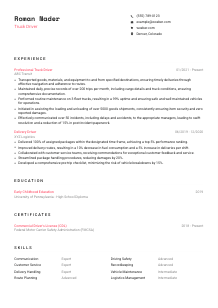
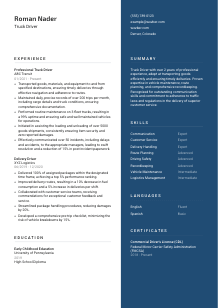
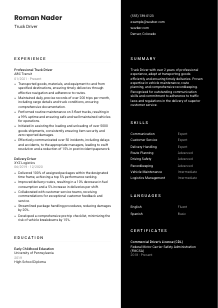
Hauling freight, but your CV feels stuck in traffic? Check out this Truck Driver CV example, built with Wozber free CV builder. Learn how to steer your driving experience and route knowledge to match job posts, keeping your career moving at the right speed on the open road of opportunities!
Truck driving CVs are read through the lens of operational reliability. Hiring teams want to see whether you can move freight safely, stay on schedule, complete inspections and logs correctly, and handle the day-to-day realities of the road without creating compliance or service problems.
A tailored CV changes what stands out first. When your experience, CDL details, safety record, route work, and trip documentation match the language of the posting, an employer can quickly connect you to the load type, reporting needs, and delivery pace they are hiring for. Wozber's free CV builder helps you organise that information in an ATS-friendly CV format, so your background is easier to read as real driving readiness.
For a Truck Driver, the top of the CV should read like a professional driver profile, not a generic contact block. Clear identity, correct contact details, and location information help employers quickly confirm they can reach you and that you meet practical hiring requirements such as route area or terminal proximity.
Use your full name in a clean, readable font so it is easy to spot at the top of the page. Keep the styling straightforward. In transportation hiring, clarity matters more than design flourishes.
Place "Truck Driver" directly under your name if that is the role you are applying for. If your recent title was "Professional Truck Driver" or "Delivery Driver," keeping the target title visible helps align your CV with both the posting and ATS searches.
Your phone number and email should be accurate and professional, since dispatchers, recruiters, and fleet managers often move quickly when scheduling interviews or road tests.
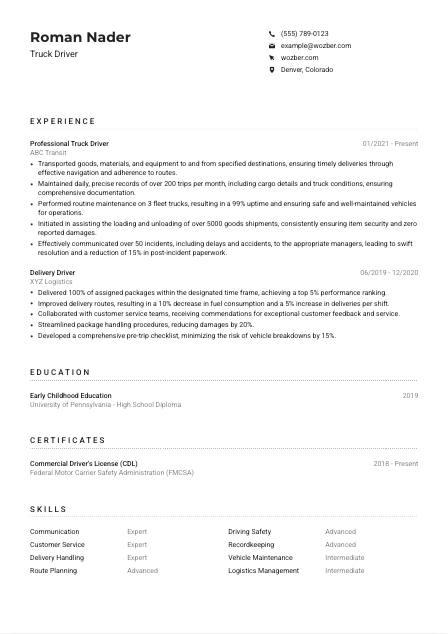
If the employer wants someone based in a certain area, include your city and state. In the example, listing Denver, Colorado immediately supports a posting that asks for local availability or willingness to relocate.
Add LinkedIn or a professional website only if it supports your driving background with consistent information. For many truck driver roles, a clean CV with strong experience, CDL credentials, and contact details matters more than a thin online profile.
This section should answer the practical basics fast: who you are, how to reach you, and whether your location fits the operation. Make that easy to confirm in the first glance.




Experience carries the most weight on a truck driver CV because it shows how you operate in real conditions. Employers look for safe driving, on-time delivery, accurate logs, cargo handling, vehicle inspections, and the kind of consistency that keeps freight moving without incidents or customer complaints.
Start by identifying the work patterns the employer cares about most. For truck driving, that often includes safe driving, timely delivery, pre-trip and post-trip inspections, routine maintenance, load security, and trip records. Those duties should appear clearly in your bullets, using the same terminology when it matches your actual work.
Begin with your most recent role and work backward. Use job titles that reflect driving responsibility, such as "Professional Truck Driver" or "Delivery Driver," and include employer name and dates so the reader can quickly see the length and progression of your road experience.
Do not stop at saying you transported goods. Show how well you did it. The sample does this effectively with points such as maintaining over 200 trip records per month and supporting 99% fleet uptime through routine maintenance. Those details tell an employer you handled both delivery execution and vehicle care.
Quantify work with metrics that belong in this field: trips per month, on-time delivery rate, fuel savings, fleet uptime, number of shipments handled, damage reduction, or incident volume managed. "Assisted with loading and unloading of over 5000 shipments" says much more than a broad claim about helping with cargo.
Prioritise experience that supports the target role. If a bullet does not say something useful about driving performance, safety, documentation, customer service, route execution, or equipment handling, cut it. Even older delivery work can stay if it proves transferable strengths such as route efficiency, checklist discipline, or zero-damage handling.
Your experience section should make it easy to picture you in the cab, on the route, and at the dock. Show a safe, dependable driver who can deliver freight, document the work properly, and keep the truck road-ready.
Education usually plays a supporting role on a truck driver CV, but it still adds structure and completeness. Most employers care far more about your CDL, driving record, inspections, and delivery history, yet your schooling can still confirm basic qualifications and help round out your profile.
If the posting does not ask for a specific degree, list your highest completed education plainly. For many truck driver roles, a high school diploma is enough to include. It shows baseline qualification without taking attention away from licenses and driving experience.
List the school name, credential, field if applicable, and graduation year or date. Do not overbuild this section. Transportation hiring managers usually spend more time on your CDL, endorsements, and driving history than on academic detail.
If you studied logistics, automotive technology, diesel mechanics, or transportation-related coursework, mention it because it adds context to vehicle knowledge or supply chain awareness. If your field is unrelated, keep the entry brief and factual.
Newer drivers with limited road experience can include training tied to safety procedures, vehicle systems, logistics, or transportation operations. If you already have solid experience behind the wheel, those details are usually less important than your work record.
Only include honors, awards, or standout coursework if they reinforce work habits that matter in trucking, such as reliability, technical discipline, or safety awareness. Otherwise, leave the space for stronger experience and certification content.
This section does not need to do heavy lifting. Keep it clean, accurate, and brief so the focus stays on your driving qualifications and operating record.
Certificates and endorsements carry real weight in truck driving because they affect what you are legally allowed to haul and how quickly you can be placed into service. This section should make your CDL status easy to find and easy to trust.
If the posting asks for a valid Commercial Driver's License, place your CDL first. That is the core credential for the role, and it should never be buried under less relevant training.
If you hold Hazmat, Tanker, Doubles/Triples, or other applicable endorsements, list them right after the CDL. Endorsements often determine route eligibility, cargo type, and scheduling flexibility, so they can materially strengthen your candidacy.
Include the issue or active date range where relevant. In the sample, showing the CDL as active from 2018 to present immediately reassures the reader that the license is current and maintained.
Outdated certificates can raise questions in a compliance-heavy field. Review this section regularly and add recent safety, inspection, or specialised hauling credentials when they support the kinds of loads or routes you want to work.
Licensing details should confirm that you are qualified to drive, properly credentialed for the freight, and ready to step into the assignment without paperwork issues.
A truck driver skills section works best when it reflects the actual demands of the route, the equipment, and the reporting expectations. Generic soft-skill lists do not help much unless they connect to freight handling, customer interactions, inspections, logs, or delivery performance.
Read the posting closely and extract the specific abilities behind the duties. In this case, that includes safe driving, communication, customer service, routine maintenance, inspections, recordkeeping, and load handling. These are the terms an employer expects to see connected to real experience.
Put the most role-critical skills near the top. Route planning, driving safety, vehicle maintenance, delivery handling, cargo security, and trip documentation usually carry more hiring value for a truck driver than broad workplace traits. The sample skills list works well because it centers on route planning, driving safety, and recordkeeping instead of vague claims.
Choose skills that map directly to the role rather than listing everything you have ever done. A concise, targeted list is better for ATS optimisation and easier for a fleet manager to scan. Use wording that matches the posting naturally, and avoid stuffing the section with repeated variations of the same skill.
This section should support the story already told in your experience: you can drive safely, manage the truck, handle freight correctly, and communicate clearly with customers, dispatch, and supervisors.
Language ability matters in trucking when it affects dispatch communication, customer handoffs, paperwork accuracy, and incident reporting. For many roles, English is the key requirement because it supports safety instructions, logs, roadside communication, and day-to-day coordination.
If the employer asks for good English proficiency, list English first and state your level clearly. This is directly relevant to understanding route instructions, completing records, and communicating issues to managers.
Order languages by practical usefulness and confidence level. "Fluent English" should appear before secondary languages if it is the operational language of the job.
Extra languages can be useful for customer-facing deliveries, diverse warehouse environments, and cross-team communication. In the sample, basic Spanish adds value without overstating capability.
Use honest ratings such as Fluent, Conversational, Basic, or Native. In a role where communication can affect safety, timing, and paperwork, inflated language claims can create real problems.
Not every driving job needs multiple languages, so keep this section proportionate. Regional freight roles may only need strong English, while urban delivery routes or customer-heavy operations may benefit from an additional language.
List languages when they strengthen communication on the road, at delivery points, or with the operations team. For this profession, clear English proficiency is often the most important part.
The summary should give a quick read on the kind of driver you are before the employer gets into the details. In a few lines, it should cover your experience level, driving focus, safety habits, delivery reliability, and any credentials or strengths that match the job.
Look at the posting and identify the essentials. For a truck driver, that often means safe driving, timely deliveries, inspections, maintenance awareness, communication, and accurate trip records. Those are the ideas your summary should reflect.
Start with your title and years of experience, then anchor it in the kind of work you do. "Truck Driver with over 2 years of professional experience" is a clear opening because it immediately establishes role alignment and required tenure.
Choose two or three specifics that matter for the target job, such as route planning, vehicle maintenance, cargo handling, customer service, or compliance with traffic laws. The sample summary works because it combines transport efficiency with recordkeeping and safety, which are central to the role.
Aim for three to five lines. Skip generic traits unless they connect to the work. A concise summary should make the reader expect strong experience in deliveries, inspections, logs, and road safety, then find those points confirmed in the sections below.
Your summary should quickly position you as a driver who can be trusted with freight, equipment, documentation, and customer-facing delivery responsibilities. Keep it short, factual, and matched to the route profile of the job.
A truck driver CV works best when it shows exactly how you operate: safely, on time, in compliance, and with clear trip records. Tailor each section to the actual haul, equipment, endorsements, and reporting expectations in the posting so the employer can connect your background to the work quickly.
Use Wozber's free CV builder to shape that information into an ATS-compliant CV with clear structure, targeted wording, and stronger alignment to the job description. When your CV is built around driving performance, inspections, cargo handling, and communication, hiring teams can judge your readiness for the route without guesswork.




