



Use Wozber and land your dream job
Create CV
No registration required
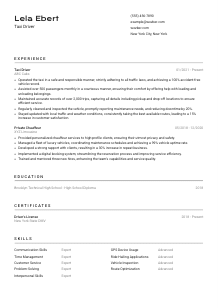
Nudging through traffic, but your CV seems to hit a red light? Cruise along with this Taxi Driver CV example, created with Wozber free CV builder. Learn how to turn your on-road expertise into a CV that matches job destinations, putting your career in the fast lane to success!
Taxi work is judged in real time. Passengers notice whether you drive safely, know the quickest practical route, keep the vehicle clean, and stay calm when traffic, weather, or pickup changes test your judgment. Your CV should make those day-to-day standards visible, especially the parts that show you can handle both the road and the customer experience.
When a CV is tailored well, hiring teams can quickly separate someone who simply has a license from someone who has handled paid driving, trip volume, passenger service, and vehicle upkeep professionally. Wozber's free CV builder helps you shape that experience into an ATS-compliant CV, so driving history, route knowledge, and service skills are easy to read and match to the role.
For a Taxi Driver, the top of the CV should confirm basic hiring requirements without delay. Clear contact details, the right title, and location can answer practical questions before the reader even reaches your experience, especially when the employer needs someone already based in the service area.
Use your full name in a clean, readable format at the top of the page. Taxi hiring is practical, and an overly styled header adds nothing. What matters here is immediate recognition and a layout that keeps the focus on your driving record, customer service, and work history.
Place "Taxi Driver" directly under your name if that is the role you are applying for. Matching the posted title helps connect your CV to the opening right away and keeps your professional identity clear, especially if your background also includes related work such as chauffeur or delivery driving.
Add a working phone number and a professional email address you check regularly. For drivers, response speed matters because interviews, license checks, and shift discussions often move quickly. Keep this section simple and accurate.
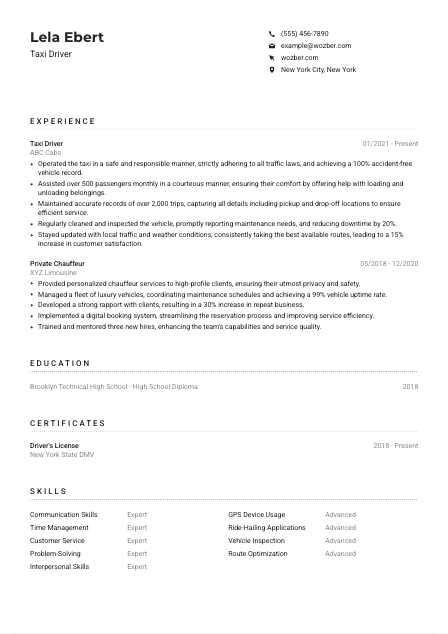
If the employer asks for a driver based in a specific city, include your city and state. In this example, listing "New York City, New York" immediately supports the posting's location requirement and removes doubt about local availability. Only include location details that genuinely match your situation.
A LinkedIn profile or personal website is optional. Include it only if it supports your application with relevant information such as driving experience, customer-facing roles, or endorsements tied to transportation or service work. If you add it, make sure the dates, titles, and responsibilities match your CV.
Keep the opening of your CV clean and factual. A hiring manager should be able to see your role target, contact details, and relevant location in seconds, then move straight to the proof that you can drive safely and serve passengers well.




Taxi employers usually spend the most time on experience because this section shows how you perform once the shift starts. They want to see safe driving, passenger care, route judgment, vehicle responsibility, and work done at real volume, not broad claims about being hardworking or reliable.
Before rewriting bullets, mark the responsibilities that define the job. For Taxi Driver roles, that often includes safe operation, traffic law compliance, passenger assistance, trip logging, vehicle inspection, and route planning using current traffic conditions. Those points should guide which achievements you emphasize and which older details you trim.
Start with your most recent job and include title, employer, and dates. Reverse chronological order works well for driving positions because it shows whether your professional driving experience is recent, continuous, and relevant. If you held related roles such as private chauffeur, shuttle driver, or delivery driver, keep the titles accurate and let the bullets explain the overlap.
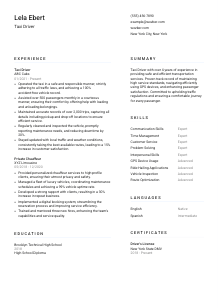
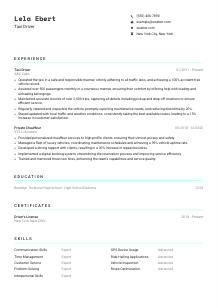
Bullet points should show how well you did the work, not just that you did it. Strong Taxi Driver bullets often mention accident-free records, passenger volume, trip counts, customer satisfaction, reduced vehicle downtime, or repeat business. The sample CV does this well with details like a 100% accident-free record, more than 2,000 trips logged, and a 20% reduction in downtime.
Quantify the parts of the job that matter operationally. Monthly passengers served, on-time pickups, route efficiency, maintenance response, repeat riders, or uptime are all useful when they are accurate. For example, stating that you assisted over 500 passengers monthly tells the reader you can handle high-volume service without losing professionalism.
If your background includes jobs outside transportation, only keep them if they support relevant strengths such as customer service, cash handling, schedule discipline, or operating under time pressure. The experience section should stay centered on professional driving, passenger interaction, and vehicle responsibility so the match to the Taxi Driver role stays obvious.
This section should leave little doubt that you can manage a vehicle responsibly, work with passengers courteously, and keep service moving under real street conditions. Specific bullets and honest metrics do that far better than generic job descriptions.
Education is usually a straightforward section for Taxi Driver roles, but it still matters because many postings set a minimum requirement such as a high school diploma or GED. Present it clearly, then use any extra training to reinforce professionalism, safety awareness, or customer-facing experience.
If the job asks for a high school diploma or GED, make sure that requirement is easy to spot. List the credential, school name, and graduation year or completion date. In the example CV, the high school diploma is enough to meet the posting's education requirement without overexplaining.
This section does not need decoration. A direct entry such as "High School Diploma, Brooklyn Technical High School, 2018" gives the reader exactly what they need. For driving roles, clean presentation matters more than extra narrative.
Most Taxi Driver jobs do not require advanced education, but training connected to transportation, logistics, hospitality, or public service can still strengthen your CV. Include it if it adds context for route planning, customer interaction, or operating procedures.
Defensive driving, road safety, first aid, conflict de-escalation, or customer service coursework can fit here if you do not have a separate place for it. These details are especially useful when they support the way you handle passengers, road risks, or daily service standards.
If you have completed refresher training or short courses after school, include the ones that sharpen your performance as a professional driver. Keep the focus on practical topics that improve safety, service quality, or vehicle care rather than listing unrelated classes.
For this role, education should confirm the requirement and support your work on the road. A short, accurate section is enough unless additional training strengthens your case in a meaningful way.
For a Taxi Driver, certifications are closely tied to legal eligibility and day-to-day trust. Employers want to know you are cleared to drive, current on any required credentials, and serious about safe, compliant service.
Put your valid driver's license first because it is central to the role. If the posting specifically mentions a clean driving record, make sure the rest of your CV supports that claim through safe-driving achievements and consistent professional driving history.
If you hold other relevant credentials, list them after your license. Defensive driving, first aid, passenger transport permits, or local transportation certifications can all strengthen your application when they are current and applicable to the job.
Dates help employers understand whether your credentials are active. For a driver's license, showing an issue range such as "2018 - Present" works well when it reflects an active, valid license. Current documents matter in transportation roles where compliance is part of daily work.
Additional training is worthwhile when it connects to the realities of the job, such as safer driving, passenger assistance, emergency response, or local regulations. You do not need a long list. A few well-chosen credentials can say more than several unrelated ones.
Your certificates should confirm that you are legally prepared to drive and professionally prepared to handle passengers, routes, and vehicle responsibility. Keep the list current and tightly tied to transportation work.
Taxi Driver skills need to reflect what happens during an actual shift. Hiring managers look for a mix of driving judgment, passenger-facing communication, and practical tool use such as GPS navigation or ride-hailing apps. A short, relevant list works better than a long inventory of generic strengths.
Start with the wording used in the posting so your CV matches the role naturally. In this example, that includes interpersonal and communication skills, GPS familiarity, ride-hailing application use, and English proficiency. Those terms connect both with human readers and ATS screening.
Choose skills that reflect the actual flow of the job, such as customer service, route optimisation, vehicle inspection, time management, and problem-solving during traffic or schedule changes. This keeps your CV tied to the work instead of drifting into broad traits that could belong to any role.
If your CV format allows it, organise skills by function. For example, you might group driving and navigation skills separately from customer service and communication skills. The sample list works because it balances service strengths like interpersonal communication with technical abilities like GPS device usage and vehicle inspection.
The right skills list tells the employer you can handle the vehicle, the route, and the passenger interaction in one shift. Keep it focused on the tools, judgment, and service habits that actually matter in taxi work.
Language ability carries practical weight in passenger transport. Drivers need to understand directions, answer questions clearly, and keep communication calm during pickups, delays, or route changes. In a large, diverse city, additional languages can also improve the passenger experience and widen the range of riders you can serve.
If the posting asks for English proficiency, list English first and label your level accurately. That immediately confirms you can handle directions, app-based communication, trip details, and everyday passenger interaction in the language required for the job.
Use clear labels such as Native, Fluent, Advanced, or Intermediate. Simple ratings are easier to read than long explanations. In the example CV, "English - Native" quickly addresses the requirement without wasting space.
Additional languages can strengthen your CV when they reflect the communities you serve or the type of riders you often encounter. Spanish, for instance, may be useful in many urban markets because it helps with directions, pickup coordination, and basic customer care.
Only claim a level you can handle in conversation. If a passenger asks route questions, confirms a destination, or needs help with luggage, your stated language level should hold up in a real interaction. Accuracy matters more than trying to sound more impressive.
Extra languages are worth listing when they help you do the job better. Keep the section brief and relevant. The point is to show smoother communication with passengers, not to pad the CV.
A clear language section shows you can communicate reliably with passengers and meet any stated English requirement. If you also speak another commonly used language, that can be a practical advantage in day-to-day service.
The summary sits near the top of the CV, so it should quickly tell the reader what kind of driver you are. For Taxi Driver roles, that usually means years of professional driving, safety record, route efficiency, customer service, and familiarity with navigation tools, all expressed in a few direct lines.
Start with a clear professional identity, such as "Taxi Driver with over 4 years of experience" or a similar line that accurately reflects your background. This immediately tells the reader whether you meet experience expectations like the 2+ years requested in the posting.
Use the next sentence to highlight the parts of your work that define performance, such as safe transportation, efficient route selection, passenger comfort, or trip accuracy. The example summary works because it combines transportation service, GPS use, and customer satisfaction without turning into a list of buzzwords.
Aim for three to five lines with no wasted wording. A Taxi Driver summary should be easy to absorb in seconds, especially when the reader is reviewing multiple applicants and looking first for paid driving experience, clean execution, and customer-facing reliability.
Finish with a line that reflects your approach to the job, such as following traffic regulations, keeping passengers comfortable, or delivering dependable service in busy city conditions. That gives the summary a grounded finish and connects your experience to daily expectations.
By the end of this section, the employer should already understand your level of driving experience, your service standard, and how you handle the essentials of the job. Keep it concise, specific, and aligned with the routes, passengers, and responsibilities you actually manage.
A well-tailored Taxi Driver CV should show three things quickly: you can drive safely, work well with passengers, and manage the practical details that keep service running, from route choices to trip records and vehicle checks.
Use Wozber to turn that experience into a polished, ATS-friendly CV format, then refine the wording with its AI CV builder and ATS CV scanner so your driving history, service metrics, and job-specific keywords align naturally with the opening.
When the CV is finished, a hiring team should be able to see that you are ready for paid driving work from day one.