



Use Wozber and land your dream job
Create CV
No registration required
Directing the rails, but your CV feels off-track? Check out this Train Conductor CV example, created with Wozber free CV builder. Learn how to line up your railroad experience with job requirements, keeping your career journey on the right track!
Train conductors work in an environment where timing, safety, and communication have no room for guesswork. A hiring team wants to see more than general transportation experience. Your CV should quickly show that you can follow signals and timetable instructions, complete pre-trip checks, coordinate with dispatch and engineering staff, and keep passengers safe and informed while the train stays on schedule.
For this kind of role, small wording choices change how clearly your background comes through in ATS screening and human review. Wozber's free CV builder helps you line up your experience with the posting in an ATS-friendly CV format, so certifications, operating knowledge, and passenger-facing work are easy to find. That makes it easier for the employer to recognize you as someone who can handle active rail operations from day one.
Rail employers expect immediate clarity on who you are, what role you are targeting, and whether basic logistics are already covered. In a Train Conductor CV, the personal details section should remove friction fast so the reader can focus on your operating experience, certification, and safety record.
Use your full name at the top of the page in a clean, readable format. Keep it slightly more prominent than the rest of the header so it is easy to identify in a printed CV, PDF, or ATS-parsed profile. This section does not need decoration. It needs to be unmistakable.
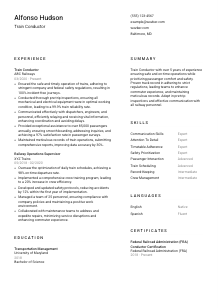
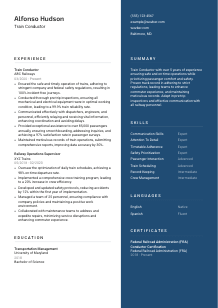
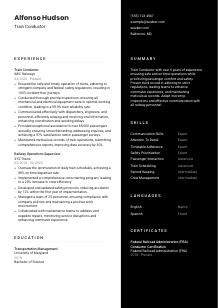
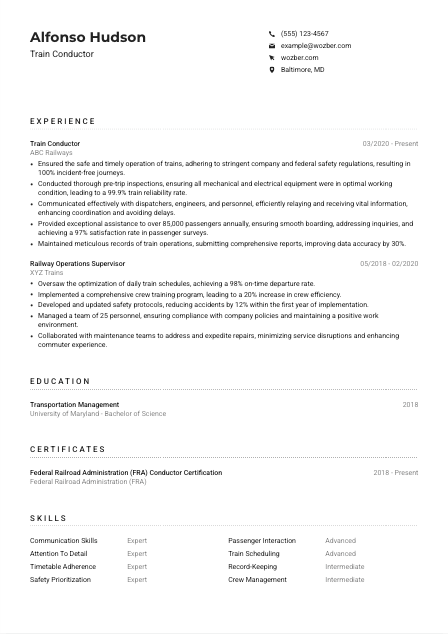
Place the role title directly under your name and match the job posting when it fits your background. If you are applying for a Train Conductor position, say "Train Conductor" rather than a broader label like "Transportation Professional." The sample CV does this well and immediately anchors the rest of the document in railway operations.
List a phone number and professional email address that work reliably. For a role built on clear communication with dispatchers, engineers, crew members, and passengers, even simple details like a typo-free contact line matter. If you include a website or LinkedIn profile, make sure it supports your rail background rather than distracting from it.
If the employer names a city or relocation expectation, include your city and state in the header. In this case, Baltimore, MD is relevant because the posting specifically asks for local availability or willingness to relocate. That is a tailoring point, not a rule for every Train Conductor job, but when it appears in the posting, answer it directly.
A LinkedIn profile can strengthen your application when it mirrors your CV and includes relevant rail experience, certifications, and progression into conductor-level responsibility. If the profile is sparse or outdated, leave it off until it reflects the same standards as your CV.
Your header should answer basic logistical questions in seconds: who you are, which rail role you want, and whether the employer can contact and place you without extra follow-up.




This section carries the most weight for a Train Conductor because the work is practical, regulated, and visible in measurable outcomes. Hiring teams look for safe train movement, rule compliance, inspection discipline, crew coordination, passenger handling, and reliable reporting. Your bullets should show how you performed in those areas, not just that you were present for them.
Before writing bullets, identify the operational priorities in the job description. Here, the standout themes are safe and timely operation, pre-trip inspection of mechanical and electrical equipment, communication with dispatchers and engineers, passenger assistance, and record-keeping. Build your experience section around those same working realities so the employer sees direct overlap with conductor responsibilities.
List your positions in reverse chronological order, starting with the most recent job. For railway hiring, title progression matters. A direct conductor role should be highly visible, while related roles such as railway operations supervisor can still add value when they show schedule oversight, safety leadership, crew coordination, or service continuity.
Write bullet points that connect the task to the outcome. "Conducted pre-trip inspections" is better when expanded into reliability, compliance, or reduced service disruption. In the sample CV, metrics such as 100% incident-free journeys, 99.9% reliability, and service delivered to 85,000 passengers annually make conductor work tangible. Use numbers that fit your own record, whether that is on-time performance, inspection accuracy, delay reduction, safety results, or passenger volume.
Prioritise accomplishments that speak directly to rail operations. If you have other customer service, logistics, or supervisory experience, keep only the parts that translate well, such as rule adherence, shift coordination, incident response, or documentation discipline. The closer the work is to train movement and passenger safety, the more space it deserves.
Train Conductor CVs benefit from concrete performance markers because the job itself is measured through reliability, compliance, coordination, and passenger experience. Include figures where they are honest and useful: on-time departure rates, accident reduction, passenger satisfaction, reporting accuracy, crew size, or inspection consistency. Numbers help the reader understand the scale and discipline of your work.
After reading this section, the hiring team should have a clear picture of the routes you have supported, the operating standards you met, and the safety and service outcomes you produced.
Education rarely outweighs conductor experience and certification, but it still helps frame your professional base. For rail operations roles, education is most useful when it reinforces transportation knowledge, operational discipline, or formal preparation for safety-focused work.
Even when a job description does not require a degree, it may still reward education related to transportation systems, operations, logistics, or safety management. Look at the work itself for clues. If the role centers on movement control, compliance, and coordination, relevant study can support your candidacy without needing to dominate the CV.
List your degree, school, and graduation year in a straightforward format. This section should be easy to scan and easy for an ATS to parse. For most Train Conductor CVs, one concise entry is enough unless you have additional rail-specific training that genuinely strengthens your application.
If your degree connects naturally to rail or transit work, make that visible. A Transportation Management degree, like the one in the sample CV, adds context because it supports scheduling, operations, and service coordination. That kind of alignment is useful, but it should still sit behind experience and certification in the overall CV hierarchy.
Relevant coursework, workshops, or training in transportation safety, operations management, passenger service, or compliance can help if you are earlier in your career or moving into conductor work from a related railway role. Keep these additions selective and tied to the actual demands of the target position.
Academic honors, associations, or rail-related learning activities can be worth mentioning when they reinforce a clear professional direction. This matters most when your experience is still growing and you need more proof of commitment to the field. If you already have several years of conductor experience, keep education concise.
Use education to support your rail background, not to compensate for it. For experienced conductors, this section should quietly confirm preparation while experience and certification do the heavier lifting.
In train operations, certifications are not optional extras. They tell the employer you meet regulated standards and can legally perform key duties. For a Train Conductor, the right certificate should be easy to find and impossible to miss.
If the posting calls for a specific credential, list it exactly and make sure the wording matches the official name. Here, the Federal Railroad Administration FRA Conductor Certification belongs near the top of the certifications section because it is a stated requirement and a core hiring filter.
Focus on certifications tied to rail safety, operations, compliance, or equipment procedures. A long list of marginal credentials can dilute the section. Employers care most about certifications that show you are cleared, current, and prepared for live railway operations.
Add the issue date or active date range when available. In regulated roles, recency matters. The sample CV shows the FRA certification as active from 2018 to present, which immediately tells the reader it remains current and relevant.
Rail safety rules, procedures, and operating expectations evolve. If you complete renewals or additional relevant training, include them when they reinforce your reliability in a safety-sensitive environment. This is especially useful if the employer emphasizes federal compliance or operational discipline.
A hiring manager should be able to scan your certifications and confirm quickly that you meet the formal requirements to step into conductor duties safely and compliantly.
A Train Conductor skills section works best when it reflects actual operating demands, not generic strengths. Think in terms of signal interpretation, timetable adherence, passenger handling, crew communication, inspection discipline, reporting accuracy, and safety-first decision-making. Those are the skills that connect directly to the job.
Start with the skills the employer names, then add the ones embedded in the work. This posting explicitly asks for communication, attention to detail, timetable and signal understanding, safety prioritization, and English proficiency. It also implies coordination with dispatch, passenger support, and accurate record submission. Those are the phrases worth mirroring when they match your experience.
Lead with the abilities that matter most in active rail service. For this role, safety prioritization, timetable adherence, passenger interaction, and communication with crew and dispatch belong ahead of broader transferable skills. The sample CV gets this right by foregrounding communication, attention to detail, timetable adherence, and safety.
Choose skills you can support elsewhere in the CV through experience, training, or certification. A shorter list tied to real conductor work is more persuasive than a long menu of vague traits. If you add skill levels, make sure they reflect your actual working ability and stay consistent with the rest of the document.
Every skill here should connect back to train movement, crew coordination, passenger service, or compliance. If it does not help explain how you operate safely and reliably, it can stay off the page.
For a Train Conductor, language ability is operational, not cosmetic. Clear communication affects passenger instructions, crew coordination, announcements, and incident handling. If the posting names a required language, treat it as a core qualification and present it with the same clarity you would give to certification or safety knowledge.
When the job description specifies strong English proficiency, list English prominently and include your level. That requirement matters because conductors must understand instructions, document operations accurately, and communicate clearly with passengers, engineers, and dispatch.
Start with the language named in the posting, then add any others that can genuinely support service on the route or in the passenger population you serve. This ordering shows that you understand which communication demands are essential and which are additional strengths.
Extra languages can be valuable in passenger-facing rail roles, especially on routes serving diverse communities or high-volume public traffic. In the sample CV, Spanish adds useful context because it can improve passenger assistance without distracting from the required English proficiency.
State your level with plain terms such as Native, Fluent, Intermediate, or Basic. Avoid inflated descriptions. In a safety-sensitive role, honest communication about language ability matters as much as honest reporting about any other skill.
Only include languages you can use meaningfully in announcements, questions, directions, or service interactions. This section is strongest when it supports the actual communication environment of the job rather than trying to look impressive on its own.
This section should show that you can handle essential English communication and, where relevant, serve passengers and crew more effectively across a broader range of interactions.
The summary is your opening professional statement, and for this role it should sound grounded in rail operations. A hiring manager should see conductor experience, certification-level credibility, safety focus, and operating discipline within a few lines. Keep it compact, but make every phrase earn its place.
Start with your title and a realistic measure of experience, such as "Train Conductor with 5+ years of railway operations experience." That immediately places you in the right lane and helps distinguish you from candidates whose background is only adjacent to conductor work.
Use the summary to echo the duties that matter most for the target job. For this position, that means safe and timely train operation, pre-trip inspections, communication across rail personnel, passenger support, and accurate records. The sample summary does this effectively by combining on-time operations, safety, passenger comfort, inspections, and cross-team communication.
Aim for a short paragraph that reads quickly and contains real operating substance. Three to five lines is usually enough. Skip broad claims about being hardworking or dedicated unless you tie them to railway outcomes such as incident-free service, reliability, or compliance.
Finish by reinforcing what you bring to the employer now. That could be a safety record, strong command of timetable and signal instructions, or experience supporting high passenger volumes without service disruption. The ending should sound like proven readiness for conductor duties, not a generic statement about career goals.
If the summary is doing its job, the reader should understand your conductor background, your operating strengths, and why you belong in the interview pool before they reach the second section.
A Train Conductor CV should leave no ambiguity about three things: your safety record, your command of rail operations, and your ability to communicate clearly with both crew and passengers. When each section supports those points with specific titles, certifications, duties, and measurable outcomes, the application reads like someone ready for active service rather than someone adjacent to it.
Use Wozber's free CV builder to tighten that alignment across the whole document, from ATS optimisation to clearer wording and structure. With an ATS CV scanner, targeted revisions, and an ATS-friendly CV template, you can present your experience in a format that makes conductor qualification, compliance, and day-to-day operating value easy to judge.