



Use Wozber and land your dream job
Create CV
No registration required
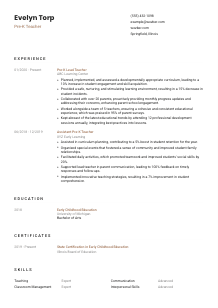
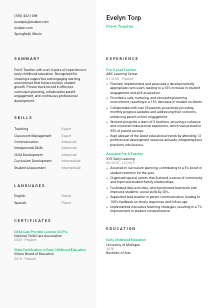
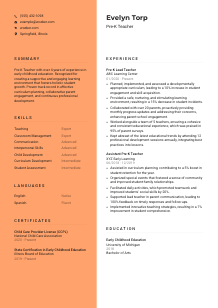
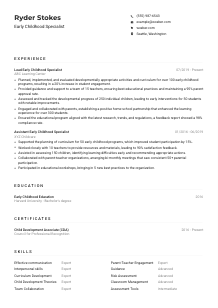
Nurturing minds, but your CV feels like naptime? Check out this Pre-K Teacher CV example, created with Wozber free CV builder. Learn how to align your early childhood magic with the job requirements, sparking career growth like a burst of giggles at storytime!
Pre-K teaching CVs need to show far more than a love of working with children. Schools want to see how you build a classroom that is safe, calm, developmentally appropriate, and full of structured learning through play. Your CV should make that visible through curriculum planning, classroom routines, family communication, and the way you support social, emotional, and early academic growth.
A tailored CV also helps a hiring team quickly separate general childcare experience from true early childhood teaching experience. Using Wozber's free CV builder to shape an ATS-compliant CV makes it easier to match your language to the posting, surface credentials such as early childhood certification, and present the teaching work that matters most for a preschool classroom.
For a Pre-K Teacher, the header needs to confirm practical basics fast. School leaders should be able to see who you are, what role you are pursuing, and whether you meet immediate logistics such as contact access and, when relevant, location requirements.
Use your full name at the top in a clear, readable format. Keep it more prominent than the rest of the header so principals, directors, or hiring coordinators can identify your application quickly when reviewing a stack of teaching CVs.
Place "Pre-K Teacher" directly under your name if that is the role you are applying for. This works especially well when your current title is close but not identical, such as "Pre-K Lead Teacher" or "Assistant Pre-K Teacher," because it connects your background to the classroom opening right away.
List a phone number you answer regularly and a professional email address, ideally a simple variation of your name. In education hiring, missed calls can mean missing interview scheduling, classroom observation requests, or follow-up about licensing and references.
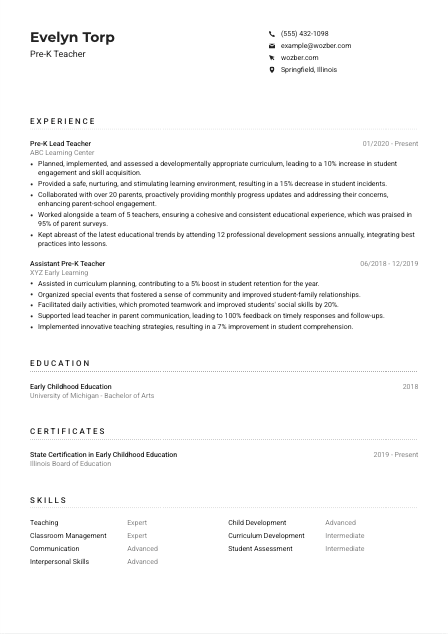
If the school specifies that candidates must be based in a certain area or willing to relocate, say so clearly in your header. In the provided example, listing Springfield, Illinois directly supports a stated requirement and removes an avoidable question early in the review process.
A LinkedIn profile, teaching portfolio, or personal site can strengthen your application when it includes material that supports your classroom work, such as lesson themes, parent communication samples, or your teaching philosophy. Only include it if it is current and aligned with early childhood education.
This section does not need personality flourishes. It needs accuracy, professionalism, and clear alignment with the role so the school can move straight to your teaching background.




This is where schools look for day-to-day teaching proof. Hiring teams want to see whether you can plan age-appropriate activities, manage behaviour with care, communicate with families, and contribute to a consistent early learning environment.
Read the posting line by line and mark the duties that define the classroom. For a Pre-K Teacher, that usually includes developmentally appropriate curriculum, child safety, parent updates, collaboration with staff, and professional development. Those priorities should shape which bullets you lead with and which classroom examples you choose.
List your positions in reverse chronological order and make the preschool or early childhood teaching work easiest to spot. Include job title, school or centre name, and dates. If you have held both support and lead roles, show the progression clearly, as the example CV does from Assistant Pre-K Teacher to Pre-K Lead Teacher.
Replace generic statements like "responsible for lesson planning" with bullets that show what your teaching produced. Strong examples include improving student engagement, reducing classroom incidents, strengthening social skills, or increasing family participation through regular progress updates.
Metrics can add credibility when they reflect real classroom results. In the sample CV, a 10% increase in student engagement, a 15% decrease in incidents, and monthly communication with more than 20 parents give the reader a concrete sense of scope and performance. You can also quantify class size, parent response rates, survey results, or the number of professional development sessions completed.
Prioritise accomplishments that prove you can deliver a strong early childhood program. Curriculum design, learning-through-play activities, behaviour support, parent communication, and collaboration with other teachers belong here. Leave out older or less relevant achievements unless they clearly strengthen your case for a classroom-based Pre-K role.
Your experience section should leave little doubt about how you teach, how you manage the room, and how your work affects children, families, and the wider teaching team.
For Pre-K roles, education is not a formality. It often establishes whether you meet the baseline for child development knowledge, teaching methodology, and eligibility for certification or licensing.
If the posting asks for a bachelor's degree in Early Childhood Education or a related field, make that qualification easy to confirm. List the degree, field of study, school, and graduation year in a clean format. In the example, "Bachelor of Arts in Early Childhood Education" directly supports the stated requirement.
Keep the structure simple so school administrators can scan it fast. Degree first, then field, institution, and graduation date usually works best. This is especially helpful when your degree title differs slightly from the language in the posting but the field still aligns.
When a school asks for Early Childhood Education, use that exact field name if it matches your academic record. Accurate wording supports ATS matching and reduces ambiguity about whether your background is in early childhood, elementary education, or a broader education track.
If you are early in your career, you can include honors, practicum placements, or coursework tied to child development, play-based learning, literacy foundations, or classroom assessment. Once you have substantial teaching experience, these details matter less unless they are directly relevant to the position.
Professional learning in behaviour support, inclusive instruction, early literacy, trauma-informed practice, or developmental assessment can be worth noting if it adds useful context. Keep the focus on training that improves how you teach preschool-aged children, not on unrelated coursework.
A school should be able to confirm your academic foundation in seconds. Clear education details support your credibility as someone prepared to teach young children with the right developmental approach.
In Pre-K hiring, certifications often move from preferred to essential. This section tells the school whether you meet licensing expectations and whether your credentials are current for classroom practice.
If the job asks for state certification or licensure in Early Childhood Education, list that credential at the top of this section. It is one of the first things a school may check before moving your application forward. The sample CV does this well by placing state certification ahead of the additional license.
Prioritise licenses and certificates that relate directly to early childhood classrooms, child care settings, developmental instruction, or child safety. A short, relevant list is stronger than a long list of general training with little connection to Pre-K teaching.
Include dates when a credential is current, recently earned, or requires renewal. This is useful for schools that need to confirm you are presently licensed or eligible to teach. A format such as "2019 - Present" works well when the certification remains active.
Beyond required licensing, additional credentials can show where you have invested in your teaching practice. For Pre-K educators, that might include child care licensing, early learning frameworks, classroom management training, or family engagement programs. Keep the emphasis on training that improves work with preschool-aged children.
This section should answer a practical hiring question quickly. Are you licensed, current, and prepared to work in an early childhood classroom? Make that easy to confirm.
The best skills sections for Pre-K teachers do not read like a generic personality list. They highlight the classroom abilities, child-development knowledge, and communication strengths that support daily teaching in an early learning environment.
Start with the language the school already uses. In this case, the most important areas include child development, age-appropriate teaching methods, communication, interpersonal skills, and collaboration. Those are the skills to prioritise because they connect directly to classroom performance.
List the strengths you can back up elsewhere in the CV. If your experience bullets show lesson planning, student assessment, family communication, and classroom routines, use those same themes here. The example CV handles this well with skills such as Classroom Management, Child Development, Curriculum Development, and Student Assessment.
Use concise skill names that a school can scan quickly, and avoid padding the section with vague traits. For a Pre-K Teacher, practical skills such as behaviour guidance, play-based instruction, classroom management, early literacy support, and parent communication usually carry more weight than broad claims like "hardworking" or "team player."
When this section is tailored well, it supports everything else on the page. The reader should see a consistent picture of a teacher who understands young children, runs a steady classroom, and works well with families and colleagues.
Language ability can matter in early childhood settings because communication with families is constant. Daily updates, concern management, and trust-building all depend on clear language use, especially in a role that works closely with parents and caregivers.
If the role requires English, list it first with an accurate proficiency level such as "Native" or "Fluent." This covers a basic hiring requirement and reassures the school that you can handle parent conversations, classroom instruction, and staff communication in English.
After English, include any additional languages that could help in family engagement or classroom inclusion. In the sample CV, Spanish is a useful secondary language because it may support communication with more families, even though it is not listed as a requirement.
Use clear labels such as Native, Fluent, Intermediate, or Basic. Avoid overstating your level. In education roles, language ability often becomes visible quickly through parent meetings, written updates, and collaboration with staff, so accuracy matters.
Additional language skills can strengthen your application when they support family relationships, cultural responsiveness, or smoother day-to-day communication. Keep the emphasis on useful school-based outcomes rather than listing languages as decoration.
For most Pre-K Teacher applications, languages are a supporting section rather than a leading one unless the school specifically serves a multilingual community. Include them clearly, but let your teaching experience and credentials carry the main weight.
When listed honestly and briefly, language ability adds useful context to your profile. It can help a school picture how you will communicate with children, families, and colleagues across a diverse learning community.
The summary should give a school leader a quick, credible snapshot of your classroom background. In a few lines, it should establish your experience level, your approach to early childhood teaching, and the strengths most relevant to the opening.
Before you write the summary, identify the two or three themes the school cares about most. For this role, those include developmentally appropriate instruction, child development knowledge, parent communication, and collaboration with staff. Build your opening around those points rather than writing a generic objective.
Lead with a direct professional introduction, such as "Pre-K Teacher with 4+ years of experience in early childhood education." This works because it immediately frames your background and level. The sample summary uses this structure effectively and keeps the focus on classroom experience.
Follow your opening with two or three specifics that reflect how you teach. Strong examples include creating supportive learning environments, planning age-appropriate curriculum, supporting child development, and building productive relationships with families. Choose strengths you can prove in your experience section.
Aim for a short paragraph with real teaching substance, not broad enthusiasm. You do not need to say everything here. You need to make the reader want to continue into the experience section, where your classroom results, parent communication, and collaboration become more detailed.
A well-written summary gives the school a quick read on the kind of Pre-K teacher you are. It should sound experienced, child-centered, and closely aligned with the classroom needs described in the posting.
A Pre-K Teacher CV works best when it shows how you translate child development knowledge into daily classroom practice. Clear examples of curriculum planning, safe learning environments, family communication, and collaboration with other educators give schools a much better picture than generic teaching language ever could.
Use Wozber to build an ATS-friendly CV format that reflects the posting accurately, highlights missing requirements, and helps you tailor each section with the right early childhood terminology. When your degree, certification, classroom outcomes, and teaching approach are easy to read, schools can quickly see your readiness for the role.




