



Use Wozber and land your dream job
Create CV
No registration required
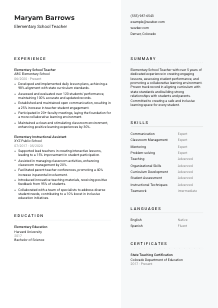
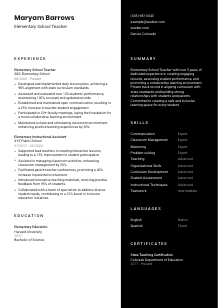
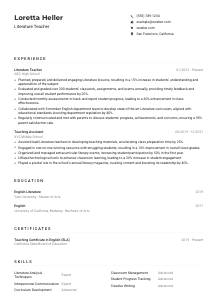
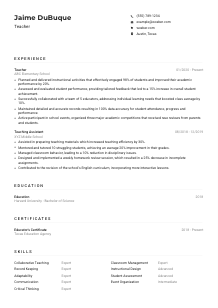
Nurturing young minds, but your CV feels a bit off? Head into recess with this Elementary School Teacher CV example, created with Wozber free CV builder. Learn how to tailor your playful pedagogy to meet school standards, putting your career at the head of the class!
Elementary teaching CVs are read through the lens of daily classroom practice. Schools need to see whether you can plan standards-aligned lessons, manage behaviour, track student progress, communicate with families, and keep a room safe and productive across a full school day. Vague statements about
When those classroom responsibilities are mirrored clearly, your CV is easier to process in both human review and ATS screening. Wozber's free CV builder helps you align your wording with the posting, keep an ATS-friendly CV format, and surface the teaching experience, certification, and instructional scope that matter first for an elementary classroom.
School administrators expect the top of the CV to answer practical questions fast. They should be able to see who you are, what role you teach, how to contact you, and whether you meet any location or communication requirements without searching through the page.
Your name should sit at the top in a clean, readable size. Skip decorative formatting. In school hiring, clarity matters. Principals and HR teams often review many applications at once, so make your header easy to scan and professional at a glance.
Place
Include a reliable phone number and a professional email address. Double-check both. If a school wants to move quickly from application review to an interview or reference check, broken contact details can stop the process before your classroom experience is even discussed.
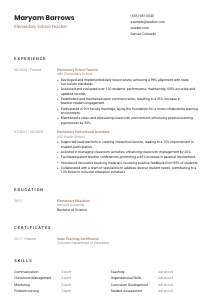
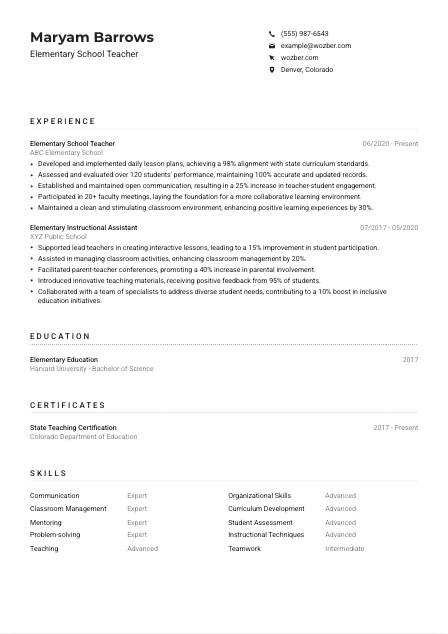
If the job requires candidates to be based in a specific area, show that clearly in your personal details. Here, listing Denver, Colorado directly addresses the posting's location requirement. Use this as a tailoring move when geography affects eligibility or start-date logistics.
A LinkedIn profile, teaching portfolio, or school-safe professional website can help if it shows lesson planning, classroom projects, family engagement, or professional development. Only include it when the content is current and consistent with your CV.
This section should confirm the basics quickly and cleanly. Once those details are in place, the reader can focus on your instruction, student support, and classroom results.




For elementary teaching roles, experience is where schools look for day-to-day execution. They want to see how you plan instruction, manage a room, assess learning, communicate with families, and contribute to the wider school team.
Start by marking the responsibilities that define the job. In this description, the big themes are daily lesson planning, student assessment, recordkeeping, parent and staff communication, collaboration, and classroom environment. Those themes should shape which bullets you lead with and how you describe your work.
List positions in reverse chronological order. For each one, include school name, title, and dates, then use bullets that show what you were responsible for in practice. Elementary hiring teams want to understand your grade-level teaching context, classroom ownership, and how your responsibilities grew over time.
Replace generic task lists with accomplishment-focused bullets. The sample does this well with lines such as developing daily lesson plans with 98% alignment to state curriculum standards and maintaining accurate records for more than 120 students. That kind of phrasing helps a principal picture both the work and the result.
Quantify your work where it reflects real teaching impact. Useful metrics include number of students taught, improvement in participation, family conference attendance, curriculum alignment, accuracy of records, workshop participation, or changes in engagement and behaviour. The numbers should support your teaching story, not distract from it.
Keep the section centered on work that matches the classroom, the curriculum, and the school community. If a bullet does not strengthen your case for lesson delivery, student growth, behaviour support, collaboration, or communication, move it down or remove it. Relevance matters more than volume.
Your experience section should leave no doubt that you can handle the instructional, behavioral, and organizational demands of an elementary classroom. Focus on actions and results a school can immediately recognize.
Education carries real weight in elementary hiring because it confirms both subject preparation and basic eligibility for the classroom. Schools usually want to see the degree first, then the field, institution, and graduation timeline in a format that is easy to verify.
When a job calls for a bachelor's degree in Elementary Education or a related field, make that credential explicit. If your degree matches directly, say so clearly. The sample's Bachelor of Science in Elementary Education does exactly that and leaves little room for doubt.
List degree, field of study, school, and graduation year in a clean order. This helps both school reviewers and applicant tracking systems pick up the qualification quickly. Avoid crowding this section with extra detail unless it adds hiring value.
Specific wording matters here.
Coursework, honors, student teaching placements, or academic awards can help if you are early in your career or if they connect directly to literacy instruction, child development, classroom management, or differentiated teaching. Once you have solid classroom experience, keep these details selective.
Even if you have a separate certificates section, check that your education area works smoothly with it. Elementary teaching jobs often pair degree requirements with state certification requirements, so the two sections should reinforce each other and make your eligibility easy to follow.
This section should quickly confirm that you have the formal preparation expected for elementary instruction. Clear degree information supports the rest of the CV by showing that your classroom experience rests on the right foundation.
In elementary education, certification is not a minor extra. It often determines whether you can be considered at all. This section should show active, relevant credentials first, especially any state-issued teaching license named in the posting.
This posting specifically asks for a state-issued teaching certification, so that credential should appear clearly and near the top of the section. In the example,
List certificates that matter for teaching authorization or classroom practice before optional professional development. State licensure, endorsements, ESL credentials, special education authorizations, reading certifications, or similar role-linked credentials usually belong first.
If a license is current, renewable, or tied to a valid date range, include that information. Schools need to know whether you are ready to teach now, whether renewal is current, and whether any credential timeline may affect onboarding.
Additional training can strengthen your profile when it connects to student learning or classroom needs, such as literacy instruction, behaviour support, differentiated instruction, trauma-informed practice, or educational technology. Keep the section focused on credentials that matter to the job you are targeting.
A well-built certificates section should make your licensure status easy to understand. For teaching roles, that clarity carries real hiring weight.
Elementary schools look for a mix of instructional skill, classroom leadership, communication, and organisation. Your skills section should reflect how the job is actually done, not read like a generic list of positive traits.
Use the job description as a starting point for the vocabulary in this section. Here, classroom management, instructional techniques, curriculum development, communication, organisation, and teamwork are all named priorities. If those match your background, use that same language naturally.
Build a focused list that covers both teaching delivery and school collaboration. Strong options for elementary roles include lesson planning, student assessment, behaviour management, parent communication, differentiated instruction, literacy or numeracy instruction, recordkeeping, and collaboration with staff or specialists.
You can organise skills by instructional, classroom, and interpersonal strengths, or simply place the most job-relevant ones first. In the sample, classroom management, curriculum development, student assessment, communication, and organizational skills are all aligned with the posting. That keeps the section practical and easy to scan.
Every skill listed should connect to real work in an elementary school. If you cannot support it with a classroom example, lesson outcome, or collaboration story, it likely does not belong here.
Language ability can be especially useful in elementary settings, where teachers communicate not only with students but also with families, support staff, and the wider school community. This section matters most when language proficiency affects classroom communication or family engagement.
If the posting calls for strong English command, list English clearly with an accurate proficiency level. Since elementary teachers deliver instruction, document student progress, and communicate with families in English, this requirement should be easy to spot on the CV.
Additional languages can strengthen your application when they help with family outreach, bilingual communication, or culturally responsive teaching. In the sample, Spanish adds useful context because it may support communication with a broader school community, though it is an added advantage rather than a universal requirement.
Terms such as native, fluent, intermediate, and basic are usually enough. Keep the ratings accurate. Schools may rely on this information for parent communication, classroom placement, or support across multilingual settings.
If you are applying in districts with linguistically diverse student populations, language ability can be a meaningful differentiator. Include it when it genuinely supports your teaching practice, family engagement, or collaboration with school staff.
List languages only when they add hiring value. For elementary roles, that usually means they improve instruction, accessibility, or communication with families and students, rather than simply filling space on the page.
When language skills are relevant, they should strengthen the picture of you as a teacher who can connect clearly with students, families, and colleagues across the school environment.
The summary sets the tone for the rest of the CV. For an elementary teaching application, it should quickly establish your years of experience, classroom strengths, and the kind of student-centered results you deliver.
Before writing, identify the few responsibilities that define the job. In this posting, lesson planning, student assessment, communication, collaboration, and classroom environment stand out. Your summary should reflect that same mix instead of staying broad.
Start with a direct line that names your profession and years of experience, such as
Mention strengths that matter in elementary classrooms, such as aligning instruction to standards, tracking student progress, supporting positive behaviour, or building strong family communication. The sample summary works because it stays tied to teaching practice rather than using generic personality language.
Aim for a short paragraph of three to five lines. That is enough space to position your classroom experience, key strengths, and one clear point about your teaching approach. Avoid repeating details that already appear in your experience bullets word for word.
By the time someone finishes your summary, they should already understand your instructional focus, your level of experience, and the kind of elementary teacher you are likely to be on day one.
An elementary school teacher CV works when each section supports the same hiring picture: you can plan instruction, manage the classroom, track learning, communicate with families, and contribute to the school community with professionalism and care.
Use Wozber to tighten that alignment, improve ATS optimisation, and shape an ATS-compliant CV around the language schools actually use. The final result should make your teaching readiness easy to recognize before you ever step into the interview.