



Use Wozber and land your dream job
Create CV
No registration required
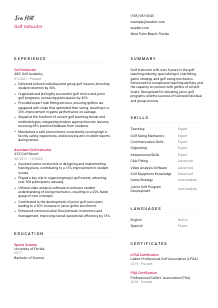
Mastering the backswing but feeling stuck in the rough with your CV? Tee up with this Golf Instructor CV example, built to par perfection with Wozber free CV builder. Learn how to align your teaching drive with job requirements, and swing into interviews with confidence!
Golf instruction is hands-on, technical work. Hiring teams want to see how you teach different player levels, how well you understand swing mechanics and club fit, and whether your lessons lead to better performance, stronger retention, or fuller clinics. Your CV should make that coaching range visible right away.
For Golf Instructor roles, the first screen often comes down to whether your CV clearly shows teaching credentials, lesson scope, and tools like video analysis in language that matches the posting. Wozber's free CV builder helps you shape that into an ATS-compliant CV, so the hiring team can quickly see whether you can coach, fit, and communicate at the standard the role requires.
This section sets the professional frame before anyone reads your lesson outcomes or certifications. For a Golf Instructor, that means making it immediately clear who you are, what role you do, and whether you meet practical requirements such as location and contactability.
Your name should sit at the top in a clean, readable format. Keep it slightly larger than the rest of the text so it anchors the page without looking styled for style's sake. In a coaching profession built on trust and person-to-person interaction, clear presentation matters.
Place "Golf Instructor" directly under your name if that is the role you are pursuing. This keeps your positioning consistent with the posting and helps ATS systems and hiring managers immediately connect your background to golf lessons, player development, and instruction.
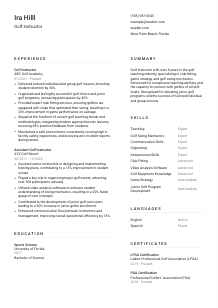
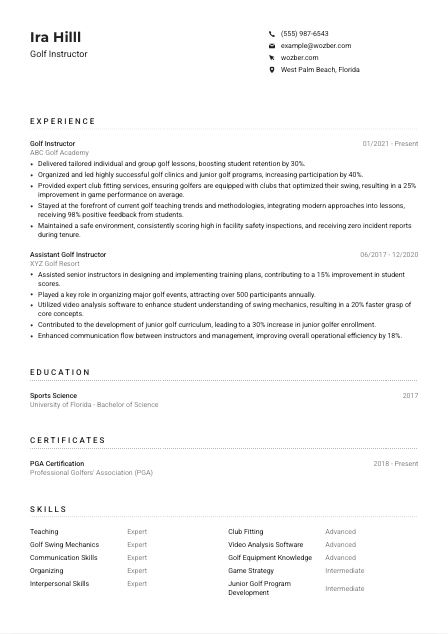
Include a reliable phone number, a professional email address, and your city and state. If the posting includes a location requirement, match it when truthful. In the example, "West Palm Beach, Florida" works well because it answers a stated requirement without forcing the employer to guess about relocation or commuting.
If you have a website, booking page, LinkedIn profile, or coaching portfolio that shows lesson offerings, junior programs, clinic work, or teaching credentials, include it. Make sure it supports what your CV claims, whether that is swing analysis expertise, club fitting services, or player development work.
Do not use this area for age, marital status, headshots, or other unrelated details unless local norms specifically require them. Save the space for information that supports your candidacy as an instructor and keeps the CV clean for both ATS review and human screening.
Keep the top of the CV simple, accurate, and aligned with the job. A hiring manager should be able to confirm your role, location, and contact details in seconds and move on to your teaching experience.




This is where Golf Instructor CVs either become convincing or stay generic. Hiring teams look for lesson delivery, player improvement, club fitting knowledge, clinic leadership, junior instruction, and safe facility practices. Vague bullets about "teaching golf" miss the real work.
Read the posting closely and pull forward roles where you delivered lessons, coached different ability levels, ran clinics, supported junior programs, or used teaching technology. If a job asks for tailored instruction, your bullets should show how you adapted coaching plans to player goals, swing issues, or skill progression.
For each role, include your title, employer, and dates, then describe the work in terms that matter in golf instruction. Mention one-on-one lessons, group sessions, club fitting, event support, or curriculum development where relevant. The sample CV does this well by covering both direct instruction and junior program leadership rather than listing only broad coaching duties.
Golf instruction is measurable in several ways. Add metrics tied to student retention, clinic participation, improvement in scores, faster skill development, feedback ratings, or safety records. In the example, gains like 30% higher retention and 40% more clinic participation make the teaching impact easier to understand than general claims about being effective.
Focus on experience that supports your ability to coach, communicate, and improve golfer performance. If you include broader golf operations work, connect it back to instruction, player service, or program delivery. A Golf Instructor CV benefits more from bullets about swing coaching, fitting sessions, and junior development than from unrelated administrative detail.
Use the terms employers use when they match your real work, such as "golf swing mechanics," "club fitting," "group lessons," "junior golf programs," or "video analysis software." This improves ATS optimisation and keeps your CV aligned with the posting. Wozber's ATS CV scanner can help you spot missing terminology and tighten how each role matches the target position.
By the end of this section, the reader should understand the level you teach at, the formats you lead, and the results your instruction produces. Make your bullets read like proof of coaching practice, not a generic work history.
Education usually plays a supporting role for Golf Instructors, but it still helps frame your foundation in sports science, kinesiology, coaching, or related study. Present it clearly, and use it to reinforce your understanding of movement, performance, and athlete development.
Some Golf Instructor jobs focus heavily on certifications, while others value a degree in sports science, physical education, or a related field. If your education lines up, make that easy to spot. In the example, a Bachelor of Science in Sports Science supports the technical side of teaching swing mechanics and player development.
List the degree, field of study, school name, and graduation year. That is usually enough. A simple structure helps the hiring team and ATS read the section quickly without losing the more important parts of your CV, such as coaching outcomes and credentials.
If your degree or coursework relates to biomechanics, motor learning, sports psychology, or athlete conditioning, that connection matters. Golf employers may not need a long academic explanation, but they do value education that supports better lesson planning and player communication.
This is most helpful if you are early in your career or if a course directly supports the role, such as sports performance analysis or coaching methodology. Keep it selective. Only include classes, projects, or distinctions that strengthen your profile as an instructor.
Golf teaching credentials usually carry more hiring weight when they are easy to find in a dedicated certificates section. If your CV is short and you need to combine information, do it carefully. Otherwise, let education show your academic base and let certifications prove current teaching qualification.
Your education should support your coaching credibility without taking over the page. Keep it concise, relevant, and clearly tied to the physical and instructional side of golf development.
For Golf Instructor roles, certifications are often one of the first checkpoints. They show that your teaching methods meet recognized professional standards and that your instruction is grounded in current practice rather than informal playing experience alone.
When a posting asks for credentials such as PGA or LPGA certification, list them clearly and exactly. That requirement is too important to bury. In the example, both certifications are named in a way that makes qualification easy to confirm during the first pass.
Lead with certificates tied to golf instruction, club fitting, player development, coaching methodology, or performance analysis. General training credentials can still help, but the section should first answer a simple question: are you formally qualified to teach golfers at the level this role expects?
If a certification is active, renewable, or ongoing, show that clearly. Current status matters because golf instruction evolves through new methodology, teaching technology, and player development practices. Dates also reduce follow-up questions during screening.
Add new certifications when they sharpen your instructional range, whether in junior coaching, club fitting, biomechanics, or technology-assisted analysis. Employers notice instructors who keep their methods current, especially when the role includes clinics, varied student levels, or modern teaching aids.
A reader should be able to confirm, at a glance, that you hold current teaching credentials relevant to the role. Clear certification details strengthen trust before the interview ever starts.
Golf Instructor skills need to cover both technical coaching and client-facing delivery. Employers want to see that you can explain swing changes, fit equipment, manage group sessions, and build rapport with beginners, juniors, and experienced golfers alike.
Start with the capabilities the job actually names. In this case, that includes golf swing mechanics, club fitting, game strategy, communication, and video analysis software. Use only the skills you genuinely apply in lessons, fittings, or program delivery.
A Golf Instructor is judged partly on technical knowledge and partly on how well that knowledge is delivered. Pair instruction-focused skills such as swing analysis or equipment knowledge with interpersonal strengths such as communication, patience, and the ability to adapt coaching to different skill levels.
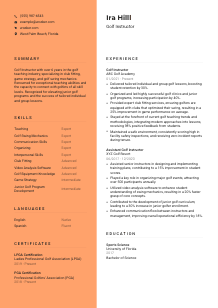
Put the skills most central to the target role near the top. If the posting emphasizes teaching and fitting, those should appear before more secondary abilities. The sample CV handles this well by giving visible placement to teaching, swing mechanics, communication, club fitting, and video analysis software.
Treat this section as a quick map of what you can coach, explain, and deliver. When the most relevant golf instruction skills appear first, the CV becomes easier to match to the role.
Language skills matter in golf instruction when they help you teach more clearly, connect with a broader player base, or support programs with diverse participants. Use this section to show communication range, not to pad the CV.
If the posting requires English, list it clearly with an honest proficiency level. For an instructor, this matters beyond conversation. It affects lesson delivery, safety instructions, equipment guidance, and the ability to explain technical concepts without confusion.
Additional languages can be valuable, especially in golf markets with varied clientele, tourism, or junior program outreach. In the example, Spanish strengthens the profile because it suggests broader communication reach during lessons, clinics, and parent interaction.
Choose terms such as "Native," "Fluent," "Intermediate," or "Basic." These are easy for employers to interpret and keep expectations realistic. Avoid inflating your level, especially in a teaching role where communication quality directly affects player progress.
Not every Golf Instructor role needs multiple languages, but some clubs, resorts, and academies serve international guests or multilingual local communities. If that applies to your background, language skills can support the client-service side of instruction.
Only list languages you can actively use in a lesson or customer setting. If you have not used a language in years, refresh it before presenting it as a strength. Instruction roles depend on clarity, so accuracy here matters.
Used well, this section shows that you can teach and communicate with a wider range of golfers. Keep it honest, relevant, and tied to real interaction on the course or practice facility.
The summary is where you establish your teaching identity in a few lines. For Golf Instructor roles, that usually means combining years of experience with your coaching specialties, lesson formats, certifications, and the kind of player outcomes you are known for.
Before writing, identify the priorities running through the role. Here, those include instruction across skill levels, club fitting, swing mechanics, communication, and teaching tools. Your summary should reflect that mix instead of opening with a broad statement about loving golf.
Start with your title, years of experience, and strongest coaching areas. A line such as "Golf Instructor with 6+ years of experience in swing mechanics, club fitting, and player development" gives immediate context and places you in the right professional lane.
Use the next sentence to show what sets your instruction apart. That might be strong junior program growth, high lesson retention, experience with video analysis, or success teaching both individual and group formats. The sample summary works because it names both technical specialties and the ability to connect with golfers of all skill levels.
Aim for 3 to 5 sentences or a short paragraph. Every phrase should earn its place by clarifying your coaching profile. Skip generic descriptors and focus on what the employer should expect from your lessons, your communication style, and your instructional results.
After reading your summary, the hiring team should already understand your teaching level, your specialties, and the kind of golf program or lesson environment you can step into. That clarity sets up the rest of the CV well.
A Golf Instructor CV works best when each section points to the same core message: you can teach effectively, adapt to different golfers, and improve performance through sound instruction. Keep your certifications visible, your experience measurable, and your skills aligned with how the role is actually practiced.
Use Wozber's free CV builder and ATS CV scanner to tighten phrasing, match job-specific terminology, and present everything in an ATS-friendly CV format. The finished CV should make it easy to judge your teaching credibility, technical range, and readiness to lead lessons from day one.