



Use Wozber and land your dream job
Create CV
No registration required
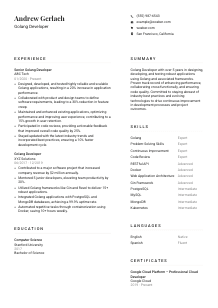
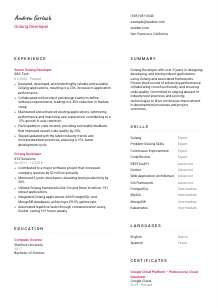
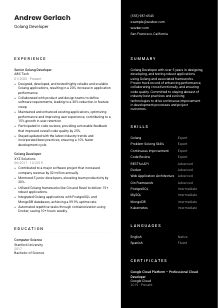
Go fast and furiously, but feel your CV isn't up to par? Check out this Golang Developer CV example, built with Wozber free CV builder. It shows how to match your Go language talents with job expectations, crafting a career journey as efficient as your code!
Backend Go work is judged in production terms. Hiring teams want to see whether you can build services that stay fast under load, keep APIs predictable, and hold up when code moves from local development into containers, databases, and deployed environments. A Golang Developer CV needs to make that engineering scope visible quickly, especially around service design, code quality, and performance work.
Screening often narrows fast when backend CVs stay too generic. If Go, RESTful APIs, database work, Docker, or Kubernetes are buried under broad software language, you can look like a generalist instead of a developer ready for this stack. Wozber's free CV builder helps you shape an ATS-compliant CV around the exact terminology in the posting, so reviewers can immediately connect your experience to the services, infrastructure, and collaboration patterns the role actually requires.
For engineering roles, the header is simple but important. It should confirm who you are, how to reach you, and whether you meet any practical filters the employer has set before anyone gets to your API work or backend achievements.
Use your full name in a clean, readable format at the top of the page. Keep it easy to scan so the focus moves quickly to your Golang title, recent backend roles, and technical strengths.
Match your headline to the role you want when it is accurate to your background. If the posting is for a "Golang Developer," using that title under your name immediately aligns your profile with the position instead of leaving the reader to infer it from later sections.
List a reliable phone number and a professional email address. Engineering hiring moves through recruiter calls, coding screens, and technical interviews, so one typo in your contact information can block the process before your CV is ever discussed with the team.
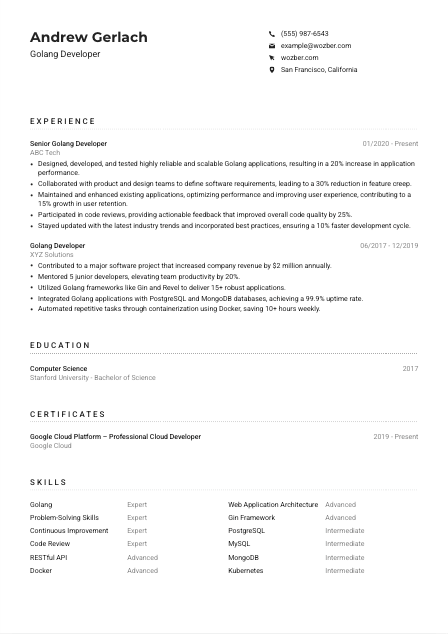
If the employer requires candidates to be based in a specific city or state, show that clearly in your personal details. In the example here, listing San Francisco, California directly addresses the location requirement and removes uncertainty about eligibility.
A GitHub profile, personal site, or LinkedIn page can strengthen your case if it shows Go repositories, API projects, cloud deployments, or technical writing. Make sure the tools, dates, and experience shown there line up with the CV so your professional profile reads consistently.
Your personal details should remove friction. Once this section confirms your identity, contact information, and any location requirement, the reader can move straight to your Go development experience.




This is where a Golang Developer CV earns attention. Backend teams look for proof that you have built services, improved performance, worked with APIs and databases, and contributed to codebases that need to stay reliable after release.
Before rewriting bullets, mark the requirements that define the work: Golang, Gin or Revel, RESTful API design, web application architecture, PostgreSQL or MySQL or MongoDB, Docker, Kubernetes, code reviews, and scalable code. Those are not filler terms. They tell you what language, system scope, and engineering practices your experience section should surface for ATS optimisation and for the human reviewer reading after it.
List your most recent role first, with company, title, and dates kept easy to scan. For backend hiring, progression matters. A move from Golang Developer to Senior Golang Developer, like in the example, suggests broader ownership across design, testing, performance tuning, or team review practices.
Focus each bullet on what you built, improved, or maintained. Good Golang bullets mention services, APIs, frameworks, database integrations, performance gains, reliability, or review contributions. The sample bullet about increasing application performance by 20% works because it ties Go development to a result the team can care about in production.
Use metrics that fit engineering work: latency improvement, uptime, deployment speed, throughput, feature delivery volume, defect reduction, retention impact, or hours saved through automation. The example's 99.9% uptime, 15+ applications delivered, and 10+ hours saved weekly through Docker-based automation all show scope in ways that feel native to backend work.
If an older bullet does not support your case for API design, scalable services, databases, containers, collaboration, or code quality, trim or rewrite it. The strongest experience sections keep the emphasis on the parts of your work that match this kind of role, including maintaining existing applications and participating in code reviews, both of which appear in the target posting.
By the end of your experience section, the reader should have a clear picture of the systems you worked on, the stack you used, and the production results you influenced. That is what turns general software experience into a credible Golang profile.
Education usually plays a supporting role for experienced Golang Developers, but it still helps frame your technical base. For backend positions, a degree in computer science or a related field can reinforce your grounding in data structures, software design, and systems thinking.
Some Go roles list a degree requirement, others do not. Even when the posting focuses more on hands-on development, a relevant field such as Computer Science still adds context for your backend and architecture experience.
List the degree, field of study, school, and graduation year in a clean structure. Recruiters and engineering managers usually want to confirm the credential quickly and return to your service design, API, and infrastructure experience.
If your degree aligns closely with software engineering, backend development, or computer science, make that easy to see. In the example, a Bachelor of Science in Computer Science supports the candidate's path into Go development without needing extra explanation.
If you are early in your career, academic projects involving distributed systems, web services, database design, or concurrent programming can help fill out your profile. For a more experienced developer, keep this brief unless a project directly supports the target role's stack or domain.
Honors, engineering clubs, hackathon work, or research can be worth mentioning when they show practical development interest or technical depth. Use them selectively so this section stays supportive rather than overshadowing stronger professional experience.
Your education section should confirm that you have the technical grounding for backend work. Once that is clear, let your Go experience, API delivery, and infrastructure work carry most of the weight.
Certifications matter most when they reinforce the way you build and deploy software. For Golang roles, they are especially useful when the job touches cloud platforms, Kubernetes, containerized environments, or platform-level development practices.
Prioritise certifications that connect to the employer's environment or to adjacent responsibilities in the role. For this posting, cloud and Kubernetes credentials make sense because the job calls for Docker and Kubernetes experience alongside application development.
A short list of targeted certifications is more persuasive than a long catalogue of loosely related badges. Credentials such as Certified Kubernetes Administrator or a cloud developer certification strengthen a Go CV because they suggest deployment awareness beyond writing code alone.
Dates help the reader understand whether your certification is recent, active, or from an earlier stage of your career. In fast-moving backend ecosystems, timing matters, especially around orchestration, cloud tooling, and platform practices.
When your certifications point to current learning, they reinforce that you stay current with deployment patterns, cloud services, and modern development workflows. That supports the job requirement around keeping up with industry trends and best practices.
The best certificates add depth to your Go profile by backing up the infrastructure and platform side of the role. Keep the focus on credentials that make your backend experience more credible.
For a Golang Developer, the skills section should read like an honest snapshot of your working stack. Hiring teams scan this area for language, frameworks, API knowledge, databases, container tools, and the engineering habits that shape maintainable backend code.
Pull the required and preferred terms directly from the description when they reflect real experience. Here that includes Golang, Gin, Revel, RESTful API design, web application architecture, PostgreSQL, MySQL, MongoDB, Docker, Kubernetes, code review, and problem-solving. This improves ATS alignment while also helping technical reviewers confirm stack fit at a glance.
Order matters. Lead with the technologies and practices closest to the role rather than burying them under generic programming labels. If the job is centered on Go backend work, Golang, API design, frameworks, databases, and containers should appear before broader items like teamwork or continuous improvement.
Separate technical skills from broader working strengths when possible. For example, you might cluster languages and frameworks, databases, infrastructure tools, and engineering practices such as code review or performance optimisation. That structure makes both ATS parsing and human review easier, especially in an ATS-friendly CV format.
This section should let someone scanning in seconds understand your backend toolkit. When the right Go, API, database, and container terms are visible immediately, the rest of the CV lands more clearly.
Language ability can matter more in engineering roles than candidates sometimes expect. Backend developers work through design discussions, pull request feedback, issue tracking, and cross-functional planning, so communication needs to be clear as well as technically accurate.
If the posting specifies a mandatory language, list it first with your proficiency level. Here, English is explicitly required, so it should appear clearly rather than being left implied.
Lead with the language that supports the day-to-day work of the role. A line such as "English: Native" or "English: Fluent" confirms you can handle documentation, technical discussion, and code review communication without friction.
Additional languages are worth listing when they are real strengths. They can be helpful on distributed teams, in multinational product environments, or in customer-facing engineering contexts, even if they are not central to every Golang role.
Use clear labels such as Native, Fluent, Advanced, or Intermediate. Honest levels set the right expectation for meetings, written communication, and collaboration across engineering, product, and design teams.
If the work involves remote collaboration, cross-border teams, or frequent stakeholder interaction, language range can add value. For a backend role like this one, strong English matters most because requirements, reviews, and architecture discussions depend on it.
List language skills with the same clarity you use for technical skills. For this kind of role, the key point is simple: your CV should make it obvious that you can communicate effectively in the team's operating language.
Your summary should frame the kind of Golang developer you are in a few lines. This is where you connect years of experience to the parts of the role that matter most, such as API development, scalable services, database work, code quality, and collaboration across product and engineering teams.
Start with the core work, not vague software language. For a Golang Developer position, mention the type of systems you build, such as web applications, backend services, or RESTful APIs, and the level of experience you bring to that work.
A direct opening like "Golang Developer with 5+ years of experience" gives immediate context. The example CV does this well by establishing backend focus from the first line and then moving into design, development, and testing work.
Use the summary to mention only the capabilities most central to the role. For this posting, that could include Golang frameworks, scalable application development, cross-functional collaboration, performance improvement, or code review practices. Choose the points you can prove in the experience section.
Aim for a short paragraph that sounds like an engineer describing real work. Skip broad claims and use concrete wording instead. A tight summary is enough to establish your focus and prepare the reader for the metrics, tools, and delivery examples that follow.
A solid summary tells the reader what kind of Go developer you are before they reach the first bullet. Keep it specific enough to frame your backend strengths and short enough that your experience can do the deeper proving.
A Golang Developer CV works when it shows more than familiarity with Go syntax. It should show that you can design APIs, work with databases, ship containerized services, and improve performance in code that other engineers have to maintain.
Use Wozber's AI CV builder to align your wording with the posting, strengthen ATS optimisation, and present your experience in an ATS-friendly CV template that keeps the stack and results easy to scan. The finished CV should make one conclusion easy to reach: you can contribute to production Go systems with confidence from day one.




