



Use Wozber and land your dream job
Create CV
No registration required
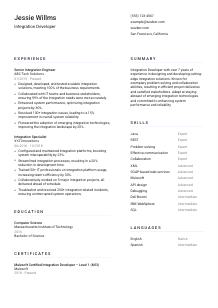
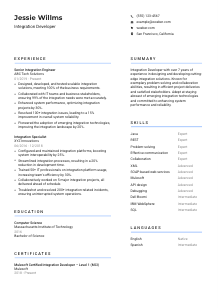
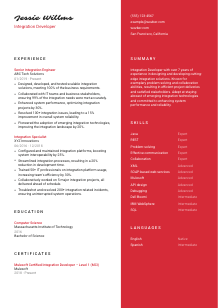
Bridging systems, but your CV feels disconnected? Sync it up with this Integration Developer CV example, created with Wozber free CV builder. It shows how to bring your integration mastery in line with job demands, ensuring your career path follows a well-integrated trajectory!
Integration work sits where business processes, APIs, and legacy systems meet, so employers look for developers who can do more than wire systems together. Your CV needs to show how you design flows, work through data and service constraints, troubleshoot failures, and keep integrations stable under real production demands.
For this kind of role, early CV screening often hinges on whether your platform experience and service-layer skills are obvious fast. Wozber's free CV builder helps you shape an ATS-compliant CV around the right integration terms, so hiring teams can quickly see experience with platforms, web services, and performance-focused delivery.
This section is brief, but it still carries practical information that can affect whether your application moves forward. For an Integration Developer, clear contact details and a precise title remove friction and make it easier to connect you to the platform and API work the role requires.
Use your full name in a clean, readable format at the top of the page. Keep it slightly more prominent than the rest of the header so the CV feels easy to navigate from the first glance.
Place "Integration Developer" directly beneath your name when that matches the role you are pursuing. It helps frame your experience around integration architecture, middleware, APIs, and system connectivity instead of leaving employers to infer your focus from past job titles alone.
Your phone number and email should be current and professional. For technical hiring, response speed matters, especially when interview loops involve architecture discussions, coding screens, or platform-specific follow-up.
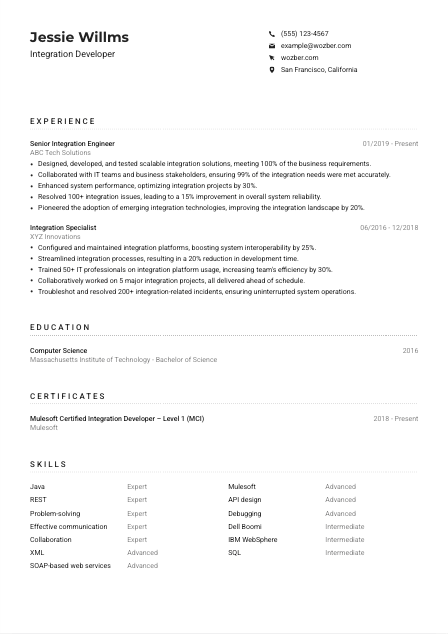
If a job calls for a specific location, state it clearly in your header. In the example, listing San Francisco, California directly supports the employer's stated requirement and avoids questions about relocation or eligibility at the first review stage.
Include a LinkedIn profile, portfolio, or personal site only if it strengthens your case. For an Integration Developer, this could point to API projects, platform certifications, technical write-ups, or architecture work that aligns with your CV.
A clean header should answer the basics immediately: who you are, how to reach you, and whether you meet any location requirement the employer listed.




Experience is the section most likely to decide whether you move to the next round. Hiring teams want to see the kind of systems you connected, the platforms you used, the reliability or performance you improved, and how you worked with stakeholders when integration requirements were still taking shape.
Read the posting for the technical through-line. Here, the priority is clear: design, develop, test, troubleshoot, and improve integration solutions using platforms such as Mulesoft, Dell Boomi, or IBM WebSphere, with Java, XML, REST, and SOAP in the stack. Shape your bullets around that same kind of work if it reflects your background.
List your positions in reverse chronological order with job title, company, and dates. That format helps reviewers quickly trace progression from hands-on integration support to broader ownership of solution design, debugging, performance tuning, or stakeholder-facing delivery.
Replace generic lines like "worked on integrations" with what you actually delivered. Strong bullets mention the integration type, the technical action, and the result. The sample CV does this well with points about designing scalable solutions, improving system performance by 30%, and resolving more than 100 integration issues.
Numbers carry weight in integration roles because they show scale and reliability. Use metrics tied to delivery time, issue volume, interoperability, response quality, uptime, defect reduction, or performance gains. Results such as a 20% faster development cycle or a measurable reliability improvement tell a much clearer story than broad claims about success.
Prioritise experience that matches integration architecture, middleware configuration, API development, service orchestration, testing, and production support. If you have broader software engineering history, keep it only when it strengthens the case for platform work, cross-functional collaboration, or solving data flow and system communication problems.
When this section is tailored well, a reviewer should be able to tell which platforms you used, what kinds of integrations you owned, and what changed because of your work.
For Integration Developer roles, education usually serves as a qualification check rather than the main selling point. Still, the degree line matters because many employers use it to confirm formal grounding in computer science, information systems, or related technical study.
If the posting asks for a Bachelor's degree in Computer Science, Information Technology, or a related field, list that information plainly. The example CV handles this well with a Bachelor of Science in Computer Science, which aligns directly with the requirement.
Include your degree, field of study, school, and graduation year. Straightforward formatting helps both ATS parsing and human review, especially when the education check is part of the initial screen.
If your degree title is broad, use the field name or a short clarifier to connect it to integration work. Courses or academic projects involving distributed systems, databases, APIs, enterprise applications, or XML-based messaging can help, particularly earlier in your career.
Relevant coursework is most useful when you have limited professional experience or when it directly supports the target role. Choose subjects that reinforce integration fundamentals, such as web services, software engineering, data structures, systems design, or enterprise architecture.
Honors, hackathons, engineering clubs, or capstone work are worth listing when they reinforce technical depth or collaboration. Skip anything that does not strengthen your case for building, testing, or supporting production integrations.
This section should quickly confirm that you meet the academic baseline and, where useful, show early technical exposure that supports your integration background.
Certifications matter most in integration hiring when they confirm hands-on platform depth. If your CV mentions Mulesoft, Dell Boomi, IBM WebSphere, or another enterprise integration stack, a relevant certification can reinforce that experience and help distinguish you from generalist developers.
List certifications that connect directly to the integration environments you work in. The example includes Mulesoft and IBM WebSphere credentials, which support the kind of platform experience the job description calls for.
Choose certifications that strengthen your target profile instead of listing every course you have completed. For integration roles, middleware, API management, enterprise messaging, cloud integration, and vendor platform certifications usually matter more than broad entry-level tech badges.
If a certification is active, recently earned, or tied to a current product version, include the date range or issue date. That helps employers gauge how current your platform knowledge may be in a field where tools and best practices evolve quickly.
If you are actively pursuing another relevant certification, mention it only when it is credible and close enough to completion to matter. Ongoing learning carries more weight when it points toward integration architecture, API tooling, or the platform family used by the employer.
The best certification section supports your experience section by confirming that your platform knowledge is current, specific, and directly useful in enterprise integration work.
A hiring team should be able to scan your skills section and understand your technical range within seconds. For an Integration Developer, that usually means a mix of platforms, service technologies, programming languages, debugging ability, and the collaboration skills needed to translate business requirements into working integrations.
Separate required tools from supporting capabilities. In this posting, Mulesoft, Dell Boomi, IBM WebSphere, Java, XML, REST, and SOAP are direct technical targets, while problem-solving, communication, and collaboration support the day-to-day work of gathering requirements and resolving integration issues.
Feature the tools and methods you can genuinely use in the target environment. If your background includes API design, middleware configuration, data mapping, SQL, testing, or debugging, include them when they support the integration work being advertised.
Keep the list tight and relevant instead of turning it into an inventory of everything you have touched. A focused mix like the sample's platform skills, service technologies, and collaboration strengths is easier for recruiters, hiring managers, and ATS filters to process.
Your skills section should immediately confirm that you have the platform knowledge, service-layer fluency, and troubleshooting range the role depends on.
Language skills are usually a supporting section, but they still matter when the posting names one directly. In integration work, clear written and verbal communication matters because requirements often come from business teams while implementation happens across engineering, QA, and support functions.
If the job description names English proficiency as a requirement, include it directly with an honest level such as Native or Fluent. That removes ambiguity for roles that depend on technical discussion, documentation, and stakeholder communication.
Order languages by relevance to the role. When English is mandatory, it should lead the section, followed by any additional languages that may help in multinational teams, vendor communication, or cross-region support.
Additional languages can be useful in global organizations, especially when integration teams work across offshore delivery, regional business units, or external implementation partners. Include them if they are real working skills, not just familiarity.
Use levels that match your actual ability to speak, write, and collaborate. Technical roles often involve nuanced conversations about incidents, data contracts, testing results, and change requests, so accuracy matters.
If the position involves cross-functional or international coordination, language skills become more relevant. They are rarely the deciding factor for an Integration Developer, but they can support a profile built around communication-heavy implementation work.
List languages clearly, lead with the required one, and let the section support your broader case as someone who can communicate technical work accurately.
Your summary should give a hiring team a quick read on your level, technical focus, and the kind of integration work you handle well. In a few lines, it should connect years of experience with the platforms, service patterns, and delivery results that matter for the job.
Anchor the summary in the work you really do, whether that is enterprise application integration, API-led connectivity, middleware support, or building scalable service-based solutions. Keep it close to your track record rather than using broad tech language.
Lead with your role and experience level, then mention the technologies most relevant to the target job. For this opening, that could include integration platforms plus Java, XML, REST, or SOAP if they are central to your background. The sample summary does this effectively by pairing years of experience with integration solution design and performance improvement.
Choose strengths that matter in integration delivery, such as translating business requirements into technical flows, troubleshooting production issues, improving reliability, or collaborating across teams. Keep the claims grounded in the kind of work your experience section proves.
Aim for a short paragraph that can be read in seconds. Four to five lines is usually enough to establish platform depth, delivery scope, and the value you bring without repeating the rest of the CV.
A well-written summary should quickly tell the reader what kind of integration problems you solve, which technologies you bring, and why your background fits the role.
A tailored Integration Developer CV should make three things easy to recognize right away: the platforms you know, the integration problems you have solved, and the business or system outcomes your work improved. When your experience, skills, certifications, and summary all point in the same direction, the CV reads like a clear match instead of a collection of technical fragments.
Wozber's free CV builder can help you turn that experience into an ATS-friendly CV template with stronger ATS optimisation, cleaner structure, and language that lines up with the posting. The final result should make it easy for a hiring team to see that you can design, build, troubleshoot, and improve integrations in a production environment.




