



Use Wozber and land your dream job
Create CV
No registration required
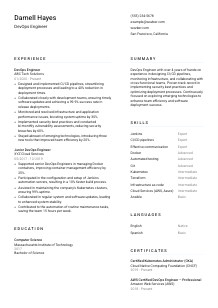
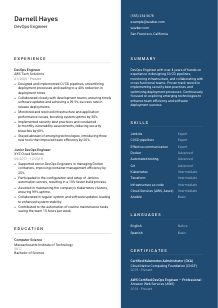
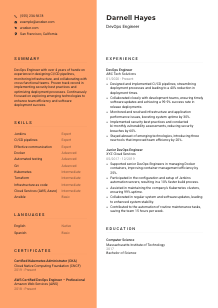
Automating pipelines, but your CV feels manual? Check out this DevOps Engineer CV example, created with Wozber free CV builder. Learn how to present your integration expertise in line with job requirements, scripting a career as smooth as your deployment processes!
DevOps work gets judged in production terms. Hiring teams want to see how you improve release speed, system uptime, environment consistency, security posture, and collaboration between engineering and operations. CVs often miss that mark by listing tools without showing what those tools changed, whether that was faster deployments, fewer failed releases, cleaner infrastructure as code, or more stable services.
A tailored DevOps CV makes your operating scope easier to read quickly, especially when an ATS is scanning for terms tied to pipelines, containers, orchestration, automation, and cloud infrastructure. Wozber's free CV builder helps organise that language into an ATS-friendly CV format so recruiters and engineering leaders can quickly see whether you've handled the delivery, reliability, and cross-team work the role requires.
For DevOps positions, the header should establish basic alignment fast: who you are, what role you do, and whether practical requirements like location and contactability are already covered. Keep it clean and factual so nothing slows down the first read.
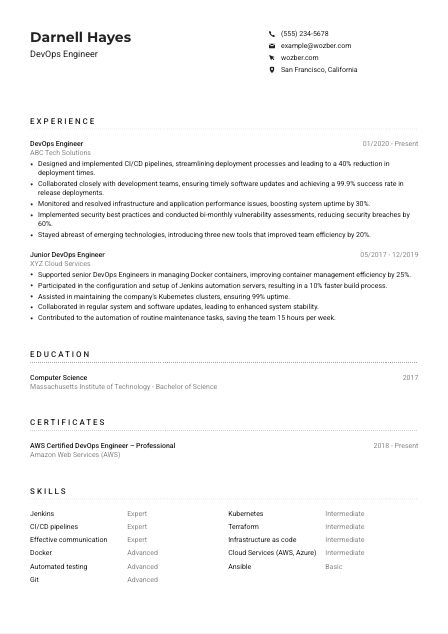
Use your full name as the clearest element in the header, followed by the job title you are targeting. For a DevOps application, pairing your name with "DevOps Engineer" immediately frames the rest of the CV around automation, infrastructure, and release engineering rather than a broader systems or software profile.
If the posting is for a DevOps Engineer and that reflects your background, use that wording directly under your name. Exact title matching helps both ATS parsing and human review, especially when employers are sorting between adjacent profiles such as SRE, Platform Engineer, Cloud Engineer, or Systems Engineer.
List a reliable phone number and a professional email address that looks appropriate in a technical hiring process. DevOps hiring often moves quickly once a team finds someone with the right CI/CD, Kubernetes, or Terraform background, so make it easy for recruiters and engineering managers to reach you without friction.
If the job has a stated location requirement, reflect that clearly in your header. In the example, "San Francisco, California" supports a posting that asks candidates to be local or willing to relocate. That kind of detail belongs here because it answers an operational question before anyone has to ask.
A website, GitHub, or polished LinkedIn profile can strengthen a DevOps CV when it reinforces the same story as the rest of the application. Link only to profiles that support your work with infrastructure, automation, cloud platforms, or deployment workflows, and make sure the technologies and dates match your CV.
This section does not need personality flourishes. It needs accuracy, role alignment, and any logistical detail that affects hiring, so the reader can move straight into your technical background.




The experience section carries most of the weight on a DevOps CV. Hiring teams look for what you built, automated, stabilized, secured, and improved across environments, release pipelines, and cross-functional workflows. Tool names matter, but production outcomes matter more.
Before editing your bullets, underline the work themes in the job description: CI/CD design, automated deployment, infrastructure troubleshooting, security practices, and collaboration with developers. Then shape your experience around those same themes. If a role emphasizes seamless releases, your bullets should show how you improved deployment speed, release success rate, rollback stability, or test automation coverage.
Start with your most recent position and include job title, company, and dates in a format that is easy to scan. For DevOps candidates, progression matters. A move from Junior DevOps Engineer to DevOps Engineer, as shown in the example, quickly signals growing ownership across pipelines, containers, clusters, and infrastructure operations.
Each bullet should show a concrete action and the operational result. Focus on work such as building Jenkins pipelines, managing Docker-based deployments, maintaining Kubernetes clusters, codifying infrastructure in Terraform, or resolving incidents that affected performance. The example does this well with results like a 40% reduction in deployment time and a 99.9% release success rate.
Quantify results with measures that make sense in this field: deployment frequency, lead time, failed deployment rate, uptime, alert reduction, infrastructure provisioning speed, incident volume, mean time to recovery, or hours saved through automation. Numbers are most persuasive when they connect to service reliability or engineering throughput, such as improving uptime by 30% or saving 15 hours a week through automated maintenance tasks.
Resist the urge to document every task you handled. Prioritise work that reflects release engineering, cloud infrastructure, observability, platform support, automation, and secure operations. If you have mixed experience, keep the bullets that best connect to the employer's stack and workflow, and trim anything that reads like unrelated general IT support.
The best DevOps experience sections make it clear where you improved delivery speed, reliability, security, or operational efficiency. After reading your bullets, a hiring manager should understand the environments you worked in and the results you produced there.
Education usually plays a supporting role for experienced DevOps candidates, but it still matters when a posting asks for a specific academic background. Keep the section direct and make sure it confirms the technical foundation the employer requested.
If the posting asks for a bachelor's degree in Computer Science, Engineering, or a related field, state your degree in those terms as clearly as possible. In the example, a Bachelor of Science in Computer Science aligns directly with the requirement and removes any ambiguity.
List school, degree, field of study, and graduation year. That is usually enough for DevOps hiring, where the heavier review sits in your hands-on work with pipelines, containers, cloud platforms, and automation. Keep the structure easy for both ATS parsing and quick recruiter review.
If you are early in your career, details such as operating systems, networking, distributed systems, cloud computing, security, or software engineering coursework can strengthen the section. Those subjects connect naturally to DevOps responsibilities like infrastructure management, deployment automation, and vulnerability assessment.
Projects can help if they demonstrate real technical depth, such as building a CI/CD workflow, provisioning cloud infrastructure, automating test runs, or deploying containerized services. Keep them only when they add something your work history does not already show.
Honors, research, or relevant technical clubs can be useful, especially for candidates with limited professional experience. Include them when they reinforce engineering rigor or practical systems work, not just to fill space.
For most DevOps candidates, this section should confirm the requested academic background and then get out of the way. Let it support the technical story your experience and skills already tell.
Certifications can add real weight in DevOps hiring when they reflect technologies the team actually uses or show depth in cloud, automation, or container orchestration. They work best as proof of current technical range, not as decoration.
Prioritise certifications that connect to the environment named in the posting or to widely used DevOps responsibilities. Cloud credentials, Kubernetes certifications, and automation-focused certifications are especially relevant when a role involves container platforms, infrastructure as code, or production deployment workflows.
Order certifications by relevance to the target role, not by prestige alone. In the example, AWS Certified DevOps Engineer and Certified Kubernetes Administrator are a strong fit because they support work in cloud infrastructure, orchestration, and operational reliability.
Include earned dates and renewal status when applicable. In fast-moving technical areas such as Kubernetes, cloud services, and security practices, current certification dates help show that your knowledge has kept pace with current tooling and platform standards.
A certificate is most credible when your experience section shows you actually used the related tools in production or near-production settings. If you list Terraform, Kubernetes, or AWS credentials, make sure your bullets also reflect provisioning, deployment, monitoring, or operations work tied to those areas.
Good certification choices make your CV easier to trust. They should reinforce the stack, platform depth, and continuous learning already visible in your hands-on DevOps work.
The skills section should read like a practical inventory of how you work. For DevOps roles, that usually means a blend of automation tools, infrastructure technologies, deployment practices, cloud platforms, and collaboration skills that support release coordination and incident response.
Pull the exact terms that define the role's stack and workflow, then include the ones you genuinely use. In this posting, that includes Jenkins, Docker, Kubernetes, Terraform, CI/CD pipelines, automated testing, and infrastructure as code. Matching that language helps both ATS systems and technical reviewers connect your background to the job faster.
Do not stop at product names. Pair tools with the practices that matter in DevOps, such as pipeline design, deployment automation, monitoring, troubleshooting, configuration management, security hardening, and collaboration with development teams. The example handles this well by combining technologies like Jenkins and Docker with workflow skills like CI/CD and automated testing.
A shorter, sharper skills section is better than a long catalogue of every platform you have touched once. Group your strongest tools and methods around the target role, and avoid padding the section with marginal technologies unless they are directly relevant to the job.
Your skills section should give a quick, accurate read on the environments and practices you can contribute to right away. Prioritise the tools and methods that support deployment speed, infrastructure consistency, and reliable operations.
Most DevOps roles rely on clear written and verbal communication because the job sits between development, operations, security, and sometimes support. Language skills matter most when they affect collaboration, documentation, incident handling, and release coordination.
If the role specifies English proficiency, list English first and state your level clearly. In this posting, English is a stated prerequisite, so this section should confirm that requirement without forcing the reader to search for it.
Additional languages can be useful in globally distributed engineering teams, vendor communication, or documentation-heavy environments. Include them if they are real working skills, but keep the focus on the language required to perform the job day to day.
Choose ratings that reflect how well you can actually communicate in meetings, written updates, incident channels, and technical documentation. "Native," "Fluent," "Intermediate," and "Basic" are all useful when they are accurate.
For DevOps, communication often happens in standups, release planning, incident reviews, change documentation, and cross-functional troubleshooting. List a second language if you can use it meaningfully in those settings, not just for casual conversation.
Language skills are usually a supporting detail in technical hiring, unless the role depends on multilingual coordination. A concise list is enough as long as it confirms the required language and any additional communication value you bring.
This section does not need much space, but it should confirm that you can communicate clearly where DevOps work actually happens: deployment planning, incident response, documentation, and team coordination.
Your summary should give a compact read on your level, technical focus, and operational impact. In a few lines, it should tell the reader whether you have worked on delivery automation, infrastructure reliability, cloud platforms, security practices, and cross-team release support.
Start with your title and years of relevant experience, then anchor the summary in the work you actually do. For DevOps candidates, that often means CI/CD pipeline design, infrastructure automation, container orchestration, cloud operations, or production support.
Choose two or three strengths that match the posting closely. If the role emphasizes deployment automation, system monitoring, troubleshooting, and secure infrastructure, your summary should surface those themes directly instead of using broad statements about being results-driven or detail-oriented.
A summary becomes stronger when it hints at measurable performance. The example works because it mentions hands-on experience with pipeline design, infrastructure monitoring, security practices, and deployment optimisation. You can sharpen that further with outcomes tied to release speed, uptime, or deployment success if space allows.
Aim for three to five sentences. Avoid repeating full bullet points from the experience section, and skip generic soft-skill claims unless they connect to real DevOps collaboration such as working with developers to deliver timely, stable releases.
A strong summary helps the reader place you quickly: what environments you have worked in, what operational problems you solve, and what kind of DevOps ownership you can step into next.
A DevOps CV should make your deployment, automation, infrastructure, and reliability work easy to understand in one pass. When the wording reflects the posting accurately and your bullets show measurable production impact, you give hiring teams a much clearer picture of how you would contribute.
Use Wozber's AI CV builder, ATS CV scanner, and ATS-friendly CV templates to tighten your wording, align key technologies with the job description, and build an ATS-compliant CV that still reads naturally to engineers. The final result should make one thing clear fast: you can improve delivery pipelines and keep systems running well under pressure.




