



Use Wozber and land your dream job
Create CV
No registration required
Coding the future, but your CV is stuck in a loop? Check out this Associate Software Engineer CV example, created with Wozber free CV builder. It shows how to match your programming prowess to job requisites with ease, and launch your career trajectory without any syntax errors!
Associate Software Engineer hiring usually centers on execution under guidance. Teams want to see that you can write clean code, test your work, fix defects without drama, and contribute inside an established development process rather than only in coursework or isolated projects. Your CV should make that practical engineering range easy to spot from the first few lines.
A tailored CV changes how quickly your experience reads against the role's technical baseline. When your language reflects the stack, workflows, and responsibilities named in the posting, an ATS-compliant CV built in Wozber's free CV builder is easier to match to requirements like Java, SQL, code reviews, and cross-functional delivery. That gives the hiring team a faster read on whether you can contribute on a production team from day one.
This section is simple, but it still does real work in software hiring. Recruiters and hiring coordinators use it to confirm role alignment, contactability, and, when stated in the posting, location eligibility. Keep it clean, accurate, and stripped of anything that does not help move your application forward.
Use your full name as the clearest visual element at the top of the page. In engineering hiring, a crowded header can make the CV feel less polished before anyone reaches your project work or code-related achievements. Keep the styling professional and readable.
Place "Associate Software Engineer" directly beneath your name if that is the role you are targeting. Matching the posted title helps your CV line up with ATS searches and keeps your positioning clear to recruiters who may be scanning several levels at once, from intern to senior engineer.
Include a reliable phone number and a professional email address that uses your name. Hiring teams move quickly when scheduling screening calls or technical interviews, so broken contact details can cost you momentum. Avoid casual usernames that weaken an otherwise technical profile.
If the job requires you to be in a specific market, show that clearly in your header. Here, listing "San Francisco, California" answers a stated requirement and removes unnecessary back-and-forth about availability. Use location this way when the posting makes geography part of the screening criteria.
Include GitHub, LinkedIn, or a personal site if it strengthens your software profile. The best links show repositories, shipped projects, technical writeups, or a consistent work history. For an early-career engineer, a GitHub profile with readable code and active commits can reinforce what your CV claims.
Your personal details should confirm who you are, what role you want, how to reach you, and whether you meet any stated location requirement. That is enough. Save the deeper proof for the sections where engineering judgment, delivery history, and technical range come through.




For an Associate Software Engineer, experience is less about grand ownership claims and more about showing steady contribution to real software work. Hiring managers look for proof that you can build features, debug issues, collaborate with senior engineers, and work within review and release processes without hand-holding on every task.
Read the description the way you would read an implementation brief. Highlight the repeated actions and tools, such as designing and coding software, testing and debugging, participating in code reviews, working with cross-functional teams, and using languages like Java, C++, Python, or SQL. Those should shape the language of your bullets so your experience maps naturally to the role.
List each position in reverse chronological order with job title, company, and dates, then focus the bullets on software tasks and outcomes. For this kind of role, the most useful bullets usually mention features built, modules maintained, defects resolved, review participation, performance improvements, or delivery impact. The sample CV does this well by pairing responsibilities with technologies like Java and SQL.
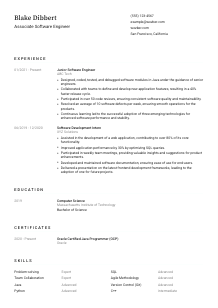
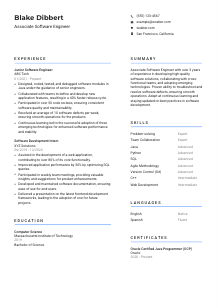
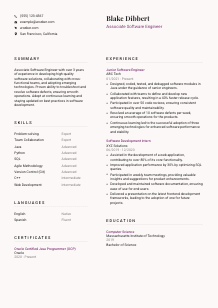
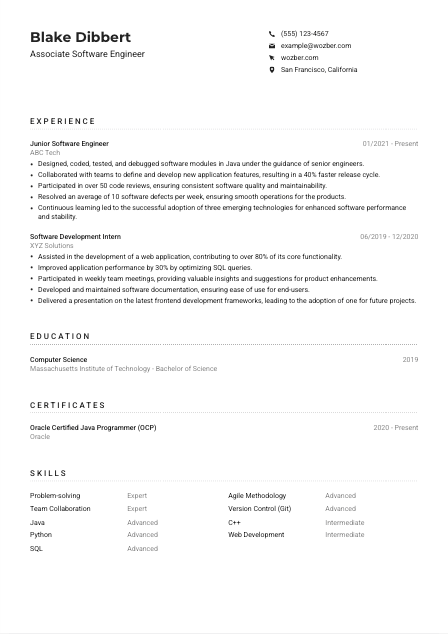
Lead bullets with verbs that show direct contribution, such as "designed," "implemented," "tested," "debugged," "reviewed," or "optimised." That immediately tells the reader whether you wrote production code, supported releases, or improved maintainability. A line like "Designed, coded, tested, and debugged software modules in Java under the guidance of senior engineers" is strong because it shows both hands-on execution and the level of responsibility expected at the associate stage.
Numbers make engineering work easier to evaluate when they relate to delivery speed, defect volume, performance, scale, or review activity. The example bullets use metrics naturally, including a 40% faster release cycle, 50+ code reviews, and 10 defects resolved per week. Use your own equivalents, such as reduced query time, improved uptime, faster build times, or fewer production issues after release.
Early-career CVs can get crowded with unrelated tasks, but software teams want to see the work that proves you can contribute in their environment. Prioritise development experience, debugging, testing, code review, collaboration with product or QA, and work with databases or core languages. If a bullet does not help explain your engineering ability, trim it or rewrite it.
A useful experience section makes it clear that you have already worked in a development rhythm that includes coding, testing, reviews, bug fixing, and team collaboration. When those details are specific and measured, hiring teams can picture you contributing to an existing codebase rather than learning from scratch.
For associate-level software roles, education often confirms the foundation behind your coding work. A degree in computer science, engineering, or a related field helps establish that you have covered core concepts such as data structures, algorithms, systems, and software development practices, especially when your experience level is still building.
If the posting calls for a bachelor's degree in Computer Science, Engineering, or a related field, make that easy to find. Do not bury the field of study or rely on abbreviations that may be unclear in ATS parsing. The education entry should directly reflect the requirement when you meet it.
List your degree, school, field of study, and graduation year in a clean structure. For software roles, clarity matters more than decoration. The example entry, showing a Bachelor of Science in Computer Science with graduation year, gives a recruiter exactly what they need in a few seconds.
If your background is lighter on professional experience, include relevant coursework, specialization, or academic concentration that supports the target role. Courses in databases, object-oriented programming, operating systems, or software engineering can help reinforce qualifications tied to Java, Python, C++, or SQL.
Projects belong here when they demonstrate coding, debugging, database design, API work, or team development experience that is not yet fully represented in your job history. Keep the description outcome-focused. Mention the language used, what you built, and one result such as improved performance, delivered functionality, or successful deployment.
Hackathons, programming clubs, research work, or academic awards can add value when they reinforce your software profile. They are most useful for newer engineers whose work history is still short. Keep only the items that show sustained technical engagement or strong academic performance.
Your education section should quickly show that you meet the degree expectation and have the technical grounding to work in a professional development environment. If your experience is still early, use projects and relevant coursework to bridge classroom learning to production-style work.
Certifications are rarely the deciding factor for an Associate Software Engineer, but the right one can strengthen a CV by confirming a language, platform, or development focus. They are most helpful when they support the stack named in the job description or show recent effort to deepen practical skills.
Start with the job description. If certifications are required, list them exactly and prominently. If they are not required, include only the ones that add useful technical context. For this example, an Oracle Java credential supports a role that names Java among its core languages, even though the posting does not make certification mandatory.
Prioritise certifications that reinforce the languages, platforms, or development areas most relevant to the job. For an associate engineer role, that might mean Java, cloud fundamentals, database work, or testing tools. Relevance matters more than quantity.
Include the year earned or validity period when appropriate. In software hiring, dates help indicate whether your knowledge is current, especially for tools and ecosystems that change quickly. This also helps recruiters distinguish between an active credential and one completed many years ago.
A short certificate section works best when it supports a pattern already visible in your CV, such as steady learning, technical curiosity, or growth in a core language. Keep the section lean. One relevant certification is stronger than a long list of low-value course badges.
Certificates should reinforce the technical story your CV already tells. When they align with the language, platform, or problem space of the job, they add useful depth without distracting from your actual software experience.
The skills section helps recruiters and ATS tools connect your background to the role's technical baseline quickly. For an Associate Software Engineer, that usually means programming languages, database familiarity, version control, development practices, and a few collaboration skills that matter in day-to-day engineering work.
Start with the explicit requirements. Here that includes at least one major programming language such as Java, C++, or Python, familiarity with relational databases and SQL, problem-solving, teamwork, and clear English communication. Use the exact language where it reflects your real experience so ATS matching stays accurate and natural.
List your strongest and most relevant skills first, especially the ones that appear in your work history. If your bullets mention Java modules, SQL optimisation, code reviews, and Agile work, those skills belong near the top. The sample CV handles this well by pairing Java, Python, SQL, Git, and Agile methodology with concrete accomplishments elsewhere on the page.
Organise skills into sensible categories when you have enough depth, such as programming languages, databases, tools, methodologies, and collaboration skills. This makes the section easier to read during a quick screen and helps prevent a mixed list where important technical capabilities get buried.
Your skills list should reinforce what the hiring team already sees in your experience, not introduce a long inventory with no proof behind it. When the language matches the posting and the skills are backed by real work, this section does its job well.
Software engineering is technical work, but communication still affects delivery. Associate engineers need to explain bugs, discuss implementation choices, participate in reviews, and collaborate with product, QA, or senior developers. If a posting calls out English communication directly, treat that as a real requirement rather than a minor detail.
When the job asks for clear English communication, list English at the top of the language section with an honest proficiency level such as "Native" or "Fluent." This is especially important when the role includes code reviews, issue triage, documentation, and cross-functional collaboration.
Extra languages can be valuable, especially on distributed teams or customer-facing products, but only list them if you can use them professionally or conversationally. The sample CV includes Spanish as fluent, which adds useful context without overstating its importance.
Do not overload this area with low-proficiency entries unless they are clearly useful to the employer. For most associate engineering roles, one required language plus one or two genuine additional strengths is enough.
Choose standard terms such as "Native," "Fluent," "Intermediate," or "Basic." Hiring teams should be able to understand your level immediately without interpreting custom scales or vague wording.
Language ability matters in engineering when you are writing documentation, responding to support issues, presenting technical ideas, or collaborating across functions. If communication is one of your strengths, the language section can quietly support that broader picture.
For this kind of role, language skills are less about decoration and more about whether you can work effectively in reviews, meetings, documentation, and day-to-day collaboration. Keep the section honest, clear, and aligned with the posting.
Your summary should give a hiring manager a fast, grounded read on the kind of engineer you are. For an Associate Software Engineer, that usually means a brief statement of experience level, core languages or technical areas, and the kind of team contribution you have already made in development, debugging, and delivery.
Review the posting before writing a single line. If it emphasizes coding under senior guidance, cross-functional collaboration, code reviews, defect resolution, and ongoing learning, your summary should reflect those themes rather than generic statements about passion for technology.
Start with a direct line that states your title or level, years of experience, and main engineering strengths. A summary like the sample's works because it quickly establishes 3+ years in software development, high-quality software delivery, collaboration, and troubleshooting without sounding inflated.
Use terms from the job description where they describe your real background, including software development, Java, Python, SQL, problem-solving, code reviews, or cross-functional work. This improves ATS optimisation and keeps the summary aligned with what the team is actually hiring for.
Three to five lines is usually enough. Focus on the strongest points only: experience level, core technical strengths, and one or two work outcomes such as resolving defects, shipping features, or improving performance. Leave the detail for the experience section.
A well-written summary tells the reader, early and clearly, that you have relevant software experience, know the core tools or languages, and can contribute inside a team development process. That is the context the rest of your CV should then prove.
Once your CV reflects the actual work of an Associate Software Engineer, coding, debugging, code reviews, collaboration, and steady learning, it becomes much easier for hiring teams to place you at the right level. Keep the language close to the posting, keep the metrics honest, and keep every section tied to real software contribution.
Wozber's free CV builder helps you put that into an ATS-friendly CV format, and its ATS CV scanner can highlight missing requirements, match role-specific terminology, and tighten alignment before you apply. The finished CV should make one thing clear fast: you can step into a development team and produce reliable work.




