



Use Wozber and land your dream job
Create CV
No registration required
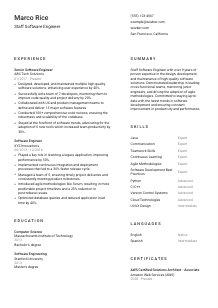
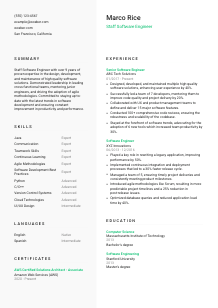
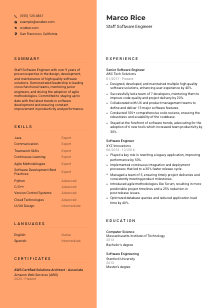
Masterminding code, but your CV feels like a broken loop? Check out this Staff Software Engineer CV example, built with Wozber free CV builder. It shows how to match your engineering strengths to job expectations, scripting a career narrative that runs as efficiently as your top algorithms!
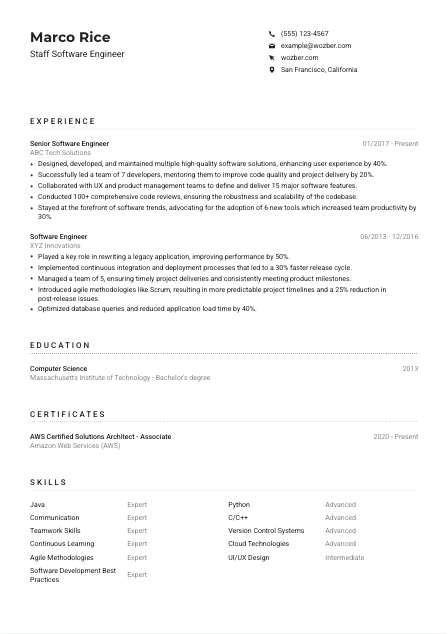
Staff Software Engineer CVs are read through the lens of technical judgment. Hiring teams want to see whether you have operated beyond ticket delivery and into system design, code quality, engineering standards, and team influence. A CV that only lists languages or generic development work usually misses the real scope of staff-level expectations.
For this level, the first screening question is often whether your experience maps to senior technical ownership quickly enough to survive ATS filtering and an engineering manager's skim. Wozber's free CV builder helps you shape that story into an ATS-compliant CV by aligning your wording with the job description and making leadership, delivery outcomes, and technical depth easier to spot in seconds.
At staff level, the personal details section should be clean and direct. It is not where you prove architecture depth or mentoring range, but it does need to remove friction so a recruiter or hiring manager can immediately confirm who you are, what role you are targeting, and whether you meet any stated logistics such as location.
Use your full name at the top in a larger, readable font. Staff engineers are often reviewed by recruiters, hiring managers, and engineering leaders in sequence, so this section should be easy to scan and easy to remember.
Place "Staff Software Engineer" directly under your name when that is the role you are applying for. Matching the posted title helps frame the rest of the CV around staff-level scope rather than leaving the reader to infer whether you are aiming for senior, principal, or another engineering track level.
List a working phone number and a professional email address. Avoid clutter, novelty formatting, or outdated handles. For technical hiring, clean contact information supports a CV that already reads as organised and production-minded.
If the job includes a location requirement, show it clearly in your header. Here, San Francisco, California matters because it is explicitly requested in the posting. When a logistics filter appears this early, removing doubt helps your application move forward faster.
Include a LinkedIn profile, GitHub, portfolio, or personal site if it strengthens your candidacy. For a Staff Software Engineer, links are most useful when they support technical credibility through open-source work, architecture writing, engineering talks, or a polished professional profile.
Treat this section like a clean system entry point. It should confirm your target role and basic eligibility without making the reader work for it.




This is where a Staff Software Engineer CV usually stands or falls. Hiring teams are looking for technical leadership in practice: system improvements, delivery ownership, code review standards, mentoring, cross-functional work, and measurable engineering outcomes. Your bullets should show how you influenced the product and the way the team builds software.
Read the posting for the work that defines the role, not just the tools. In this case, the priorities include building high-quality software, collaborating across functions, mentoring junior engineers, conducting code reviews, and adopting better tools or methods. Those themes should shape which achievements you surface and how you phrase them.
List your positions from most recent to oldest with company, title, and dates. For a staff-level application, recent roles usually carry the most weight because they show your current scope, technical maturity, and whether you have already been operating as a lead engineer or senior individual contributor.
Each bullet should connect an engineering action to a result. Strong examples include redesigning a service, improving release reliability, leading a migration, mentoring developers through code quality improvements, or partnering with product and UX to ship features. The sample CV does this well by pairing actions like leading a team or conducting code reviews with outcomes such as better delivery, stronger scalability, and feature launches.
Use metrics that reflect software work honestly: latency improvements, release speed, defect reduction, productivity gains, feature count, team size, review volume, or adoption of new tooling. Figures like "led a team of 7," "conducted 100+ code reviews," or "cut release cycle time by 30%" help translate technical work into business and team impact.
Prioritise experience that shows architecture thinking, technical execution, collaboration with product or design, and influence on engineering practices. Older bullets that focus only on routine implementation or unrelated side work can be trimmed unless they explain an important part of your technical progression.
Your experience should make it easy to see that you can build software, raise engineering standards, and guide other developers without losing delivery momentum.
For a Staff Software Engineer, education usually supports the application rather than carrying it. Still, when the posting names a degree requirement, your education section should confirm that match quickly and without extra detail getting in the way.
Start by checking the exact education asked for in the posting. Here, a bachelor's degree in Computer Science, Engineering, or a related field is the baseline. If you meet it, make that easy to find. A Bachelor of Science in Computer Science is a direct match and should be listed clearly.
List degree, field of study, school, and graduation year. At staff level, this section does not need heavy formatting or explanation. Clear presentation is enough, especially when your work history already carries most of the decision weight.
If you hold multiple degrees, keep the one most aligned with software engineering easy to spot. In the example, the bachelor's in Computer Science satisfies the stated requirement, while the master's in Software Engineering adds depth without needing extra commentary.
Most experienced staff engineers can skip course lists. Add them only if they strengthen a transition, highlight a specialised domain, or support a less conventional background. Otherwise, experience, architecture work, and delivery results matter far more.
Honors, major academic projects, or research can stay if they are directly relevant and concise. For most candidates with 8+ years of experience, this section should stay compact so the CV keeps attention on systems built, teams influenced, and results delivered.
This section should confirm that you meet the educational requirement and then get out of the way so your engineering record stays in focus.
Certifications are rarely the core hiring signal for a Staff Software Engineer, yet they can strengthen a CV when they support the technical environment of the role. The useful ones usually point to platform depth, architecture knowledge, security awareness, or ongoing learning in fast-moving areas like cloud and infrastructure.
List certifications that reinforce your actual engineering work or the stack used by the employer. A cloud credential, security certification, or platform-specific certification can add useful context when the role involves scalable systems, distributed services, or infrastructure-heavy delivery.
A short, focused list reads better than a long inventory. In the example, the AWS Certified Solutions Architect - Associate works because it supports modern software delivery and scalable system thinking. That is more useful than listing unrelated short courses or outdated badges.
Include the date earned and, if relevant, the active period. Engineering teams want to know whether the certification reflects current knowledge, especially for cloud platforms, security standards, and tooling that changes quickly.
Staff engineers are often expected to recommend better tools, patterns, and methodologies. Well-chosen certifications can support that story by showing that you keep your technical judgment current, especially when paired with experience bullets about adoption, modernization, or platform improvements.
Keep only credentials that sharpen your technical profile or reinforce the kind of systems and platforms you are likely to work on.
The skills section should read like a concise map of your technical range and leadership surface. For a Staff Software Engineer, that means balancing programming languages and engineering practices with the collaboration and mentoring skills that show up in real delivery work.
Start with the requirements that appear explicitly. Here, that includes modern programming languages such as Java, Python, or C/C++, plus agile methodologies, version control, communication, teamwork, and mentoring. Those terms belong in your skills section only if they reflect real experience elsewhere on the CV.
If the posting asks for Java, Python, or version control systems and you have used them in production, include those exact terms. Matching the employer's wording supports ATS optimisation and helps technical reviewers quickly connect your background to the stack and engineering practices they need.
Put the most relevant skills first and avoid a flat list of everything you have touched. A useful order might start with core languages and engineering practices, then move into cloud, CI/CD, scalability, code review, mentoring, or cross-functional collaboration depending on the role. The sample CV gets close by emphasizing Java, Python, agile methods, version control, and communication.
Every skill here should be supported by your experience, whether through shipped software, team leadership, code quality work, or platform improvement.
Language listings are brief, but they still matter when the posting names a communication requirement. For staff engineers, language ability is tied to technical discussion, mentoring, design review, and cross-functional work, not just day-to-day conversation.
If the job description specifies a required language, list it clearly. This posting requires English, so English should appear first with an accurate proficiency level such as Native or Fluent.
Extra languages can be worth listing, especially in globally distributed teams or organizations with international stakeholders. They are secondary to engineering strength, but they can support collaboration across regions and teams.
Terms like Native, Fluent, Intermediate, and Basic are enough. Avoid vague wording. Clear labels help the reader understand how comfortably you can contribute in documentation, technical discussions, planning meetings, and mentoring conversations.
For a Staff Software Engineer, communication often includes design docs, code review comments, architecture discussions, and stakeholder meetings. If you list multiple languages, do it as a practical collaboration asset, not as a decorative section.
Strong communication matters at staff level because influence often runs through explanation, alignment, and coaching. Language proficiency can reinforce that broader picture when the rest of the CV already shows mentoring and cross-functional leadership.
List the languages you can actually use in professional settings, and make the required one impossible to miss.
Your summary should quickly place you at the right level. For a Staff Software Engineer, that means combining years of experience with a few clear markers of technical ownership, delivery impact, and team influence. Skip broad claims and use this space to frame the kind of engineer you are.
Pull out the recurring priorities from the posting and reflect them in your opening lines. Here, that includes software design and development, collaboration across functions, code quality, mentoring, and staying current with modern engineering practices. These themes give your summary the right vocabulary for ATS and human review alike.
Start with a concise identity statement that covers your title or level, years of experience, and technical domain. The example summary works because it immediately establishes more than 9 years in software development and points to designing, developing, and maintaining high-quality software solutions.
Use one or two phrases that show how you operate at staff level. Mention leading cross-functional initiatives, mentoring engineers, improving engineering practices, scaling systems, or driving adoption of better tools and methodologies. Keep it grounded in work you have actually done.
Aim for a short paragraph that introduces your strongest differentiators without repeating your entire experience section. A focused summary is more effective than a long block of general claims, especially when an engineering manager is scanning for technical level, leadership range, and relevance in under a minute.
A well-written summary should make the reader expect staff-level engineering judgment before they even reach your experience bullets.
When each section reflects the real demands of staff-level software engineering, your CV becomes much easier to evaluate for technical depth, delivery impact, and team influence. That is what hiring teams need to see quickly.
Use Wozber's free CV builder to structure your content in an ATS-friendly CV format, refine the wording with role-specific language, and check alignment with an ATS CV scanner. The result should make one thing clear right away: you are ready to operate at Staff Software Engineer level.




