



Use Wozber and land your dream job
Create CV
No registration required
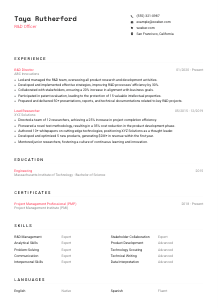
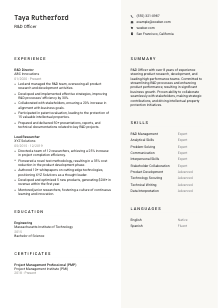
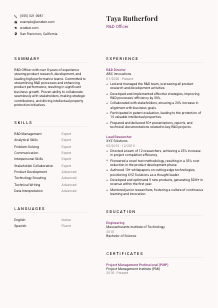
Exploring the cutting-edge, but your CV feels outdated? Check out this R&D Officer CV example, created with Wozber free CV builder. It shows how to present your research ventures in a way that resonates with employers, keeping your career trajectory in tune with the forefront of innovation!
R&D Officer hiring usually turns on whether your CV shows you can move ideas from investigation to usable product outcomes. Hiring teams look for leaders who can guide research, improve development workflows, interpret complex findings, and keep technical work tied to business priorities such as product performance, cost, speed, and intellectual property value.
A tailored CV makes that progression easier to follow, especially when an ATS first scans for terms tied to R&D leadership, product development, technical reporting, and cross-functional collaboration. Wozber's free CV builder helps you align your wording with the posting and build an ATS-compliant CV that surfaces the work most relevant to the role. That gives reviewers a faster read on whether you can lead research programs that produce practical results.
For an R&D Officer, the personal details section should read cleanly and professionally. This role often sits at the intersection of technical teams, product leadership, and executive stakeholders, so even the header should reflect clarity, credibility, and readiness for a senior position.
Place your name at the top in a clear, readable format so it stands out immediately. For senior R&D roles, that simple choice matters because your CV is often reviewed quickly alongside project outcomes, patents, team scope, and technical leadership history.
Add a title that matches the role you are pursuing, such as "R&D Officer," especially when your background includes adjacent titles like R&D Director, Lead Researcher, or Product Development Manager. This helps frame your experience around research leadership and innovation strategy from the first line.
Use a current phone number and a professional email address. Senior research roles often move through several interview stages involving technical leaders, product partners, and HR, so your contact details need to be accurate and easy to scan.
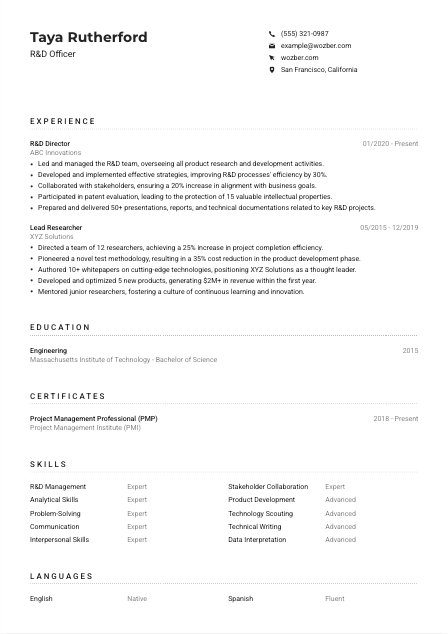
If a posting requires you to be in a specific area or willing to relocate, show that clearly in your location line. In the example, listing San Francisco, California immediately answers a stated requirement and removes uncertainty before the employer gets into your research background.
Include a LinkedIn profile or professional website if it supports your candidacy with publications, patents, project overviews, technical talks, or leadership achievements. For R&D work, these links are most useful when they reinforce your track record in innovation rather than simply repeat your CV.
Do not include details such as age, marital status, or other non-job-related identifiers. Keep the focus on information that supports your candidacy for a role centered on research leadership, product development, and technical collaboration.
This section should remove friction, not create it. Keep it concise, accurate, and aligned with the role so the reader can move quickly to the parts of your CV that show how you lead R&D work and deliver product results.




Experience carries the most weight on an R&D Officer CV because employers want to see how you have led research, improved development processes, and turned technical effort into business value. Strong entries show scope, methods, collaboration, and measurable outcomes rather than broad statements about innovation.
Start by identifying the few capabilities the employer is clearly hiring for. In this case, the core themes are team leadership, product research and development, process improvement, stakeholder alignment, patent support, and technical communication. Those themes should shape which roles and bullets you emphasize.
List your most recent role first and work backward so the reader can follow your development into senior R&D leadership. For each entry, include your title, company, and dates in a consistent format that makes your progression easy to track.
Each bullet should show what changed because of your work. For an R&D Officer, that often means higher process efficiency, better product performance, faster project delivery, stronger technical methods, or protected intellectual property. The example does this well by pairing leadership actions with outcomes like improved process efficiency and stronger business alignment.
Use metrics that belong naturally to research and product development work. Efficiency gains, cost reductions, number of products developed, revenue from launches, patent counts, team size, presentation volume, and project throughput all help translate technical leadership into business terms. A bullet like "improved R&D process efficiency by 30%" gives far more weight than a general claim about streamlining operations.
Prioritise bullets that show leadership across cross-functional work, not only lab or technical execution. This posting emphasizes collaboration with product managers and engineers, so examples involving stakeholder alignment, technical reporting, and strategy implementation should move higher than narrower individual contributor work. That is why experience such as managing a research team, protecting 15 intellectual properties, or delivering 50+ technical presentations reads strongly for this kind of position.
Your experience section should show a consistent pattern of leading research, improving development work, and connecting innovation to business goals. When the bullets are specific and measurable, your readiness for an R&D Officer seat becomes much easier to see.
Education matters in R&D because it establishes the technical base behind your decisions, problem-solving approach, and credibility with scientific or engineering teams. For a senior role, the section should be straightforward and closely tied to the degree background the employer requested.
Check the posting for the academic baseline and make sure your CV reflects it clearly. Here, a bachelor's degree in science, engineering, or a related field is required, with an advanced degree preferred. If you have a directly relevant degree, place it in a way that is easy to spot.
Present each education entry with the key details employers expect to see at a glance. For technical leadership roles, simplicity works best because the main question is whether your training supports the research scope of the job.
If you hold more than one degree, lead with the one that best supports product research, engineering judgment, experimentation, or technical development. In the example, a Bachelor of Science in Engineering from MIT aligns directly with the employer's requirement and supports the candidate's credibility in an R&D leadership context.
Most experienced R&D candidates do not need to list coursework unless it helps explain specialised expertise. Use it when your degree title is broad but your studies covered areas directly tied to the role, such as materials science, product design, testing methods, data analysis, or applied research.
If you completed notable research projects, a thesis, lab work, design competitions, or honors that relate to product innovation or technical problem-solving, include them selectively. This is especially useful when the work connects to patents, prototype development, or a specialised domain the employer values.
This section does not need much space once you have solid experience, but it does need to confirm the technical grounding behind your decisions. Make the degree match easy to spot and let it support the research leadership story told elsewhere on the CV.
Certifications can strengthen an R&D Officer CV when they reinforce how you lead projects, manage teams, or run development work. They matter most when they add operational credibility alongside your technical and product experience.
Review the role and choose certifications that connect to how the work gets done. For senior R&D positions, project management, innovation management, regulatory training, quality systems, or specialised technical credentials can all be relevant depending on the industry.
Do not turn this section into a full training archive. Choose certifications that support leadership, delivery discipline, technical governance, or product development execution. The PMP in the example works well because it reinforces the candidate's ability to manage complex R&D initiatives across teams and timelines.
List the certification name, issuing body, and date or active period so the reader can quickly understand its credibility and recency. This is especially useful in roles where process oversight, documentation, and structured execution matter as much as technical insight.
Update certifications as you renew them or complete new training. R&D environments change with new methods, compliance demands, and product development frameworks, so recent credentials can show that your leadership approach keeps pace with the field.
Certifications should add a practical layer to your profile. When they support how you run projects, manage technical work, or guide teams through development cycles, they strengthen the case that you can handle the operational demands of the role.
An R&D Officer skills section should reflect how research work is actually delivered. That means balancing technical judgment, analytical depth, product development knowledge, and the leadership skills needed to move projects across teams and into business use.
Read the job description for repeated ideas rather than isolated keywords. Here, the recurring themes are R&D leadership, analytical problem-solving, complex data interpretation, stakeholder collaboration, product development, and technical communication. Those are the skills that deserve priority.
Use skill terms that reflect the wording of the posting when they are truthful to your background. That helps both the reader and the ATS connect your profile to the role. The example skill list does this effectively with items like R&D Management, Stakeholder Collaboration, Product Development, Technology Scouting, and Data Interpretation.
Group or order skills so the most role-critical capabilities appear first. For an R&D Officer, leadership and analytical skills usually belong near the top, followed by domain-specific strengths such as product development, technical writing, patent-related work, experimentation, or technology scouting. A focused list reads better than an oversized inventory of generic competencies.
A useful skills section helps the employer see how you operate. Lead with the capabilities tied to research direction, technical decision-making, and cross-functional execution, and let the rest of the CV prove them through results.
Language ability can matter in R&D when the work involves technical documentation, presentations, international partners, or cross-border teams. This section should stay practical and reflect the communication demands of the job rather than serving as filler.
If the posting names a required language, list it clearly and use a level that matches your real ability. Here, English fluency is mandatory, so it should appear first and be easy to find.
Describe language levels with familiar terms such as Native, Fluent, Intermediate, or Basic. R&D roles often require presentations, technical writing, and discussions with stakeholders, so vague language descriptions are less useful than standard proficiency labels.
Extra languages can strengthen your profile when they support collaboration with global teams, suppliers, research partners, or regional markets. In the example, Spanish adds breadth, but English remains the priority because it is the stated requirement.
Use one scale throughout the CV so your language section is easy to interpret.
If the role involves global product development, external research relationships, or international technical reporting, multilingual ability can be a practical advantage. Include extra languages when they support that context, not just to lengthen the section.
For an R&D Officer, language skills matter when they support reporting, collaboration, and communication across technical teams. Lead with the required proficiency and include additional languages only when they add genuine working value.
The summary should quickly establish the level of research leadership you bring and the kind of outcomes you produce. For an R&D Officer, that usually means showing years of experience, product or innovation focus, leadership scope, and the ability to connect technical work to performance and business goals.
Before writing, identify the few requirements the employer cares about most. For this role, those include 5+ years in R&D, leadership experience, innovation track record, strong analytical ability, cross-functional collaboration, and technical communication. Your summary should reflect those priorities in a compact form.
Start with your title or core professional identity, then mention your years of experience and primary area of work. The example does this effectively by presenting the candidate as an R&D Officer with more than 8 years of experience in product research, development, and team leadership.
Choose the achievements or strengths that best support the position you want. For an R&D Officer, useful proof points include process improvements, product development results, team leadership, patent support, revenue impact, or strong stakeholder alignment. Keep them specific enough to sound credible, but concise enough for a short opening section.
Aim for a brief paragraph that can be read in seconds. Skip generic claims about passion or excellence and focus instead on what kind of R&D leader you are, what you have delivered, and where you add value. A well-targeted summary should make the rest of the CV feel consistent from the first lines onward.
When this section is tailored well, it immediately frames you as a candidate who can lead research, improve development work, and communicate technical progress to stakeholders. Keep it specific, senior, and aligned with the operating realities of the role.
You now have a framework for presenting yourself as an R&D Officer with the right mix of research leadership, product development impact, and cross-functional execution. Use Wozber's free CV builder to organise each section around the requirements that matter most and keep the final document in an ATS-friendly CV format.
From there, refine the language so your achievements, technical scope, and leadership record match the target role naturally. Wozber's ATS CV scanner can help you spot missing terms, improve ATS optimisation, and strengthen section-level alignment. The final CV should make one thing clear within a short read: you know how to lead R&D work that turns complex research into business-ready outcomes.




