



Use Wozber and land your dream job
Create CV
No registration required
Working through quantum realms, but your CV feels trapped in a black hole? Learn from the atomic particles of this Physicist CV example, created with Wozber free CV builder. It shows how to unify your scientific genius with job specifics, ensuring your career trajectory aligns with the laws of your mind!
Physics hiring usually turns on proof of serious research work, not broad claims of curiosity or problem-solving. A physicist CV has to make your contribution legible quickly. Show where you worked, what kind of experimental or theoretical questions you tackled, how you handled modeling or data analysis, and what came out of that work through publications, funded projects, patents, or supervised researchers.
The first screening pass often separates general science profiles from candidates who clearly match the research agenda, methods, and technical depth of the opening. Wozber's free CV builder helps you shape that story into an ATS-compliant CV by aligning section structure and wording with the posting, so your experience in areas like computational analysis, publication record, or grant activity is easier to recognize early.
For physicists, the contact section should read like the clean header of a paper or conference abstract. Keep it exact, professional, and easy to scan. If the job includes a location condition, this is the right place to address it without distracting from your research credentials.
Use your full name as the most visible text on the CV so reviewers can immediately connect the document to your publication history, conference presentations, or academic profile. Keep formatting simple and readable rather than decorative.
Place "Physicist" directly under your name, or use a more specific variation only if it matches your background and the posting, such as theoretical physicist or condensed matter physicist. For this opening, the direct title works well because the job description stays broad across specialised areas.
Research hiring often involves multiple follow-ups across faculty, lab leadership, HR, or industry collaborators, so your phone number and email need to be reliable. Double-check every character. A typo in your email can derail interview coordination or requests for publications and references.
If the employer requires you to be in a specific city or willing to relocate, reflect that in your location line. Here, listing San Jose, California directly helps remove uncertainty because the role explicitly names that location. Use this only when the job posting makes geography part of the decision.
A personal research page, Google Scholar profile, ORCID, or LinkedIn profile can strengthen your application when it supports your publication record, grants, lab work, or speaking activity. Make sure it matches the CV on titles, dates, and institutional affiliations.
Do not include age, marital status, photo, or other personal details unless a region-specific application norm requires them. Physics CVs gain more from clean identification and research access points than from unnecessary personal information.
This section should answer basic logistics in seconds: who you are, how to reach you, and whether any stated location requirement is covered. Once that is clear, the reader can stay focused on your research record.




This is where a physicist CV earns credibility. Hiring teams look for signs of independent thinking, technical execution, publishable work, and collaboration across labs, institutions, or industry. Your bullets should show what problem you worked on, what methods you used, and what the work produced.
Start by marking the priorities in the posting, then match your experience to them. For this role, that means experimental or theoretical research, computational analysis, publication activity, multidisciplinary collaboration, mentoring, and grant work. If your background spans several subfields, prioritise the one closest to the employer's research direction.
List your most recent position first so reviewers see your current research level, lab scope, and leadership responsibilities without digging. Use a consistent format for each entry to keep the timeline clear.
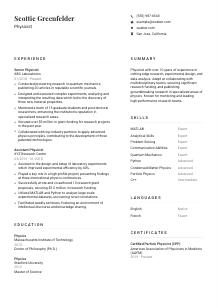
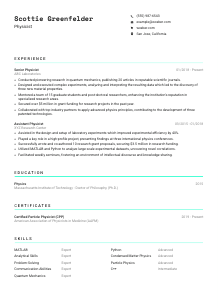
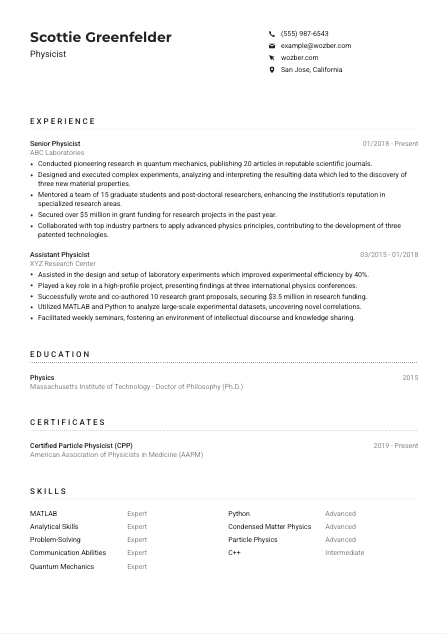
Avoid bullets that only describe tasks like "conducted experiments" or "analysed data." Show what the work advanced. Strong bullets mention the research area, the method, and the result. The example CV does this well by tying quantum mechanics research to published articles, material property discoveries, and patented technologies.
Quantification is especially persuasive in scientific hiring because it gives scale to your work. Include publication count, grant dollars secured, number of students mentored, conference presentations, patents, efficiency gains, dataset size, or experimental throughput improvements where those measures are real and relevant. Metrics like 20 journal articles, $5 million in funding, or a 40% efficiency gain tell a much clearer story than broad claims of impact.
Choose bullets that reinforce the kind of physicist you are. For this posting, collaboration with industry partners, advanced modeling in MATLAB or Python, mentoring junior researchers, and funding success all belong near the top. Older or less relevant work can stay brief unless it adds a critical method, subfield, or achievement that supports your candidacy.
A strong experience section makes your research trajectory easy to follow from question to method to result. When each bullet shows technical contribution and outcome, the reader can quickly judge whether you can lead, publish, collaborate, and win support for future work.
In physics, education is usually more than a formality. Advanced roles often require a Ph.D., and the field of study can signal your theoretical foundation, laboratory training, and entry point into a specialty. Present your degrees so reviewers can immediately confirm that your academic background meets the level of the role.
When a posting calls for a Ph.D. in Physics or a related field, your doctorate should be impossible to miss. Put the highest degree first and make the field explicit. This opening also asks for 5+ years of post-doctoral experience, so your education and experience dates together should make that trajectory visible.
Keep each education line straightforward so institutions and degrees can be scanned quickly by both people and ATS systems. A simple order works best.
If your doctorate or graduate work aligns with the employer's focus, surface that either in the field line or through nearby experience bullets. This posting mentions areas such as quantum mechanics, condensed matter physics, and particle physics, so candidates with one of those backgrounds should make that connection obvious instead of leaving it implied.
For experienced physicists, detailed coursework is usually unnecessary unless it points to a niche method, instrumentation background, or theoretical foundation not otherwise visible. Dissertation topic, major research project, or thesis area can be more useful than a long list of classes.
Prestigious fellowships, competitive scholarships, or notable academic honors can strengthen the section, particularly for research-intensive environments. Include them when they add meaningful context about scholarly standing, not simply to extend the list.
This section should quickly establish that you meet the academic bar and, where relevant, point toward your specialty. Once that is clear, the rest of the CV can focus on the research output built on top of that training.
Certificates are not always central in physics hiring, but they can help when they reinforce a specialised niche, regulated environment, or applied research context. Include them only when they add something your degrees and experience do not already show clearly.
Start with the job posting. If no certificate is required, treat this section as optional support rather than filler. For physicists, credentials are most useful when they connect to a specialty, instrumentation environment, safety standard, or industry-facing application of your research.
A short, relevant list is better than a crowded one. The example CV includes a particle physics credential, which helps reinforce subject-matter depth. Use the same logic for your own background. If a certificate does not sharpen your profile for the target role, leave it out.
If a credential is current, renewable, or tied to recent technical practice, include the date range. That helps the reader place it in context, especially in fast-moving areas that involve current methods, compliance, or specialised equipment.
Physics careers often expand into new tools, methods, or application areas over time. Review this section when you move deeper into a specialty, collaborate with industry, or add training that supports grant work, advanced computation, or emerging research domains.
Certificates should sharpen your scientific profile, not dilute it. If they reinforce your specialization or applied expertise, they belong here. If not, your publications, grants, and research record will carry more weight.
A physicist's skills section should read like a compact map of how you work. It needs to cover the computational tools, analytical strengths, and domain expertise that support your research, without collapsing into a long list of generic traits.
Read the description for methods, tools, and scientific demands, then mirror those terms where they match your background. This role specifically calls for computational work in MATLAB, Python, or C++, along with analytical strength, mathematical depth, and expertise in a specialised area of physics.
List software, programming languages, modeling tools, and domain knowledge alongside the professional capabilities that matter in research settings. For a physicist, that may include numerical simulation, data analysis, experimental design, quantum mechanics, condensed matter, signal processing, or mentoring and scientific communication. The example CV handles this well by combining MATLAB and Python with subject expertise and collaboration-oriented strengths.
Do not treat the skills section as a keyword dump. Prioritise the tools and strengths you can support in your experience bullets, publications, or summary. A tighter list built around your real methods and specialty will perform better in ATS optimisation and hold up better in interviews.
The best skills section helps the reader connect your methods to your outcomes. When your software, analytical strengths, and physics specialization line up with the rest of the CV, your profile reads as technically coherent.
Physics work often depends on clear communication across papers, proposals, presentations, and cross-functional collaborations. Your language section should confirm required proficiency and, when relevant, show broader capacity for international research settings.
If a posting names a required language, list it first and use a clear proficiency label. Here, English is a condition of employment, which matters not only for day-to-day communication but also for journal writing, conference talks, grant proposals, and collaboration across disciplines.
Use standard levels that a hiring team can interpret quickly. If you are a native English speaker, say so directly. If you work professionally in another language, mark that accurately rather than overstating fluency.
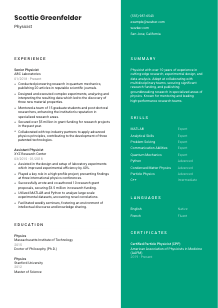
Extra languages are useful when they support international collaborations, multinational research teams, or conference activity, but they should stay secondary to the required language. In the example CV, French adds helpful context without overshadowing English.
Choose one set of labels and apply it evenly across all languages so the section remains easy to scan.
Language breadth matters more when the work involves international partners, global conferences, or distributed research teams. If that is part of your target field, list additional languages that genuinely support your ability to collaborate or present work abroad.
This section does not need to be long. It simply needs to confirm that you can operate in the language the role requires and, if relevant, contribute comfortably in broader research settings.
Your summary should work like the abstract of a strong paper. In a few lines, it should establish your level, research identity, technical strengths, and the kind of results you are known for. This is where you help the reader place the rest of the CV quickly.
Before writing, identify the major themes in the posting so your summary reflects the right mix of specialization and scope. For this role, that includes advanced research, computational analysis, publication record, collaboration, mentoring, and funding activity.
Open with a direct description of your level and field, such as how many years of experience you have and which areas of physics define your work. If your background is strongest in quantum mechanics, particle physics, or experimental modeling, say that plainly instead of relying on vague descriptors.
Choose achievements that carry weight in scientific hiring. Publications, funded grants, patents, major discoveries, advanced modeling work, or supervised research teams all work well. The example summary is strongest where it points to funding success, multidisciplinary collaboration, and leadership of high-performing research teams.
Aim for a short paragraph that can be read in seconds. Cut general claims like "hardworking" or "results-driven" unless they are attached to concrete scientific work. Precision matters here just as much as it does in an abstract or proposal overview.
A clear summary gives immediate context for the rest of your CV. By the time the reader reaches your experience section, they should already understand your specialty, seniority, and the kinds of scientific results you deliver.
With the right tailoring, a physicist CV can show much more than subject knowledge. It can show research direction, technical method, publication strength, funding credibility, and your ability to work across labs, students, and industry partners. Wozber's free CV builder helps organise that material into an ATS-friendly CV that stays readable while matching the language of the role.
Before you send it, review the document for alignment between the posting and your real work. Use an ATS-friendly CV template, refine wording with Wozber's AI CV builder if needed, and run an ATS CV scanner to catch missing terminology or weak section match. The final version should make one thing easy to judge: whether you can contribute meaningful physics research from day one.




