



Use Wozber and land your dream job
Create CV
No registration required
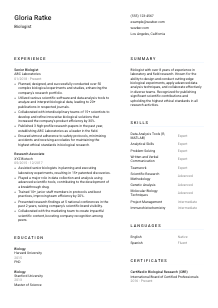
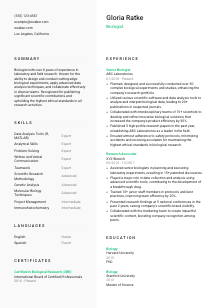
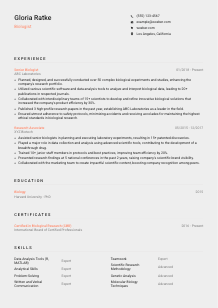
Into DNA, but your CV feels stuck in a double helix? Slide through this Biologist CV example, created with Wozber free CV builder. Learn how to present your cellular savoir-faire to match career criteria, making your job search as diverse and dynamic as the ecosystems you explore!
Biologist hiring often turns on whether your CV shows how you work as a researcher, not simply that you have worked in biology. Teams want to see experiment design, data interpretation, publication or presentation history, and steady adherence to lab or field protocols. Your CV should make that scientific track record easy to follow from the first lines.
A tailored CV also helps separate broad biology experience from the exact kind of research contribution an employer needs. With Wozber's free CV builder, you can shape an ATS-compliant CV around the language of the posting so terms like experimental design, data analysis, scientific software, and research communication are surfaced clearly. That gives hiring teams a faster read on whether you can step into the study, interpret results, and communicate findings with confidence.
The Personal Details section is simple, but for a Biologist it still sets an immediate professional frame. Keep it clean, accurate, and aligned with the role so the hiring team can move quickly from your contact information to your research background.
Use your full name in the largest text on the page so it is easy to identify in a stack of applications or an ATS record. Skip nicknames and unnecessary credentials here. Save degree details like PhD for the education section, where they carry more context.
Place "Biologist" directly under your name if that is the role you are applying for. If your current title is more specialised, such as Research Associate or Senior Biologist, you can still use the target title when it matches your experience. This keeps your positioning clear before the reader reaches your experiment history or publication work.
Include a phone number you answer, a professional email address, and only links that strengthen your candidacy. For biology roles, a LinkedIn profile, university page, publication list, or research portfolio can be useful if it reflects your current work and uses the same titles and dates as the CV.
Some biology openings have site-specific lab access, fieldwork logistics, or on-site collaboration needs. In the example posting, Los Angeles, California is explicitly required, so listing that location in your header immediately removes a practical concern. If a job does not state a location requirement, keep this simple and factual.
A website earns its place when it points to publications, conference presentations, projects, or technical methods relevant to your research area. If it is sparse or outdated, leave it off. For this profession, a clean publication trail is more useful than a generic personal site.
This section does not need personality flourishes. It needs accurate contact details, a clear professional label, and any logistics the employer must know immediately, so the focus stays on your research record.




For a Biologist, the experience section carries the most weight because it shows how you run studies, handle data, and contribute to scientific output. Hiring teams look for evidence of experimental ownership, analytical depth, collaboration across functions, and results that matter in a lab, field, biotech, or academic setting.
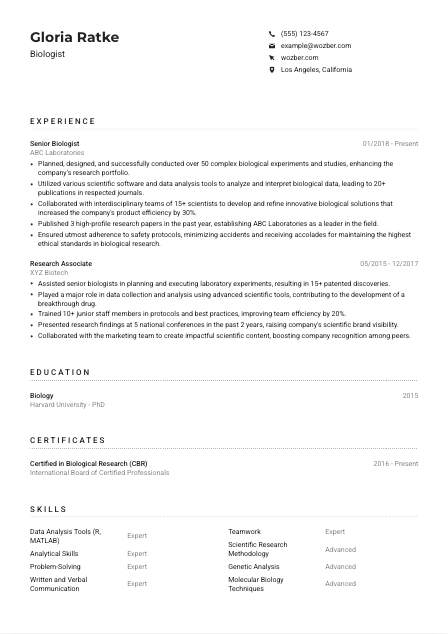
Start by identifying the work the employer needs done: designing experiments, conducting studies, analysing biological data, collaborating with interdisciplinary teams, publishing findings, and following safety and ethical standards. Then mirror those priorities with experience bullets that show where you have already done that work. In the sample CV, bullets map closely to those themes by covering experiment volume, publications, cross-functional collaboration, and safety performance.
List each role with job title, organisation, and dates in reverse order so your research progression is easy to follow. Biology hiring often depends on understanding scope over time, such as whether you moved from supporting studies to leading them, or from collecting data to designing methods and interpreting outcomes. Clean structure helps that progression stand out.
Numbers matter when they reflect how biology work is actually measured. Include counts of experiments, publications, patents, conference presentations, trained staff, study samples, or efficiency gains when those metrics are real and relevant. The sample does this well with details like "50 complex biological experiments," "20+ publications," and team collaboration that improved product efficiency by 30%.
Many biology roles sit at the intersection of research, product development, clinical teams, bioinformatics, regulatory functions, or academic collaborators. Your bullets should show what happened when you worked across those surfaces. Instead of writing only "collaborated with teams," explain the outcome, such as refining a biological solution, supporting a drug program, or improving protocol adoption across the lab.
Avoid vague claims about being hardworking or detail-oriented. Use each bullet to show a method you used, a problem you solved, or a result you delivered. Strong biology bullets often include experiment design, assay work, data interpretation, software use, publication output, protocol compliance, or research impact. If a bullet does not help a reader understand your contribution to scientific work, cut it.
A hiring manager should be able to see what you investigated, how you handled the data, and what came out of the work. Use Wozber's ATS CV scanner to align your wording with the posting while keeping your experience section grounded in real studies, measurable output, and credible scientific scope.
Education carries real weight in biology because degree level often signals research training, methodological rigor, and subject depth. Present it in a way that makes your academic preparation immediately clear, especially when the role requires graduate study.
When a posting calls for a Master's or PhD in Biology or a related field, make sure that degree is easy to spot. List your highest relevant degree first and use the exact field name where appropriate. In the sample, the PhD in Biology is the strongest match and should naturally lead the section.
Use a consistent structure with degree, field, institution, and graduation year. Biology CVs do not need decorative formatting in this section. What matters is fast recognition of your training level, the discipline, and where that training took place.
If your degree is in Biology, Molecular Biology, Ecology, Genetics, Biochemistry, or another related area, name it clearly rather than relying on the institution or thesis title to imply fit. This matters in ATS screening and in human review, especially when the employer is filtering for a precise scientific background.
If you are earlier in your career, include thesis work, dissertation focus, major research projects, or advanced coursework that connects directly to the role's work. That can help bridge the gap when your professional record is still developing. For more experienced biologists, keep this selective and focused on research areas that still support the target job.
Additional academic distinctions, fellowships, or formal research training can support your profile when they relate to your area of biology. Keep the emphasis on relevance. The section should confirm scientific preparation, not turn into a complete academic biography.
Your education section should confirm that your scientific foundation matches the level of work expected. Wozber's ATS-friendly CV template helps present graduate training, field alignment, and relevant academic work in a format that is easy to scan and easy to parse.
Certifications are usually secondary to hands-on research experience in biology, but the right ones can strengthen your profile. They are especially useful when they reinforce lab safety, regulated environments, research compliance, or specialised methods.
Start with the job description. Some biologist roles ask for biosafety, animal handling, clinical research, or environmental compliance credentials, while others do not mention certifications at all. In the example posting, none are required, so certificates should support the application rather than dominate it.
Choose certifications that relate to how biology work is done. Laboratory safety, biological research practice, human subjects training, GMP, GLP, or field sampling credentials can all be relevant depending on the role. The sample CV uses Laboratory Safety Certification and a biological research credential well because both reinforce day-to-day scientific work.
If a certification is current, renewed, or continuously maintained, show that clearly. Dates matter most when the credential reflects ongoing compliance or current technical knowledge. That is particularly useful in labs where safety and ethical standards are part of the hiring decision.
Biology changes quickly across methods, instrumentation, and compliance expectations. Relevant certificates can show that you stay current with research standards and practical requirements. Keep the list selective so each item adds something meaningful to your candidacy.
Certificates work best when they support the research profile already established in your experience and education sections. Add the ones that strengthen your scientific credibility and present them cleanly in an ATS-compliant CV built with Wozber.
The skills section should quickly show the tools, methods, and research habits you bring to a biology team. Hiring managers often scan this section for software familiarity, analytical strength, and technical methods before they read every bullet in your experience section.
Read the job description closely and extract the capabilities it names directly, such as scientific software, data analysis tools, analytical thinking, problem-solving, and communication. Then match those terms only where they reflect real experience. In the sample, software and data analysis appear alongside scientific research methodology, which creates a stronger biology-specific skills profile than generic traits alone.
Put the most relevant capabilities first. For biology roles, that usually means data analysis platforms, lab techniques, field methods, instrumentation, experimental design, statistical analysis, or specialised domain knowledge before general workplace traits. Soft skills belong here too, but they should support the scientific work rather than crowd it out.
If your background is broad, organise skills into clear categories such as data analysis, laboratory techniques, molecular methods, field research, and communication. This helps a hiring manager quickly locate the strengths that matter for the opening. It also improves ATS optimisation because related terminology appears in a structured, readable way.
A biology skills list should sound like it belongs to someone who actually designs studies, works with data, and communicates findings. Use Wozber's ATS CV scanner to check whether your technical terms and research capabilities line up with the language used in the posting.
Language skills matter in biology when the role involves writing reports, publishing papers, presenting findings, or working across international teams. Even when English is the main requirement, listing languages clearly can add useful context to your communication range.
If the posting states that you must articulate well in English, make that visible. Biology work often depends on writing clear reports, preparing manuscripts, documenting methods, and presenting at meetings or conferences, so language ability is directly tied to job performance.
Order languages by proficiency, with your most fluent language first. When English is required and you are highly proficient or native-level, make that easy to spot. The sample does this effectively by placing English before Spanish.
Extra languages can be useful in research settings with multinational teams, community-based fieldwork, conference participation, or cross-border projects. They are not a substitute for scientific ability, but they can add range to your collaboration profile.
Choose standard labels such as Native, Fluent, Intermediate, or Basic so your level is immediately understood. Avoid vague wording like "good" or "conversational" unless the employer specifically uses those terms.
If the biology role involves publication, stakeholder communication, field interviews, or international research coordination, language skills can carry more weight. If not, keep this section concise. The aim is to support your application, not overstate an area that is secondary to your scientific work.
For biologists, language proficiency supports publication, collaboration, and clear reporting. An ATS-friendly CV format from Wozber helps keep this section easy to scan while preserving the communication strengths that matter for research roles.
Your summary should introduce you as a biologist in terms that matter to research hiring. Focus on the level of work you handle, the kinds of studies or data you work with, and the scientific output or collaboration pattern that defines your background.
Review the posting before writing the summary so you know which parts of your background deserve the top lines. If the role centers on experiment design, data analysis, interdisciplinary collaboration, and publication, those themes should shape the summary instead of a generic statement about passion for science.
Begin with a direct line that states you are a Biologist and includes your years of relevant experience. This gives immediate context for the rest of the CV. The sample summary does this well by establishing more than 8 years in laboratory and field research.
Use the next lines to highlight the capabilities most relevant to the job, such as designing biological experiments, applying data analysis tools, publishing findings, maintaining rigorous safety standards, or collaborating across disciplines. Choose strengths that are backed up in your experience section so the summary feels credible rather than inflated.
Three to five sentences is enough. Avoid overloading the paragraph with every technique you know. A hiring manager should finish the summary with a clear picture of your scientific scope, your working style, and the contribution you are likely to make in the role.
A strong summary tells the reader what kind of biologist you are before they reach the details of your studies, tools, and publications. Use Wozber's ATS-friendly CV template to shape that introduction around the role's language and make your research profile easy to recognize.
A Biologist CV works when it shows how you investigate, interpret, document, and communicate scientific work. Keep every section tied to that standard, from graduate training and lab methods to publications, collaboration, and research ethics.
Use Wozber to build an ATS-compliant CV that reflects the language of your target posting and presents your experience in a clear ATS-friendly CV format. When the hiring team can quickly see your experimental scope, analytical ability, and scientific output, your application is doing its job.




