



Use Wozber and land your dream job
Create CV
No registration required
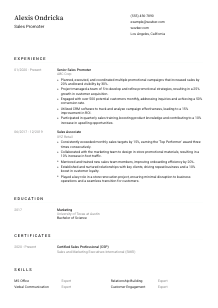
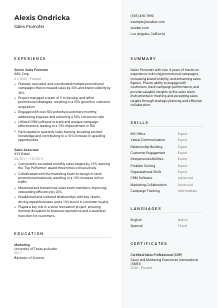
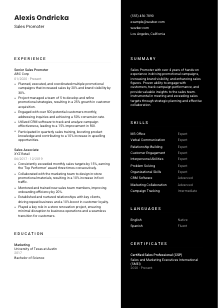
Hooking customers, but your CV isn't closing deals? Check out this Sales Promoter CV example, created with Wozber free CV builder. Learn how to position your promotional prowess to match job buzz, so your career gets all the sales and offers it deserves!
Sales promotion work sits at the point where brand visibility has to turn into real customer action. Hiring teams want to see whether you can run promotions that attract attention, handle live customer conversations well, and convert that activity into sales results they can measure. Your CV should make that commercial impact visible quickly, from campaign execution to customer engagement and follow-up reporting.
A tailored CV also helps separate general sales backgrounds from candidates who can actually support promotional strategy, track campaign performance, and work across sales and marketing. Using Wozber's free CV builder to shape an ATS-compliant CV makes it easier to align your wording with the posting's language, so employers can quickly see your experience with promotions, CRM tracking, and customer-facing execution.
For a Sales Promoter, this section should confirm practical basics fast. Employers need a clear way to contact you, a title that matches the role, and, when stated in the posting, location details that remove avoidable friction from the hiring process.
Use your full name as the clearest identifier on the page. Keep it larger than the body text and easy to scan. In customer-facing roles like sales promotion, presentation matters, and a clean header sets that tone immediately.
Place "Sales Promoter" directly under your name if that is the role you are pursuing. This keeps your positioning consistent with the job ad and helps both recruiters and ATS software connect your CV to promotional and sales-focused openings without guesswork.
List a working phone number and a professional email address you check regularly. Sales Promoter hiring often moves quickly when employers are filling event, retail, field, or campaign-support roles, so a missed call or sloppy email address can cost you an interview.
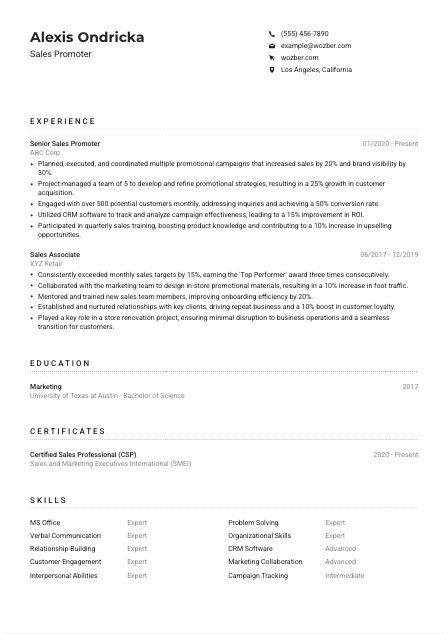
If the employer asks for a candidate based in a certain area or willing to relocate, state your city and state clearly. Here, listing Los Angeles, California directly supports the requirement and tells the employer you meet a practical condition before they reach the experience section.
Include LinkedIn or a professional website only if it reinforces your CV with consistent titles, experience, and achievements. For this kind of role, a polished profile can add useful context around customer-facing work, promotions, or brand campaigns, but only when it is current and aligned.
Keep this section simple, accurate, and aligned with the posting. For a Sales Promoter, personal details should remove basic hiring questions early so the employer can move straight to your campaign work, customer results, and sales history.




This is where a Sales Promoter CV usually wins or loses attention. Employers are looking for signs that you can execute campaigns, engage customers directly, work with sales and marketing teams, and show commercial results through volume, conversion, lift, or ROI.
Start by identifying the responsibilities the employer repeats or emphasizes. In this posting, those include planning promotional campaigns, engaging potential customers, collaborating with marketing and sales, and reporting on campaign effectiveness. Those are the experiences your bullets should surface first if you have done comparable work.
List your jobs in reverse chronological order and give the most space to positions tied to sales, promotions, retail activation, brand outreach, or customer acquisition. A title like "Senior Sales Promoter" naturally fits, but related roles such as Sales Associate can also be valuable when the bullets show campaign support, customer engagement, and sales performance.
Avoid generic lines like "responsible for promotions" or "helped customers." Show what happened because of your work. The sample does this well by tying campaign execution to a 20% sales increase and a 30% lift in brand visibility. That kind of bullet tells the employer you understand both activity and business outcome.
Quantify with metrics that hiring managers in this field recognize, such as sales growth, conversion rate, customer volume, foot traffic, campaign ROI, repeat business, or upsell performance. Figures like engaging 500+ potential customers monthly or improving ROI by 15% are stronger than broad claims about "excellent performance" because they show scale and effectiveness.
Keep older or less relevant jobs brief unless they add useful proof of selling ability, client relationship management, merchandising, or promotional execution. If a past role sits outside sales, focus only on transferable results such as hitting targets, training staff, or supporting in-store initiatives. Every bullet should help the reader picture you promoting products, handling objections, and driving response.
Your experience section should show that you can turn promotional activity into measurable sales movement. When the bullets combine campaign work, customer interaction, collaboration, and results, employers can quickly picture you contributing on the floor, at events, or across wider brand promotions.
Education matters most here as a qualification check and as supporting context for your sales and marketing experience. When the posting asks for a bachelor's degree in Marketing, Business, or a related field, make that match easy to find.
Read the education line in the posting carefully and reflect it with clear wording. This opening asks for a bachelor's degree in Marketing, Business, or a related field, so a Bachelor of Science in Marketing is a direct match and should be listed plainly.
Include degree, field of study, school name, and graduation year or date. Keep the layout simple so the education requirement is easy for both recruiters and ATS parsing to read. This section does not need extra design elements to do its job well.
If your degree aligns closely with the role, make sure the field is fully written out rather than shortened or buried. Marketing, business, communications, and similar programs can all support Sales Promoter work because they connect to consumer behaviour, campaign planning, and market positioning.
Early-career applicants can include classes tied to promotion, consumer marketing, sales management, market research, or business communication if those topics support limited work experience. If you already have several years of results in the field, coursework usually matters less than campaign outcomes and customer-facing achievements.
Honors, competition results, leadership roles, or marketing projects can help if they reinforce persuasion, event promotion, or commercial thinking. Keep them only when they add something the employer would value in a customer-facing sales environment.
For a Sales Promoter CV, education should confirm that you meet the stated degree requirement and support the story told by your experience. A concise, well-labeled entry is usually enough.
Certifications are not always mandatory for Sales Promoter roles, but the right one can strengthen your profile. They work best when they reinforce selling ability, customer communication, product positioning, or ongoing development in marketing and sales practices.
Look for credentials tied to sales, customer engagement, retail performance, brand promotion, or CRM use. This posting does not require a certificate, but a credential such as Certified Sales Professional shows added commitment to sales discipline and professional development.
Do not crowd this section with unrelated training. A short list of certifications connected to selling, account handling, customer service, or marketing execution will do more for your CV than a long inventory of low-value courses.
List the award year and, if relevant, the active period or expiration date. Current certifications can be useful in sales environments where employers value up-to-date product knowledge, communication technique, and professional standards.
Sales promotion changes with channel mix, customer expectations, and reporting tools. Training in CRM platforms, retail marketing, event promotion, or persuasive communication can make your CV stronger over time, especially when paired with real campaign results.
Certificates should reinforce your practical ability to promote products and contribute to sales growth. Keep the section focused on credentials that add weight to your customer-facing and campaign-related experience.
Sales Promoter hiring usually combines people skills with execution skills. Employers want to know whether you can talk to customers, support promotions, work with internal teams, and use tools like CRM systems to track what is working.
Start with the language the employer already uses. In this case, that includes CRM software, MS Office, verbal and written communication, interpersonal ability, and relationship-building. These terms should appear naturally in your skills section if they reflect your actual background, and they also improve ATS optimisation when used accurately.
List capabilities that support customer interaction and campaign execution, such as customer engagement, objection handling, promotional planning, lead tracking, product knowledge, sales reporting, marketing collaboration, and relationship management. The sample CV balances platform knowledge like CRM software with field-relevant strengths such as customer engagement and campaign tracking.
Choose skills that matter for the target role rather than trying to capture everything you can do. Grouping or ordering them by relevance helps. For example, communication, relationship-building, CRM proficiency, and campaign tracking should usually rank ahead of broad workplace traits. A tighter list reads better and gives hiring teams a clearer view of how you operate.
This section should quickly tell the employer that you can engage customers, support promotions, and work with the tools and reporting habits the role requires. Relevance matters more than volume.
Language ability matters in sales promotion because much of the work happens through live conversation. If the employer specifies a required language, your CV should make that visible right away, especially when the role depends on customer interaction and clear product messaging.
If the posting asks for English proficiency, list English at the top with an honest proficiency level. That handles an explicit requirement immediately and supports a role built around customer conversations, product explanation, and written follow-up when needed.
Additional languages can be valuable when working in diverse retail markets, events, or community-facing promotions. A language like Spanish can strengthen your profile if it reflects real ability to communicate with more customers and support broader outreach.
Label each language clearly with terms such as Native, Fluent, Advanced, Intermediate, or Basic. Avoid overstating ability. In a customer-facing role, language claims can be tested quickly in conversation, so precision matters.
Not every Sales Promoter role requires multiple languages, but in some markets they can help with rapport, product explanation, and trust-building on the spot. Include languages when they add real value to the kind of audience or territory you are targeting.
Frame multilingual ability as useful for customer engagement, not just as a personal accomplishment. For promotional work, an extra language can support smoother interactions, more inclusive outreach, and better customer experience in the field.
For Sales Promoter roles, languages should support real communication with customers and teams. Make the required language obvious, and include additional ones when they strengthen your reach in the market you want to serve.
The summary is your fastest chance to frame your value before the reader reaches the full work history. For a Sales Promoter, it should quickly connect your experience level, customer-facing strengths, campaign involvement, and measurable sales impact.
Pull a few ideas the employer clearly cares about, such as driving sales, increasing brand visibility, engaging customers, and tracking campaign effectiveness. Those themes should guide what appears in your opening lines, especially if they match your background.
Begin with a direct statement that names you as a Sales Promoter or closely related professional and mentions your years of experience. The sample summary does this effectively by leading with more than 4 years of hands-on experience, which quickly establishes seniority for a role asking for at least 3 years.
Use the summary to mention the capabilities that show up repeatedly in your experience, such as promotional campaign execution, customer engagement, CRM-based tracking, or collaboration with sales teams. Keep the claims grounded in what your CV can support with bullets and metrics.
Aim for a short paragraph that reads smoothly and avoids generic adjectives. Focus on outcomes and role-relevant strengths instead of broad claims about passion or hard work. In this field, a summary works best when it sounds like someone who knows how to create customer interest and turn that interest into sales.
A good Sales Promoter summary gives the reader an immediate sense of your commercial focus, customer-facing ability, and campaign experience. Once that is clear, the rest of the CV can reinforce it with metrics, tools, and examples.
A Sales Promoter CV should show more than enthusiasm for the product. It should show that you can plan promotions, engage customers confidently, work across sales and marketing, and report on results in a way the business can use.
Before sending it out, check that your wording reflects the posting, your metrics are easy to spot, and your layout stays ATS-friendly. Wozber's free CV builder, ATS CV scanner, and ATS-friendly CV templates can help you tighten that alignment and present your experience in a format employers can scan quickly.
When those pieces are in place, your CV gives hiring teams a clear read on whether you can turn promotion into sales performance.




