



Use Wozber and land your dream job
Create CV
No registration required
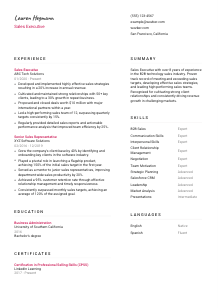
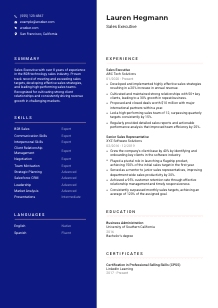
Closing deals, but your CV isn't sealing the deal? Check out this Sales Executive CV example, created with Wozber free CV builder. Learn how to highlight your revenue-boosting acumen to match job criteria, and lead your career to as many victories as your sales pitches!
Sales Executive hiring moves quickly when a CV makes commercial impact obvious. For this role, hiring teams look for proof that you can win new business, grow existing accounts, shape a sales strategy, and keep performance moving quarter after quarter. A vague list of responsibilities will not carry much weight when the job itself is tied to pipeline, revenue, retention, and team results.
The first screening pass often comes down to whether your CV clearly connects your background to the employer's sales motion. Wozber's free CV builder helps you align your wording with the posting, structure an ATS-compliant CV, and surface the right mix of B2B results, client ownership, and leadership so the reader quickly sees your ability to drive revenue.
Sales is a relationship-driven function, and your header should make it easy for a recruiter or sales leader to reach you without friction. Keep this section clean, professional, and aligned with any stated logistics in the posting.
Use your full name as the most visible element in the header. Sales CVs benefit from a straightforward, polished presentation because the first impression should feel credible and business-ready, much like a client-facing introduction.
Place "Sales Executive" directly below your name when that is the role you are pursuing. Mirroring the posted title helps frame your experience correctly from the first line and avoids leaving the reader to guess whether you are applying as an account executive, sales manager, or another adjacent profile.
Include a reliable phone number and a professional email address. In a commercial role where responsiveness matters, even small details like an outdated number or casual email can undercut the image of someone trusted to manage clients and close business.
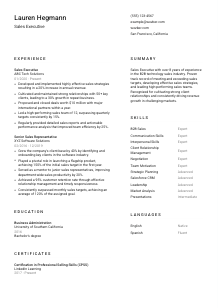
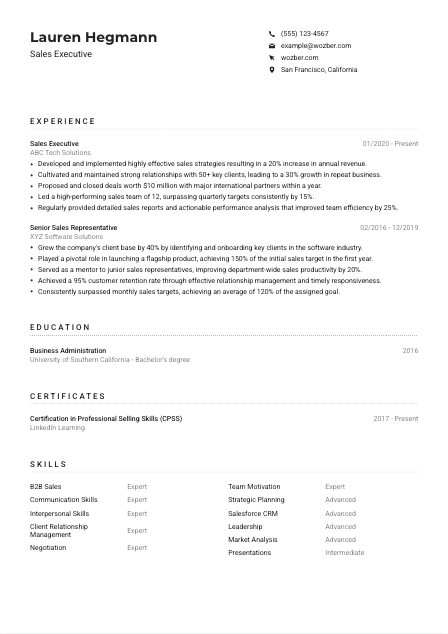
If the employer asks for local availability, show it clearly in the header. Here, listing "San Francisco, California" answers a stated requirement and removes an avoidable question about relocation or territory access. For other Sales Executive roles, include location when geography affects client coverage, office presence, or travel expectations.
A LinkedIn profile or professional website can strengthen your credibility, especially if it supports your sales background with consistent titles, industries, recommendations, or deal-focused achievements. Make sure it matches the CV in tone and timeline.
Your personal details should do one practical job well: show that you are reachable, professional, and logistically aligned with the role. Then the reader can move straight to your revenue story.




For Sales Executive roles, experience is the section that carries the most weight. Hiring managers want to see what you sold, who you sold to, the size of the business you influenced, and how your work changed revenue, retention, or team performance.
Read the job description closely and pull out the work that defines the role, such as building sales strategy, managing key accounts, identifying client needs, leading a team, and reporting performance. Then shape your bullets so they speak directly to those areas rather than describing general duties.
List positions in reverse chronological order and make career growth easy to follow. For a Sales Executive opening that asks for 5+ years in B2B sales, a path from Senior Sales Representative into Sales Executive immediately supports your seniority and commercial scope, especially in software or technology environments.
Each bullet should show action and business outcome. The sample CV does this well with results like a 20% increase in annual revenue, 30% growth in repeat business, and $10 million in closed deals. Those numbers tell a hiring leader far more than saying you "managed accounts" or "supported business development."
Quota attainment, revenue generated, deal value, pipeline growth, retention rate, client count, expansion revenue, average contract size, and team target performance are all useful measures. If you led people, include the size of the team and how their results improved. The example's "team of 12" and "surpassing quarterly targets by 15%" gives clear operational context.
Keep the focus on B2B selling, account growth, strategic planning, client relationships, reporting, and leadership if those are central to the job. Remove older or unrelated bullets that do not help prove you can run a book of business, influence revenue, or lead a sales function.
This section should make your commercial track record easy to follow. By the end of it, the reader should understand your market, your level of ownership, and the results you delivered against target.
Education rarely outranks sales performance for experienced candidates, but it still matters when the employer has named a degree requirement. Present it clearly so it supports your application without distracting from your track record.
If the role calls for a bachelor's degree in Business, Marketing, or a related field, state your degree and field exactly. A "Bachelor's degree in Business Administration" is a clean match here and helps the recruiter confirm a baseline requirement in seconds.
List the degree, field of study, school, and graduation year in a consistent format. For experienced Sales Executives, that is usually enough. The section should confirm qualifications quickly, not compete with your performance history.
When your degree relates directly to sales work, such as business, marketing, communications, or economics, do not leave that implied. Put the field in plain view so the connection between your education and commercial work is obvious.
Most senior sales candidates do not need course lists. Include them only if they reinforce something important for the target role, such as market analysis, buyer behaviour, or strategic management, and only if your professional experience is still developing.
Honors and awards can stay if they are concise and relevant, especially earlier in your career. Once you have several years of quota-carrying experience, they should remain secondary to revenue results and client outcomes.
This section should quietly confirm that you meet the formal requirement. For a Sales Executive, your selling history will do the heavier lifting.
Certifications can strengthen a sales CV when they relate directly to how you prospect, qualify, negotiate, or lead. They are especially useful when a posting names a preferred credential or when you want to show continued investment in commercial skills.
If a role lists CPSS or an equivalent credential as a plus, put it in this section clearly. That gives the employer an immediate match on a preferred qualification and signals structured training in professional selling methods.
Choose certifications tied to sales execution, CRM platforms, negotiation, account management, or leadership. A short, focused list is more persuasive than a long catalogue of unrelated courses.
Dates show recency and help place your development alongside your career timeline. In the sample, the CPSS entry dated from 2017 onward supports the idea of sustained professional development rather than a one-off course.
Sales leaders notice candidates who keep sharpening their approach to discovery, objection handling, forecasting, and team coaching. If you have recent training that supports how you sell or lead, include it here.
Certifications will not replace a proven quota record, but they can strengthen your case when they align with the role's sales process and preferred qualifications.
A Sales Executive skills section should mirror how the role actually operates. That usually means a mix of selling capability, client management, leadership, and the tools or planning skills used to move revenue consistently.
Start with the exact skills the employer names, then add closely related terms you genuinely use. For this opening, that includes B2B sales, communication, interpersonal skills, client relationship management, strategic planning, and performance reporting. This improves ATS optimisation without turning the section into a keyword dump.
Sales Executive roles often sit between individual contribution and broader team influence. Include skills that show both sides of the job, such as negotiation, account growth, forecasting, team motivation, CRM use, and market analysis. The sample skill list pairs relationship and planning strengths with Salesforce CRM and leadership, which is a useful model.
Do not overload this section with every capability you have ever used. Prioritise the skills that support revenue growth, client retention, team performance, and sales strategy, because those are the ones most likely to influence hiring decisions for a senior B2B sales role.
This section should sound like the toolkit of someone who can sell, plan, and lead. If the skills read naturally alongside your experience bullets, you are on the right track.
Language skills matter in sales when they affect client communication, territory coverage, or cross-market relationship building. Even when only one language is required, this section can still remove doubt about your communication ability.
If the posting specifies strong English communication, list English clearly with an honest proficiency level. That is especially important in roles involving proposals, presentations, negotiations, and regular reporting to management.
Lead with the language most important to the role, then list additional languages that could support client conversations or regional expansion. In many B2B environments, another fluent language can be valuable even when it is not a formal requirement.
Terms like native, fluent, intermediate, and basic are enough. Keep them consistent and believable. Overstating proficiency is risky in sales because language ability can be tested quickly in meetings, demos, or discovery calls.
If you sell into multilingual regions or global accounts, extra languages can strengthen your profile. The sample CV's Spanish fluency is a good example of an added capability that may support broader client coverage without needing to dominate the CV.
For customer-facing roles, language skills are not only about translation. They can improve trust, reduce friction in conversations, and help you navigate cultural nuances in account development and partner relationships.
List languages that genuinely support communication in the role. For a Sales Executive, clarity and credibility matter more than an impressive-looking list.
Your summary should quickly establish your level, market context, and sales results. In a few lines, it should tell the reader what kind of revenue driver you are and why your background matches the role they need to fill.
State your title or specialty, years of experience, and market focus. A summary like the example's "over 8 years of experience in the B2B technology sales industry" works because it immediately places the candidate in the right commercial context.
Build the summary around the requirements that matter most for the job. If the employer wants someone with a record of exceeding targets, building client relationships, and driving revenue growth, mention those strengths directly and back them with the tone of real performance, not generic ambition.
For senior sales roles, useful differentiators include leadership experience, strategic account growth, experience in software or technology sales, high retention, or success building repeat business. Choose two or three that genuinely define your track record.
Aim for 3 to 5 lines that create a clear commercial profile. Skip broad statements about being hardworking or passionate unless they are backed by concrete business results elsewhere on the page. Your summary should set up the evidence that follows, not compete with it.
A well-written summary tells the hiring team, in a few seconds, whether you are the kind of seller who can grow accounts, hit targets, and lead revenue conversations at the level this role requires.
A Sales Executive CV works when every section supports the same commercial story: you understand the market, build client trust, and deliver measurable growth. Keep the language close to the posting, use metrics that sales leaders care about, and make your level of ownership easy to read.
With Wozber's free CV builder, ATS-friendly CV format, and ATS CV scanner, you can tighten your wording, improve ATS alignment, and present your experience in a way that makes your sales record easy to judge. The finished CV should leave little doubt about your ability to drive targets, manage relationships, and lead revenue.