



Use Wozber and land your dream job
Create CV
No registration required
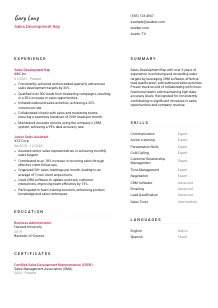
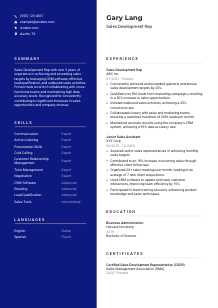
Igniting leads, but feeling the pitch on your CV falls flat? Check out this Sales Development Rep CV example, created with Wozber free CV builder. It shows how to match your prospecting prowess to the job criteria, as you carve out a sales career that keeps closing deals and ringing in success!
Sales development CVs are read through a very practical lens. Hiring teams want to see whether you can create pipeline, qualify interest quickly, keep outreach moving, and hand off opportunities cleanly to account executives or closers. If your CV stays vague about lead volume, conversion rates, outreach channels, or quota performance, it can hide the very work that defines strong SDR execution.
A tailored CV changes that first read. When the wording reflects the employer's sales motion, CRM workflow, and outbound expectations, your background is easier to match in both ATS screening and human review. Wozber's free CV builder helps organise that language into an ATS-compliant CV, so your lead qualification results, outbound activity, and handoff discipline come through clearly.
This section is brief, but it still does important work. For a Sales Development Rep, hiring teams need quick confirmation that they can contact you easily, that your title matches the function, and, when the posting asks for it, that your location lines up with the territory or office expectation.
Use your full name in a clean, readable format that stands apart from the rest of the page. Sales roles depend on professional presence, and that starts with basic presentation. Skip decorative fonts and make your heading easy to scan in a few seconds.
Place "Sales Development Rep" under your name if that is the role you are pursuing. This helps recruiters and ATS systems categorize you immediately, especially when your recent background is already in SDR, BDR, inside sales, or lead generation work.
List a reliable phone number and a professional email address. In sales hiring, fast follow-up matters, and sloppy contact details raise doubts about attention to detail. Use a straightforward email format and check that every link and number works before you send the CV.
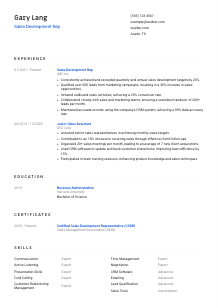
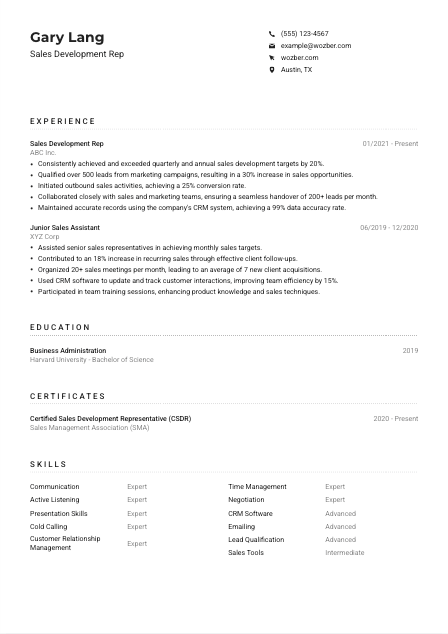
Some SDR roles are tied to a market, office, or in-person team. Here, the Austin, TX requirement makes location worth stating clearly in your header, just as the sample CV does. If a posting does not specify geography, city and state are usually enough without adding a full street address.
A LinkedIn URL can reinforce your outbound sales background, especially if it supports the same story as your CV. Keep job titles, dates, quota references, and core tools consistent across both. For a sales candidate, that consistency suggests discipline in how you manage professional information.
Your personal details should answer the practical questions first: who you are, what role you do, how to reach you, and whether you meet any stated location requirement. Make those details easy to confirm and move the reader quickly to your sales results.




This is the section that carries the most weight for an SDR. Hiring managers look for proof that you can turn activity into qualified pipeline, work a repeatable outreach process, and keep CRM data clean enough for the rest of the sales team to trust. Broad claims about being motivated or persuasive do not do much here. Numbers, workflow details, and outcomes do.
Start by marking the operating priorities in the posting. In this case, the core themes are quota attainment, lead qualification from marketing campaigns, outbound calling and emailing, collaboration with sales and marketing, and CRM accuracy. Those are the ideas your experience bullets should echo if they reflect work you have actually done.
List your jobs in reverse chronological order and make the closest match easy to spot. If you already worked as a Sales Development Rep, put that title to work for you. The sample does this well by leading with an SDR role before earlier support experience, which immediately aligns the candidate with the opening.
Generic statements like "responsible for outreach" are too thin for sales hiring. Show what you handled and what happened: lead volume, conversion rate, meetings booked, opportunities created, quota attainment, or response improvements. Bullets such as exceeding targets by 20%, qualifying 500+ leads, or maintaining 99% CRM accuracy give a hiring team real operating context.
Use wording that reflects how the employer describes the work. If the posting emphasizes "qualify leads," "outbound sales activities," and "CRM system," use those terms naturally in your bullets where they are accurate. That improves ATS optimisation and also helps the reader connect your past workflow to their current process.
Prioritise bullets that show prospecting discipline, lead handoff, campaign follow-up, CRM usage, and measurable contribution to pipeline. Older points that focus only on general admin support or unrelated tasks can be trimmed unless they show clear sales relevance. Each line should strengthen the case that you can handle SDR targets and daily execution.
For a Sales Development Rep, experience should show activity, conversion, consistency, and teamwork in the revenue process. If your bullets make it easy to see how you sourced, qualified, tracked, and handed off opportunities, the section is doing its job. Wozber's ATS CV scanner can help you line those bullets up with the wording the employer uses.
Education is usually not the deciding section for an SDR with solid experience, but it still matters when a posting specifies a bachelor's degree. Handle it clearly and without extra clutter. The aim is to confirm academic background fast, then let your sales record take over.
If the role asks for a bachelor's degree in Business, Marketing, or a related field, make that qualification easy to find. A degree such as Business Administration clearly supports the requirement and should be listed in standard format without forcing extra explanation.
Use a consistent layout with degree, field of study, school, and graduation year or date. Recruiters often scan this section quickly, especially for entry-level or early-career SDR candidates. Clean formatting helps them confirm the requirement and move on to the experience section, where the selling happens.
Business, marketing, communications, and related majors naturally support sales development work because they connect to customer behaviour, messaging, market awareness, and commercial basics. In the sample, a Bachelor of Science in Business Administration aligns neatly with the posting without needing extra framing.
If you are early in your career, you can include relevant coursework, student sales competitions, business clubs, or projects tied to prospect research, market analysis, or presentations. Once you have a few years of SDR or inside sales experience, those details become optional and usually secondary.
Academic honors, leadership roles, or capstone work can stay if they strengthen your commercial profile. For example, leading a business club outreach initiative or presenting market research can support a sales narrative. Leave out details that do not connect to communication, performance, or customer-facing work.
Your education section should confirm that you meet the degree expectation without slowing down the CV. Once that box is checked, the reader should be back to quota performance, outreach results, and lead generation experience.
Certifications are not mandatory in every SDR search, but they can add useful context, especially when they reflect prospecting, sales process, CRM discipline, or ongoing development. They work best as support for your experience, not as a substitute for it.
List certifications that connect directly to sales development, lead generation, outreach, or CRM workflows. A credential such as Certified Sales Development Representative fits naturally because it relates to the day-to-day mechanics of prospecting and qualifying opportunities.
A short, targeted list is stronger than a long catalogue of loosely related courses. Hiring teams will care more about sales certifications, platform training, or revenue-process learning than about generic online badges that do not connect to SDR work.
Certification dates help show how current the training is. That matters when the credential reflects active sales methods, modern tooling, or current outreach practice. If a certification is ongoing or recently renewed, that can support a picture of continued professional development.
Sales development changes fast, especially around CRM use, sequencing tools, messaging strategy, and qualification frameworks. Update this section when you complete training that genuinely sharpens your ability to book meetings, manage pipeline inputs, or work inside a structured sales process. Wozber can help place these credentials cleanly in an ATS-friendly CV format.
The right certificate adds professional weight when it ties back to real SDR work. Keep the section focused on training that strengthens your prospecting, qualification, and sales-process credibility.
A Sales Development Rep skills section should read like the toolset behind your results. That means communication skills matter, but so do the practical abilities that drive outreach, qualification, follow-up, and CRM hygiene. Choose skills that reflect how the work actually gets done.
Start with the language the employer uses. Here, communication, active listening, presentation skills, CRM proficiency, and sales tools are all clearly named. Those are strong candidates for your skills section if they match your background, because they align with both ATS searches and the hiring manager's checklist.
Feature the abilities most tied to meetings booked and opportunities created. For many SDR roles, that includes cold calling, email outreach, lead qualification, objection handling, CRM management, time management, and collaboration with sales and marketing. The sample CV reflects this well by pairing soft skills with core selling activities.
Do not overload the section with every skill you have ever touched. A sharper list gives a clearer picture of how you work day to day. If you include proficiency levels, make sure they are realistic and consistent with your experience bullets, especially for CRM software, outbound communication, and lead management.
The best SDR skills sections connect directly to pipeline work. If your list supports the outreach methods, qualification process, and CRM discipline shown elsewhere on the CV, it will feel credible and useful.
Language ability matters in sales because it affects how clearly you can prospect, qualify, and build rapport. Even when only one language is required, this section can still help if it confirms fluency for customer conversations and internal coordination.
When a posting explicitly states English fluency, list English clearly and use an accurate proficiency level. For an SDR, this speaks directly to cold calls, follow-up emails, discovery conversations, and handoff communication with the sales team.
If you speak another language well enough to support customer interaction, include it. Additional languages can be valuable in regional territories, diverse prospect pools, or teams selling across markets. They are a bonus, not a replacement for core SDR performance.
Use straightforward labels such as Native, Fluent, Professional Working, or Conversational. Sales hiring depends on trust, so avoid inflating your level. If you could comfortably handle a prospect call or qualification email in that language, the rating should reflect that honestly.
Some SDR roles are heavily domestic, while others support multilingual markets or broader account coverage. If the role points to international outreach or a varied customer base, your languages section becomes more relevant. If not, keep it concise and accurate.
Early-stage proficiency can still be worth listing when it supports the market, territory, or customer segment, but keep the label modest. A growing language skill can suggest adaptability, though it should never distract from the core proof of SDR ability: outreach results, qualification judgment, and consistent follow-through.
For this kind of role, language details should clarify how you communicate with prospects and teammates. Lead with required fluency, add useful extras, and keep every proficiency label honest.
Your summary should sound like a sales professional talking about measurable work, not a candidate reciting generic strengths. In three to five lines, show your level, your operating strengths, and the type of results you have produced in prospecting and qualification.
A useful summary speaks to pipeline creation, lead qualification, outbound outreach, and close coordination with the next stage of the sales team. That is the centre of the role. Build your opening around those responsibilities rather than broad claims about being driven or people-oriented.
Lead with your years of relevant work and a direct sign of results. Phrases such as "Sales Development Rep with 3+ years of experience" or "quota-exceeding SDR with experience in outbound prospecting and lead qualification" establish level and focus quickly. The sample summary does this effectively by pairing tenure with target achievement.
Bring in the capabilities the employer is hiring for, such as CRM software, lead qualification, cold outreach, campaign follow-up, or clean lead handoff. Include one or two concrete outcomes where possible, like increased sales opportunities, strong conversion rates, or high CRM accuracy, so the summary feels grounded in actual execution.
Four concise lines are usually enough. Avoid repeating bullet points word for word, and skip empty adjectives that could describe anyone in sales. A short summary with role-specific language and clear performance cues will do more than a long paragraph full of general enthusiasm.
A well-written summary should tell the reader, within seconds, what kind of SDR you are, how you work, and what results tend to follow. Once that frame is in place, the rest of the CV can back it up with numbers and examples.
When your CV clearly shows quota performance, lead qualification, outbound execution, CRM discipline, and team handoff, it speaks the language of Sales Development Rep hiring.
Use Wozber to shape that experience into an ATS-compliant CV, refine role-specific wording with its AI CV builder, and check alignment before you apply. The final version should make it easy to judge whether you can create pipeline from day one.