



Use Wozber and land your dream job
Create CV
No registration required
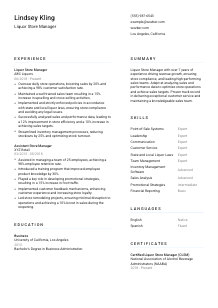
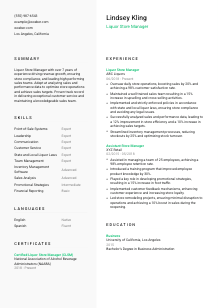
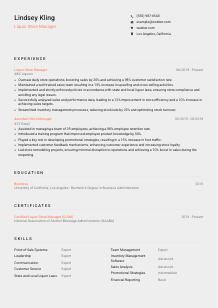
Running the shelves, but your CV is on the rocks? Check out this Liquor Store Manager CV example, made with Wozber free CV builder. It shows how easy it is to distill your management skills to match job tastes, ensuring your career path pours smoothly and never goes stale!
Running a liquor store means balancing revenue, inventory control, customer experience, and legal compliance every day. Hiring teams look for managers who can keep the floor moving, train staff to sell responsibly, and make smart decisions around stock levels, promotions, and store performance. Your CV should make that operating range visible fast.
Store manager CVs often get overlooked when they read like generic retail profiles and bury the details that matter here, such as liquor law knowledge, POS fluency, shrink control, and team coaching. Wozber's free CV builder helps you shape an ATS-compliant CV around the language used in the posting, so the hiring team can quickly see whether you can run a compliant, profitable store with a well-led sales team.
This section is straightforward, but it still does important work. For a Liquor Store Manager, your header should immediately confirm who you are, the role you are targeting, and any location detail the employer has specifically asked for.
Place your name at the top in a clean, readable format. Store owners and recruiters should be able to identify you at a glance before they move into your management experience, compliance background, or sales results.
Add the job title directly under your name and match the wording in the posting. Using "Liquor Store Manager" helps frame the rest of your CV around store operations, alcohol retail compliance, staff supervision, and sales accountability instead of broader retail management.
Include a reliable phone number and professional email address. If you add a LinkedIn profile or personal website, make sure it supports your retail leadership background rather than distracting from it.
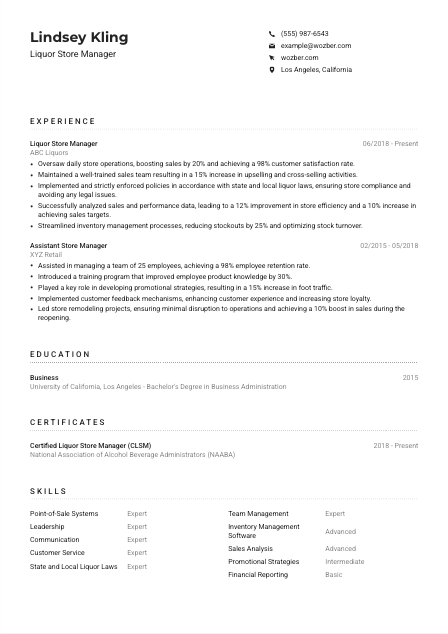
If the employer requires candidates to be based in a specific area, show that clearly in your header. Here, listing Los Angeles, California directly supports the stated requirement and removes doubt about local availability.
Skip personal information that does not help with store leadership, legal compliance, scheduling, customer service, or availability. A tight header keeps attention on the qualifications that matter for running a liquor retail operation.
Your personal details should confirm role alignment in seconds. Once that is in place, the rest of the CV can focus on what matters most for this job: operational control, team leadership, inventory discipline, and compliance.




This is the section hiring teams read most closely for a Liquor Store Manager. They want to see whether you have actually led a retail floor, controlled inventory, enforced liquor regulations, coached staff, and improved sales through disciplined store management.
Start by marking the core duties in the posting, then build your experience bullets around matching examples from your work history. For this role, that means daily operations, staff scheduling, customer service standards, inventory checks, supplier ordering, policy enforcement, and sales analysis. When your bullets reflect those same operating priorities, the connection is immediate.
List jobs in reverse chronological order and give the most space to positions where you managed people, stock, compliance, or store performance. If you moved up from Assistant Store Manager to Liquor Store Manager, as in the example, that progression helps show increasing responsibility for team oversight and business results.
Each bullet should show what you owned and what changed because of your work. Strong liquor retail bullets often cover sales growth, stock accuracy, training quality, regulatory compliance, merchandising execution, or customer satisfaction. A line such as enforcing state and local liquor laws works well because it shows operational responsibility, not just participation.
Use numbers where they reflect how store performance is measured. Sales growth, stockout reduction, upsell rates, customer satisfaction, employee retention, and efficiency gains are all relevant here. The sample CV does this well with metrics like 20% sales growth, a 25% reduction in stockouts, and a 15% increase in upselling, which immediately gives scale to the manager's impact.
Keep bullets tied to liquor retail or closely related store management work. Experience that shows team supervision, promotional execution, reorder planning, shrink reduction, or customer issue resolution belongs here. Older or unrelated work should stay brief unless it clearly strengthens your case for managing a regulated retail environment.
Your experience section should leave no doubt that you can run the day-to-day store, protect compliance, and improve results. When each bullet connects responsibility to a measurable outcome, your track record becomes much easier to trust.
A degree is not the whole story for this role, but it does matter when the posting asks for formal business or retail education. Present it clearly and show how it supports your ability to manage operations, people, and store performance.
If the employer asks for a bachelor's degree in Business, Retail Management, or a related field, make sure your education section makes that easy to spot. In the example, a Bachelor's Degree in Business Administration aligns well with the role's operational and commercial demands.
List your degree, school, field of study, and graduation year in a simple structure. Hiring teams scanning for baseline qualifications should not have to work through extra wording to confirm that you meet the requirement.
A degree in business, retail, supply chain, or a related area supports work tied to sales analysis, staff management, inventory planning, and financial oversight. If your degree title is broader, let the field of study clarify the connection.
Most experienced managers do not need detailed coursework, but it can help early-career candidates or career changers. Subjects like retail operations, business analytics, accounting, merchandising, or consumer behaviour are more useful here than generic academic detail.
Honors, relevant projects, or leadership activities can add value if they reinforce management potential or business discipline. Keep them brief and only include them when they strengthen your case for supervising a store and analysing performance.
Education should confirm that you meet the stated requirement and support the business side of your management profile. Once that is clear, the hiring focus returns to your store results and operating judgment.
Certifications are often secondary for this role, but the right one can reinforce your credibility in alcohol retail, management practice, or regulatory awareness. Include them when they add real value, not just extra lines.
Choose certifications that support the work itself, such as alcohol compliance, responsible beverage service, retail management, or supervisory training. The example certificate, Certified Liquor Store Manager, works because it directly reinforces industry-specific knowledge.
A short list of relevant certificates is stronger than a long list of loosely connected courses. Every item should relate to store operations, alcohol sales rules, customer-facing retail, or team leadership.
Regulations, systems, and store practices change, so dates matter. Showing when a certificate was earned or remains active helps signal that your knowledge is current, especially for compliance-related credentials.
As you move into larger stores or more complex retail environments, new certifications in compliance, loss prevention, inventory control, or management can support that progression. Treat this section as a record of practical development, not a static archive.
Certificates should add weight where the CV needs it most, especially around compliance and store leadership. If they are relevant and current, they can strengthen your profile quickly.
A Liquor Store Manager needs a mix of operational, commercial, and people skills. This section should show that you can run the systems behind the counter, lead the team on the floor, and make decisions that protect both sales and compliance.
Review the posting for required systems, knowledge areas, and leadership expectations, then mirror them with skills you genuinely use. Here, inventory management software, point-of-sale systems, liquor law knowledge, communication, customer service, and leadership are all central to the role.
Include both the tools and the management capabilities that drive store performance. POS systems, inventory software, sales analysis, and financial reporting belong alongside team management, training, communication, and customer service. That combination reflects how the job is actually performed.
Do not crowd this section with every retail skill you have ever picked up. Prioritise the capabilities most tied to liquor store management, such as compliance knowledge, ordering, stock control, team supervision, merchandising, and sales improvement. The sample skill list stays effective because it keeps the emphasis on systems, laws, service, and leadership.
The right skills section should read like the operating toolkit for the job. When the list reflects the store floor, the stockroom, and the management office, it supports the rest of your CV well.
Liquor retail is customer-facing work, and communication affects service quality, upselling, conflict handling, and staff direction. If the posting calls out English literacy or the store serves a multilingual community, your language section can add practical value.
When a posting specifically asks for strong English literacy, list English clearly with an honest proficiency level. This matters for policy communication, incident handling, vendor coordination, scheduling, and compliance documentation.
Additional languages can be an asset in neighborhoods with diverse customer traffic. In the example, Spanish is a useful addition because it supports customer service and day-to-day communication in many retail settings, though it is not a universal requirement.
Stick with standard terms such as Native, Fluent, Intermediate, or Basic. Accurate language ratings help hiring teams understand whether you can greet customers, handle detailed service conversations, or communicate policy and product information confidently.
If you include extra languages, think about how they support the job. They may help with customer recommendations, de-escalation, neighborhood loyalty, or communication with team members and vendors. That practical link matters more than listing languages for their own sake.
Only list languages you can actually use in a work setting. A language section is strongest when it reflects real customer or operational value, not inflated proficiency.
For this role, language skills matter when they improve service, team coordination, or local customer relationships. Keep the section accurate and tied to real store communication needs.
Your summary should give a fast read on the kind of store manager you are. In a few lines, it should connect your years of experience with the parts of the job that matter most here: operations, compliance, customer service, team leadership, and sales performance.
Start with the role's core priorities and shape your opening around them. For a Liquor Store Manager, that usually means regulated retail operations, staff leadership, inventory control, and sales results. This keeps the summary grounded in the actual job rather than generic management language.
State your title or professional identity, then add your years of relevant experience. A line like "Liquor Store Manager with over 7 years of experience" works because it establishes seniority right away and prepares the reader for operational achievements.
Mention the capabilities that define your management style and business value. Compliance with state and local liquor laws, team development, sales growth, customer satisfaction, and inventory optimisation are all strong summary material when they reflect your actual background. The example summary uses this approach well by combining revenue growth, compliance, and high-performing team leadership.
Aim for 3 to 5 lines that make the hiring team want to read your experience section next. Do not repeat every skill or every achievement. Give a compact picture of the store environment you can manage and the results you tend to produce.
A clear summary helps the hiring team place your experience in the right frame from the start. It should quickly establish that you can manage a liquor retail operation with discipline, strong service standards, and commercial awareness.
Before sending your application, read your CV as if you were hiring for a busy liquor retail operation. The key questions are simple: Can this person run the store, lead the team, stay compliant, and improve sales? If those answers are clear in your experience, skills, and summary, your CV is doing its job.
Use Wozber's free CV builder to tighten structure, tailor wording to the posting, and create an ATS-friendly CV format. With Wozber's ATS CV scanner, you can also check whether your CV reflects the requirements that matter most for the role, from inventory systems and POS tools to liquor law compliance and store performance.
That gives the hiring team a clean, credible read on your ability to manage the business from opening shift to closing report.




