




Use Wozber and land your dream job
Create CV
No registration required
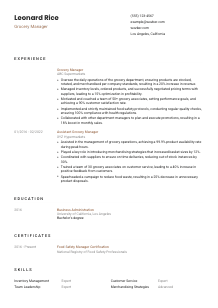
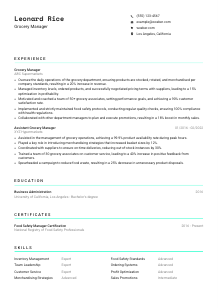
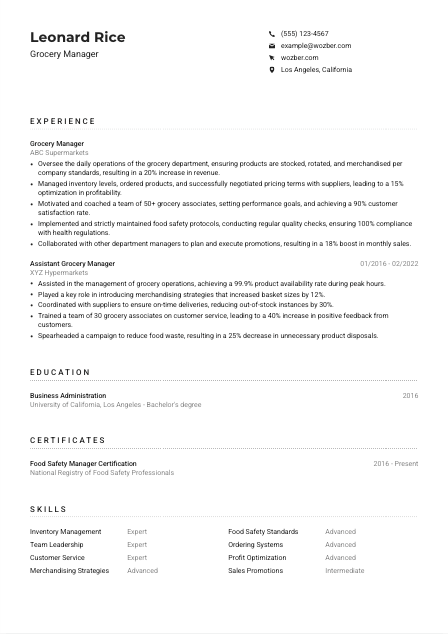
Steering shelves, but your CV's out of stock? Check out this Grocery Manager CV example, created with Wozber free CV builder. Learn how to match your store savvy to job requirements, making sure your career is always shelf-aware and never in the markdown bin.
Grocery management is operational work with very little room for drift. Hiring teams want to see how you keep shelves full, inventory moving, food safety standards in place, and associates performing well during busy trading hours. Your CV should make that operating range visible quickly, especially through examples tied to merchandising results, stock control, team supervision, and department performance.
A generic retail CV can blur the difference between someone who worked in a store and someone who ran a grocery department. Tailoring fixes that by bringing forward the terms and results that matter here, such as ordering, rotation, vendor coordination, shrink control, food safety compliance, and customer service scores. Wozber's free CV builder helps organise those details into an ATS-compliant CV, so the hiring team can quickly see whether your background matches the pace and standards of grocery operations.
This section is brief, but it still does useful work. For a Grocery Manager role, your header should immediately show who you are, how to reach you, and whether you meet practical requirements such as location for the position.
Place your full name at the top in a clear, readable size. Grocery hiring often moves fast, especially for department leadership roles, so the header should be easy to scan on both screen and print.
If you are targeting a Grocery Manager opening, use "Grocery Manager" directly beneath your name. That keeps your CV aligned with the role and helps distinguish you from broader retail or assistant manager profiles.
Use a phone number you answer reliably and a professional email address based on your name. If you include a website or LinkedIn, make sure it supports your retail leadership background and does not distract from your store operations experience.
If the employer requires someone based in Los Angeles or open to relocation, say that clearly in your header. In the sample CV, listing Los Angeles, California removes a practical question right away and supports a faster review.
Skip details that do not affect grocery department performance, such as marital status, date of birth, or unrelated personal interests. Save the space for information tied to store leadership, availability, and job alignment.
For this role, personal details should confirm availability and professionalism without taking attention away from operations, merchandising, and leadership experience. A clean header helps the rest of the CV move straight into your value as a department manager.




Experience carries the most weight in grocery management hiring. Employers want to see whether you have actually handled stock flow, margin pressure, team coaching, food safety execution, and day-to-day department performance in a live retail environment.
Read the posting for the operating responsibilities that appear repeatedly, then mirror them through your own work history. Here, that means inventory management, merchandising, supplier coordination, team development, food safety, and cross-department promotions. Your bullets should speak directly to those areas instead of staying at a generic "store management" level.
List roles in reverse chronological order and make the growth visible. Moving from Assistant Grocery Manager to Grocery Manager, as in the example, tells a useful story about readiness to own staffing, ordering, and department results rather than just support them.
Under each job, lead with outcomes tied to grocery performance. Useful metrics include revenue growth, profitability, product availability, shrink reduction, customer satisfaction, waste reduction, or compliance rates. The sample does this well with results such as a 20% revenue increase, 15% profitability improvement, and 100% food safety compliance.
Numbers add context beyond percentages. Mention team size, store volume if relevant, delivery frequency, number of SKUs, or peak-hour availability targets when you have them. Saying you coached 50+ grocery associates or maintained 99.9% product availability gives the reader a much better sense of the operation you handled.
Use this section for work that proves you can run a grocery department. Prioritise ordering, replenishment, merchandising execution, vendor communication, promotional planning, labour oversight, and customer-facing results. If a past achievement does not connect to store operations or team leadership, cut it.
Your experience section should make it easy to picture you managing inventory, people, compliance, and sales performance in a real store. When your bullets connect daily grocery work to measurable outcomes, your readiness for the role becomes much easier to judge.
Education is usually secondary to experience in grocery management, but it still helps frame your preparation. A degree in business, operations, or a related area can reinforce your understanding of staffing, financial performance, and day-to-day decision-making in a retail setting.
If you have a Bachelor's degree in Business Administration or another related field, place it clearly in this section. That aligns well with postings that prefer formal business training, like the example requirement here.
Include the degree, school, field of study, and graduation year or date range. Hiring teams do not need a long academic profile for this role. They need a clear record that supports your management background.
A business-focused degree can support your case when the role involves margin management, supplier negotiation, staffing decisions, and departmental planning. In the sample, a Business Administration degree adds useful context to the candidate's profitability and leadership results.
If you are earlier in your career or your coursework directly supports the role, mention classes like operations management, supply chain, retail marketing, or organizational leadership. Otherwise, keep the section lean and let your store results do the heavier lifting.
Clubs, leadership roles, or honors can help if they show management, accountability, or teamwork, especially for candidates with less direct grocery leadership experience. If you already have years of department management, these details are optional.
Education should reinforce the business side of your grocery management background, not compete with your store results. Keep it concise and relevant, especially when your experience already shows strong operational command.
Certifications are especially important in grocery roles when they relate to safety, compliance, and regulated handling standards. They show that you can oversee daily operations without letting quality control slip.
If you hold a Food Safety Manager Certification, list it prominently. For many grocery management roles, this is directly tied to the work, because you are responsible for quality checks, storage standards, rotation practices, and compliance with health regulations.
Only include certificates that strengthen your case for grocery leadership. Food safety, retail management, inventory systems, or loss prevention training usually make sense. A short, focused list is more credible than a long list of unrelated courses.
Include the issue date, expiration date, or renewal window when relevant. In the sample CV, showing the food safety certification as active helps confirm that the candidate's compliance knowledge is current.
If you have added training in leadership, vendor management, HACCP-related practices, or store operations systems, include it when it supports the type of grocery environment you are targeting. Ongoing development is especially useful when moving into larger-volume or more compliance-heavy stores.
For a Grocery Manager, the right certification tells an employer you can uphold standards that affect customers, inventory quality, and regulatory compliance. Prioritise the credentials that connect directly to department oversight.
The skills section should read like the operating toolkit of a Grocery Manager. Focus on the abilities that affect shelf conditions, team execution, customer experience, stock accuracy, and department profitability.
Start with the capabilities the role depends on every day. In this case, inventory management, merchandising, leadership, coaching, food safety knowledge, supplier coordination, and customer service all come straight from the job's responsibilities and requirements.
Use the same wording when it reflects your real experience. If the employer asks for "inventory management" and "merchandising strategies," include those exact terms rather than replacing them with broader retail language. The sample skills list also smartly adds connected capabilities like ordering systems and profit optimisation.
Group your strongest, most relevant skills first instead of creating a long catch-all section. For this role, hard skills and operational capabilities usually matter most up front, followed by leadership and service skills that support store execution.
A Grocery Manager skills section should quickly confirm that you can manage stock, coach associates, maintain standards, and drive sales through smart merchandising. Every skill listed should connect to how the department performs.
Language ability matters in grocery retail because managers work across associates, customers, vendors, and other department leaders all day. Clear communication supports service, coaching, conflict handling, and consistent execution on the floor.
If the role requires strong English proficiency, list English at the top with an accurate level such as Native or Fluent. That matters for team communication, safety procedures, scheduling, reporting, and customer interaction.
Additional languages can be valuable in customer-facing grocery settings and diverse labour environments. In the example, Spanish strengthens the profile because bilingual communication can help with coaching, service recovery, and day-to-day team coordination.
Use clear labels such as Native, Fluent, Conversational, or Basic. Grocery managers often need to give instructions, handle customer issues, and explain procedures, so your stated level should match what you can actually do on the job.
This section is more than a nice extra when it helps you lead a broader team or serve a wider customer base. If a language helps with associate training, vendor discussions, or customer support, it belongs on the CV.
List language skills when they add real value, but do not overbuild the section if languages are not a major hiring factor in your target roles. For most Grocery Manager CVs, this is supporting information rather than the core of your candidacy.
Language skills are worth including when they help you run the department more effectively, communicate with a broader team, or improve the customer experience. Keep the section accurate and tied to how you work in the store.
Your summary should quickly establish the kind of grocery operation you can manage and the results you tend to produce. Keep it grounded in store realities such as inventory control, team leadership, customer service, merchandising execution, and compliance.
Start with your title and years of relevant experience. A line such as "Grocery Manager with 6+ years of experience" immediately places you in the right lane and helps separate you from general retail candidates.
Use one or two sentences to highlight the parts of the job where you are strongest. That may include improving profitability through ordering and vendor negotiation, increasing sales through merchandising, or lifting customer satisfaction through team coaching. The sample summary handles this well by combining operations, leadership, food safety, and growth.
Adjust the wording for each application so the summary echoes the most important needs in the posting. If food safety standards and team development are central, bring those forward. If the store is more focused on merchandising and profitability, lead with those instead.
Aim for three to five lines with concrete language. Avoid vague claims about being results-driven or passionate unless they are supported by real outcomes elsewhere on the page. Your summary should sound like someone who has run a grocery department, not someone describing retail in general.
A well-written summary should quickly tell the reader what kind of Grocery Manager you are, what parts of the department you handle best, and what results tend to follow. When this section is tailored well, the rest of the CV lands faster.
A Grocery Manager CV should make daily execution visible. That means clear evidence of inventory control, merchandising impact, food safety oversight, team coaching, and department results, presented in language that matches the job you want.
Use Wozber's free CV builder and ATS-friendly CV templates to organise those details into a clean, targeted application. With thoughtful ATS optimisation and role-specific phrasing, your CV can show exactly what a hiring team needs to see: that you can step in and run the grocery department with confidence.




