



Use Wozber and land your dream job
Create CV
No registration required
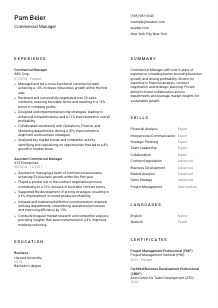
Mastering business deals, but your CV is lacking that commercial appeal? Check out this Commercial Manager CV example, created with Wozber free CV builder. Learn how to seamlessly tie your transactional talents to job specifications, making your career as lucrative as the opportunities you pursue!
Commercial Manager hiring usually turns on a practical question fast: can this person turn commercial decisions into measurable growth without giving away margin, terms, or control? Your CV should make that visible through revenue impact, pricing judgment, contract negotiation, and the way you work across finance, operations, and sales-facing teams.
When those strengths are written in the employer's language, your background is easier to rank in an ATS and easier to separate from general business development or sales profiles. Wozber's free CV builder helps you shape an ATS-compliant CV around the posting's wording so hiring teams can quickly see commercial leadership, negotiation depth, and profit-minded decision making.
Commercial managers work in high-trust conversations, from pricing discussions to contract reviews, so the top of your CV should feel clean, credible, and easy to act on. This section is simple, but it still helps establish that you are organised, accessible, and already aligned with the basics of the opening.
Use your full name as the most visible text at the top of the page. Keep the formatting professional and easy to scan in an ATS-friendly CV format, because this role calls for clarity and confidence rather than design flourishes.
Place "Commercial Manager" directly under your name when that is the role you are pursuing. Matching the posted title helps position you correctly from the first line and avoids your profile being read as broadly sales, account management, or business development when the job is specifically commercial.
List a current phone number and a professional email address, ideally in a simple format such as firstname.lastname@email.com. In a role built around negotiation, stakeholder contact, and cross-functional coordination, basic professionalism in your contact details still matters.
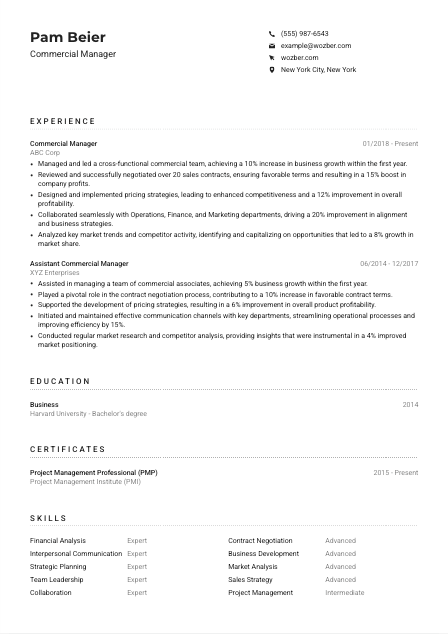
If the employer requires candidates to be based in a specific city, show that clearly in your header. Here, listing "New York City, New York" directly answers a stated requirement and removes an avoidable question before the reader reaches your experience.
A LinkedIn profile or personal website can reinforce your credibility if it matches your CV and reflects your commercial background accurately. Keep it current, especially if it includes deal exposure, market-facing work, leadership scope, or business growth achievements.
Keep this section straightforward and tailored to the posting. For a Commercial Manager, the header should confirm who you are, how to reach you, and any practical requirement such as location without distracting from your commercial track record.




This is the section where Commercial Manager candidates separate themselves. Hiring teams want to see how you influenced growth, profitability, pricing, contracts, and cross-functional execution, not just that you held a commercial title.
Read the posting closely and mark the commercial priorities it repeats. In this case, that means leading teams, negotiating contracts, building pricing strategy, partnering with Operations, Finance, and Marketing, and using market analysis to find growth opportunities. Your experience bullets should mirror those themes with your own results.
List roles in reverse chronological order and make the growth in your scope obvious. A move from an assistant commercial position into full commercial leadership, like the sample CV shows, tells a useful story about increasing ownership over revenue decisions, negotiations, and strategic planning.
Commercial CVs read better when each bullet answers, "What changed because of your work?" Replace task-only lines with outcomes tied to growth, margin, or execution. For example, "reviewed sales contracts" becomes stronger when it includes volume, favorable terms, or profit impact, such as negotiating 20+ contracts that improved profitability.
Prioritise numbers that belong naturally in this function: revenue growth, profit improvement, market share gains, contract value, pricing uplift, team size, or operational efficiency. The sample CV does this well with figures such as 10% business growth, 15% profit improvement, and 8% market share growth, all of which speak the language of commercial performance.
Not every accomplishment deserves space. Keep the emphasis on negotiation, pricing, forecasting, business development, market analysis, and collaboration with finance and operations. If a bullet does not help explain your commercial judgment or business impact, trim it in favor of something that does.
Your experience section should leave little doubt about the scale and commercial value of your work. When the bullets show revenue growth, stronger terms, sharper pricing, and effective coordination across teams, the CV starts to sound like someone ready to manage the commercial function.
For Commercial Manager roles, education usually serves as a baseline qualification rather than the main selling point. Still, it should immediately confirm that you meet the degree requirement and have the academic grounding for financial, strategic, and business decisions.
If the posting asks for a bachelor's degree in Business, Finance, or a related field, make that easy to find. A Bachelor's degree in Business, as shown in the sample, aligns directly with the requirement and supports the commercial, analytical, and market-facing nature of the job.
Use a simple structure: degree, field of study, school, then graduation year. Commercial hiring rarely rewards elaborate education formatting. It rewards speed of recognition, especially when recruiters are checking baseline requirements before moving to experience.
If your degree is closely tied to business, finance, economics, or another relevant discipline, name it precisely. That specificity helps frame you as someone with formal exposure to pricing, financial analysis, market dynamics, or business strategy.
Most mid-level and senior commercial CVs do not need course lists, but they can help if you are earlier in your career or your coursework directly supports the role. Subjects such as corporate finance, strategic management, contract law, or market analysis can be worth including when experience is lighter.
Academic distinctions can stay if they add signal without crowding the page. For an experienced Commercial Manager, they are secondary to revenue, negotiation, and pricing results, so include them only if they remain genuinely notable.
This section should confirm that you meet the degree requirement and support the rest of your story. Once that is clear, let your commercial achievements do the heavier lifting.
Certifications are not mandatory in every Commercial Manager search, but they can strengthen your profile when they reinforce commercial execution, stakeholder management, or business growth capability. The key is relevance, not volume.
Prioritise credentials that connect to commercial leadership, negotiation, project delivery, or business development. In this example, PMP and CBDP work because they reinforce structured execution and growth-oriented commercial thinking, which complements the role's mix of strategy and coordination.
Order certifications by value to the target position, not by date alone. A hiring team reviewing a Commercial Manager CV will care more about credentials tied to project management, commercial operations, or business development than generic short-course certificates.
Show the year earned and, if relevant, whether the certification remains active. That is especially useful for credentials that require renewal, since active status reflects ongoing professional development and current standards.
Commercial work changes with market conditions, pricing models, contract frameworks, and operating practices. Updating this section over time shows that your learning has kept pace, whether through formal certifications or respected industry programs.
Relevant certifications can add weight to your CV when they support the commercial challenges of the job. They work best as proof of applied capability in areas such as execution, growth planning, and structured decision making.
A Commercial Manager skill section should read like a summary of how you make money, protect margin, and coordinate decisions across the business. That means choosing skills tied to commercial outcomes, not filling space with broad corporate language.
Start with the skills the employer names directly. Here, financial acumen, contract negotiation, communication, team leadership, and market analysis all deserve space because they map directly to the job's responsibilities and screening criteria.
Blend technical and interpersonal strengths that belong in this function. Strong examples include pricing strategy, financial analysis, contract negotiation, business development, market analysis, strategic planning, stakeholder management, and cross-functional collaboration. The sample CV uses this balance well by pairing negotiation and financial analysis with leadership and communication.
Lead with the capabilities most central to the role you want. For a Commercial Manager, that usually means negotiation, pricing, financial analysis, growth strategy, and team leadership before broader traits. Ordering the list well improves both ATS matching and human review.
Every skill you keep should support the picture painted by your experience. If the section reflects how you manage contracts, pricing, growth, and stakeholder alignment, it will reinforce the rest of the CV instead of repeating empty buzzwords.
Language ability matters in commercial work when it affects negotiation, client communication, internal coordination, or market reach. This section should stay concise and should reflect the communication demands of the role rather than acting as filler.
If the role requires strong English, list English clearly and use an honest proficiency level. In this posting, English is a stated requirement, so it should be visible rather than left implied.
Additional languages can strengthen a CV when they support client-facing work, regional market coverage, or multicultural collaboration. Spanish, for example, can be valuable in many commercial environments, but include extra languages because they are useful, not just because you have them.
Choose ratings you can support in meetings, negotiations, presentations, or written communication. Commercial managers are often expected to communicate with precision, so overstating fluency can create problems quickly.
If a second language has helped you support expansion, manage relationships, or work across regions, that relevance can strengthen the section. Otherwise, keep the list lean and focused on languages that matter to the target market or business context.
For some commercial roles, multilingual ability can improve customer access, negotiation flow, and coordination across markets. Present it as a practical business asset, especially if it supports sales growth or smoother stakeholder communication.
Keep this section accurate and purposeful. When language skills support communication quality, market access, or relationship management, they add meaningful value to a Commercial Manager CV.
The summary should quickly explain your commercial scope and strongest value. For this role, that usually means years of experience, growth impact, negotiation strength, and the ability to connect strategy with profitability.
Before writing, identify the few things the employer cares about most. Here, that includes leading commercial teams, negotiating favorable contracts, developing pricing strategy, and finding growth opportunities through market insight. Those points should shape what makes it into your opening lines.
Start with a direct line that states your level and commercial focus, such as more than 6 years in commercial management, business development, or revenue-focused leadership. This immediately tells the reader whether your background sits at the right level for the role.
Add two or three strengths that matter most for the target position, such as contract negotiation, pricing strategy, financial analysis, or cross-functional leadership. The sample summary works because it centers on growth, profitability, and collaboration instead of vague claims about being results-driven.
Aim for a short paragraph that sounds grounded in actual commercial work. A concise summary with real business language will outperform one packed with broad adjectives, especially when recruiters are moving quickly through multiple CVs.
When this section is tailored well, the rest of the CV reads with more context. It should tell the employer early that your background covers the commercial levers they care about most, from negotiation and pricing to growth and profitability.
A tailored Commercial Manager CV should make your business impact easy to follow from top to bottom. If each section reinforces growth leadership, contract negotiation, pricing judgment, market analysis, and collaboration with finance and operations, the hiring team can quickly place you in the role.
Use Wozber's free CV builder to tighten the structure, improve ATS optimisation, and align your language with the posting. Pair that with careful review of your metrics, titles, and commercial achievements, and your CV will be ready to compete for serious commercial leadership openings.




