



Use Wozber and land your dream job
Create CV
No registration required
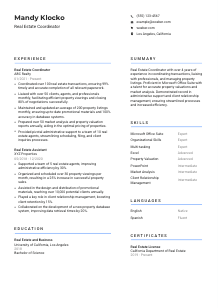
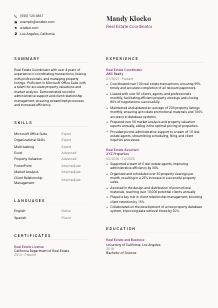
Organising property affairs, but your CV seems disordered? Check out this Real Estate Coordinator CV example, created with Wozber free CV builder. Learn how to show your coordination skills and market savvy in line with job expectations, setting your career on a foundation as firm as prime real estate!
Real Estate coordination sits where deals can slow down or keep moving. Hiring teams look for people who can keep transaction files clean, calendars on track, listings current, and communication steady across clients, agents, vendors, and internal staff. Your CV needs to show that you can manage this operational load without letting paperwork, follow-ups, or property details slip.
When that experience is tailored well, the CV quickly separates general administrative support from real transaction coordination. Wozber's free CV builder helps shape an ATS-compliant CV around the language employers use, so terms like transaction paperwork, listings management, market analysis, and client communication show up where screening systems and hiring managers expect them. That makes your day-to-day value easier to recognize.
For a Real Estate Coordinator, the top of the CV should feel organised from the first line. This section is simple, but mistakes here can create doubts about accuracy and professionalism before a hiring manager even reaches your transaction work or listing experience.
Lead with your full name in a clean, readable format. Real estate coordination is detail-heavy work, so the header should immediately feel orderly and businesslike rather than styled for effect.
Place "Real Estate Coordinator" under your name when that matches the role you are applying for. It helps frame the rest of the CV around transaction support, client communication, listing upkeep, and team coordination instead of leaving your background open to interpretation.
Include a current phone number and a professional email address. If you use a website or LinkedIn profile, make sure it reflects the same title, employers, and timeline shown on the CV. In a role that depends on accurate records and responsive communication, even small inconsistencies can hurt credibility.
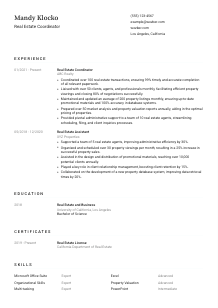
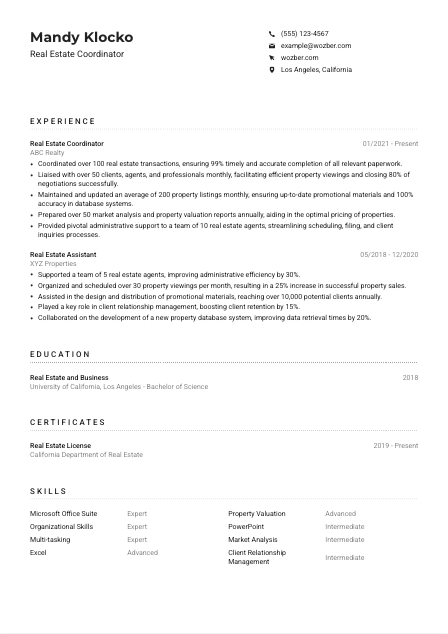
If a posting specifies a local requirement, include your city and state clearly. In the example, listing Los Angeles, California directly answers the employer's stated location need. Treat this as tailoring to the posting, not as a rule for every Real Estate Coordinator CV.
A LinkedIn profile can strengthen your application if it supports your real estate background with matching experience, license details, or market-facing work. Skip links that are outdated or thin. Every item in this section should make you easier to contact and easier to place in the profession.
Your personal details should show that you are organised, reachable, and aligned with the role from the first glance. For real estate support positions, that baseline professionalism matters more than clever presentation.




This is the section most likely to decide whether your CV moves forward. Real Estate Coordinators are hired to keep transactions progressing, support agents and clients, maintain accurate listing information, and handle a high volume of follow-ups without losing control of the details. Your bullets should reflect that operating reality.
Read the posting for the verbs and responsibilities that define the job. Here, phrases like "coordinate real estate transactions," "liaise with clients, agents, and other professionals," "maintain property listings," and "prepare market analysis" point to the core of the role. Use that language naturally in your experience if it matches work you have actually done.
Start with your most recent position and include job title, company, and dates. Real estate hiring teams want to see whether you have recent exposure to transaction files, client-facing support, listing systems, and office coordination. A clear timeline also helps them track progression from assistant-level support into fuller coordination responsibilities.
Focus each bullet on what you handled and what changed because of your work. The example does this well by showing transaction volume, listing volume, report preparation, and support for a team of agents. Statements like coordinating more than 100 transactions or maintaining 200 listings monthly tell a hiring manager far more than "responsible for paperwork."
Quantify with measures that reflect the role: transaction count, on-time paperwork completion, number of listings updated, property viewings scheduled, reports prepared, client volume supported, or efficiency gains in filing and database work. Metrics like 99% timely paperwork completion or 30 viewings scheduled per month show pace, accuracy, and workload management in terms the industry understands.
Prioritise experience that shows transaction coordination, calendar and document control, market support, listing maintenance, CRM or database usage, and cross-party communication. If an older role was broader administrative support, keep the bullets focused on the parts that translate directly, such as scheduling property viewings, handling inquiries, or improving retrieval time in a property database.
Your experience section should make it easy to picture you supporting active listings, managing transaction paperwork, and keeping agents and clients informed. Clear scope, relevant tools, and measurable workload are what make this section persuasive.
Education is usually a straightforward check in this field, but it still matters. When a posting calls for a bachelor's degree in Real Estate, Business, or a related area, your education section should answer that requirement quickly and without extra digging.
If the employer asks for a bachelor's degree, place your degree information clearly in this section with no abbreviations that could create confusion. The example's Bachelor of Science in Real Estate and Business is a direct match to the requirement, which makes screening easier.
Include the degree, field of study, school name, and graduation year or date. This is enough for most Real Estate Coordinator roles. Keep the formatting clean so the section reads like a complete credential, not a collection of fragments.
Degrees tied to real estate, business, finance, marketing, or operations deserve clear wording because they support the practical demands of the role. A directly related field tells the employer you have academic grounding in property markets, business processes, or commercial communication before they even reach your experience section.
Relevant coursework, honors, or student activities can help early-career candidates, especially if they relate to property analysis, business administration, research, or presentation work. If you already have several years of real estate experience, keep this section lean and let your transaction record carry more weight.
If you hold a real estate license or other industry credential, list it in the certifications section unless the format of your CV combines them. That keeps your education section focused and avoids burying a useful professional qualification inside your degree details.
For this role, education should confirm that you meet the stated baseline and, when relevant, reinforce your connection to real estate or business operations. Clear formatting is enough when the credential is relevant and easy to spot.
Certifications can strengthen a Real Estate Coordinator CV when they reflect legal eligibility, market knowledge, or tools used in day-to-day work. They are especially useful when the posting names a license as preferred rather than required, because they can move you ahead of similar candidates with comparable administrative experience.
If you have an active real estate license, place it first. In the provided example, the California real estate license directly supports the "license or certification is a plus" language in the job description. That kind of credential matters more than generic course completions because it connects directly to the industry.
Choose certifications that relate to real estate operations, compliance, contracts, client service, office systems, or market analysis. Do not overload this section with unrelated training. The point is to reinforce your ability to support transactions and work effectively in a brokerage or property environment.
Show who issued the certification and whether it is current. For regulated fields and licenses, dates matter because they indicate active standing. A line like "2019 - Present" is useful because it immediately signals current validity.
Real estate practices, forms, and local requirements change. Keeping a license active or adding relevant continuing education tells employers that you stay current with the operational side of the industry, not just the administrative side.
Relevant certifications add practical credibility to a Real Estate Coordinator CV. When they connect directly to licensing, compliance, or real estate operations, they support your candidacy in a way general training usually does not.
The skills section works best when it reads like the toolkit behind your results. For Real Estate Coordinators, that usually means a mix of transaction support, document control, listing maintenance, client communication, reporting, and software used to keep deals and property data organised.
Pull skill terms directly from the posting when they reflect your real experience. This one calls out Microsoft Office Suite, especially Excel and PowerPoint, along with organizational strength, multitasking, and attention to detail. Using those exact phrases supports ATS optimisation while keeping the section relevant to the actual work.
Lead with the capabilities that affect day-to-day performance in the job. For this profession, that may include transaction coordination, property listings management, market analysis, client relationship management, database systems, scheduling, and Excel-based reporting before broader soft skills.
Do not build a list made only of personality traits. Pair tools with execution skills. A stronger mix looks like Microsoft Office Suite, Excel, property valuation support, market analysis, CRM or database management, client communication, and organizational skills. The sample CV handles this well by combining Office proficiency with real estate functions such as market analysis and property valuation.
Your skills should echo the actual demands of the role, not fill space. When the list combines relevant software, transaction support abilities, and communication strengths, it reinforces the experience section instead of repeating it vaguely.
Language ability matters in real estate when the job includes client inquiries, scheduling, negotiations support, and relationship management. If a posting names English proficiency, treat that as a direct requirement and present it clearly rather than assuming it will be inferred.
Place English first when the role specifies it for customer interactions. Label your proficiency honestly as Native, Fluent, or another accurate level. For a client-facing coordinator, this is part of operational readiness, not a side detail.
Keep ratings simple and standard so employers can quickly understand your ability level. Avoid vague wording. Clear labels matter most when your role involves phone calls, written follow-ups, showing schedules, and coordination across multiple parties.
Additional languages can be valuable when they help with client communication or community outreach. In the example, Spanish strengthens the profile because it can support a broader client base. That will be especially helpful in some markets, though it is not a universal requirement.
Do not overstate your fluency. If you may need to discuss availability, paperwork, property details, or client questions in that language, your stated level should hold up in real interaction.
Mention languages that improve communication with buyers, sellers, tenants, agents, or vendors. In customer-facing real estate support, multilingual ability can improve responsiveness and trust, especially in diverse local markets.
A clear languages section helps when communication is part of the daily workflow. For Real Estate Coordinators, it can strengthen your profile by showing you can support clients and teams across a wider range of interactions.
The summary should read like a compact professional snapshot, not a generic objective statement. For this role, it needs to establish your real estate background, the kind of coordination work you handle, and a few practical strengths that match the posting.
Start with your title and years of relevant experience. For example, "Real Estate Coordinator with 4+ years of experience" immediately places you in the profession and gives context for the rest of the CV.
Mention the responsibilities that define your value, such as coordinating transactions, maintaining listings, preparing market analysis support, handling client communication, or providing administrative support to agents. This is where you separate yourself from a general office administrator.
Include strengths that matter in real estate operations, such as accuracy in paperwork, strong Excel skills, responsiveness with clients, or success handling high transaction volume. The example summary works because it mentions both transaction coordination and market analysis, then ties that to streamlined processes and efficiency.
Aim for a short paragraph that can be read quickly. Four to six lines is usually enough. Focus on role-relevant details rather than broad claims about being hardworking or passionate. The summary should preview the transaction, listing, and support work the rest of the CV proves.
A well-written summary gives the employer an immediate sense of your operating level in real estate support. By the time they move into your experience section, they should already expect to see transaction coordination, organised administration, and reliable client-facing work.
A Real Estate Coordinator CV should leave little doubt about your ability to manage paperwork, support agents, update listings, communicate with clients, and keep active deals organised. When those responsibilities are backed by real numbers, relevant tools, and clear role language, the application reads as practical and credible.
Use Wozber's free CV builder to shape that experience into an ATS-friendly CV format, and refine it further with an ATS CV scanner that checks how well your content matches the posting. The finished CV should make one thing easy to judge: you can step into the coordination work and keep the operation moving.